

Pakistan PM expresses sorrow over loss of hundreds of lives in India train crash 

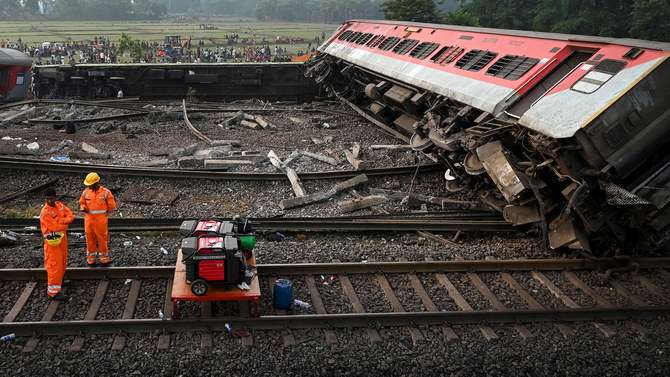
Rescue workers stand near a damaged carriage at the accident site of a three-train collision near Balasore, about 200 km (125 miles) from the state capital Bhubaneswar in the eastern state of Odisha, on June 3, 2023. (AFP)
Short Url
Updated 03 June 2023
Follow

Pakistan PM expresses sorrow over loss of hundreds of lives in India train crash 

  • A deadly train crash in the Indian state of Odisha has so far killed nearly 300 people, injured 900 others 
  • Rescuers were cutting through destroyed carriages on Saturday to find people who may still be trapped 

ISLAMABAD: Pakistan Prime Minister Shehbaz Sharif on Saturday expressed grief over the loss of nearly 300 lives in one of the deadliest train crashes in India, as rescue workers searched through piles of debris and wreckage for bodies and survivors in the Indian state of Odisha. 

Nearly a dozen coaches of one train derailed late Friday and debris from some of them fell onto a nearby track, according to railroad ministry spokesperson Amitabh Sharma. The debris was hit by another passenger train, causing up to three coaches of the second train to derail as well. 

More than 288 dead bodies were recovered overnight and around 900 people were injured in the accident in Balasore district, while rescuers were cutting through the destroyed carriages to find people who may still be trapped under the debris. 

In his reaction to the tragedy, Pakistan PM Sharif extended his heartfelt condolences to the bereaved families and said he was praying for recover of the wounded. 

“Deeply saddened by the loss of hundreds of lives in a train accident in India,” the Pakistan premier said on Twitter. “I extend my heartfelt condolences to the bereaved families who lost their loved ones in this tragedy. Prayers for speedy recovery of the injured.” 

Train accidents have not been uncommon in India and Pakistan, where a majority of railway tracks date back to the pre-partition British colonial era and there has been little improvement in the department since their independence in 1947. 

A speeding train ran over revellers watching fireworks during a Hindu festival in northern India on October 19, 2018, killing at least 60 people. 

In 2016, at least 146 people died when an Indore-Patna Express train with around 2,000 people on board derailed in Uttar Pradesh, sending carriages crashing into each other. 

In June 2021, more than 60 people died when a train hurtling through farmland derailed and collided with another passenger service in Pakistan’s southern Sindh province. 


Pakistan PM orders accelerated privatization of power sector to tackle losses

Updated 15 December 2025
Follow

Pakistan PM orders accelerated privatization of power sector to tackle losses

  • Tenders to be issued for privatization of three major electricity distribution firms, PMO says
  • Sharif says Pakistan to develop battery energy storage through public-private partnerships

ISLAMABAD: Pakistan’s prime minister on Monday directed the government to speed up privatization of state-owned power companies and improve electricity infrastructure nationwide, as authorities try to address deep-rooted losses and inefficiencies in the energy sector that have weighed on the economy and public finances.

Pakistan’s electricity system has long struggled with financial distress caused by a combination of factors including theft of power, inefficient collection of bills, high costs of generating electricity and a large burden of unpaid obligations known as “circular debt.” In the first quarter of the current financial year, government-owned distribution companies recorded losses of about Rs171 billion ($611 million) due to poor bill recovery and operational inefficiencies, official documents show. Circular debt in the broader power sector stood at around Rs1.66 trillion ($5.9 billion) in mid-2025, a sharp decline from past peaks but still a major fiscal drain. 

Efforts to contain these losses have been a focus of Pakistan’s economic reform program with the International Monetary Fund, which has urged structural changes in the energy sector as part of financing conditions. Previous government initiatives have included signing a $4.5 billion financing facility with local banks to ease power sector debt and reducing retail electricity tariffs to support economic recovery. 

“Electricity sector privatization and market-based competition is the sustainable solution to the country’s energy problems,” Prime Minister Shehbaz Sharif said at a meeting reviewing the roadmap for power sector reforms, according to a statement from the prime minister’s office.

The meeting reviewed progress on privatization and infrastructure projects. Officials said tenders for modernizing one of Pakistan’s oldest operational hubs, Rohri Railway Station, will be issued soon and that the Ghazi Barotha to Faisalabad transmission line, designed to improve long-distance transmission of electricity, is in the initial approval stages. While not all power-sector decisions were detailed publicly, the government emphasized expanding private sector participation and completing priority projects to strengthen the electricity grid.

In another key development, the prime minister endorsed plans to begin work on a battery energy storage system with participation from private investors to help manage fluctuations in supply and demand, particularly as renewable energy sources such as solar and wind take a growing role in generation. Officials said the concept clearance for the storage system has been approved and feasibility studies are underway.

Government briefing documents also outlined steps toward shifting some electricity plants from imported coal to locally mined Thar coal, where a railway line expansion is underway to support transport of fuel, potentially lowering costs and import dependence in the long term.

State authorities also pledged to address safety by converting unmanned railway crossings to staffed ones and to strengthen food safety inspections at stations, underscoring broader infrastructure and service improvements connected to energy and transport priorities.