

Pakistan PM in Ankara to attend Erdogan’s inauguration

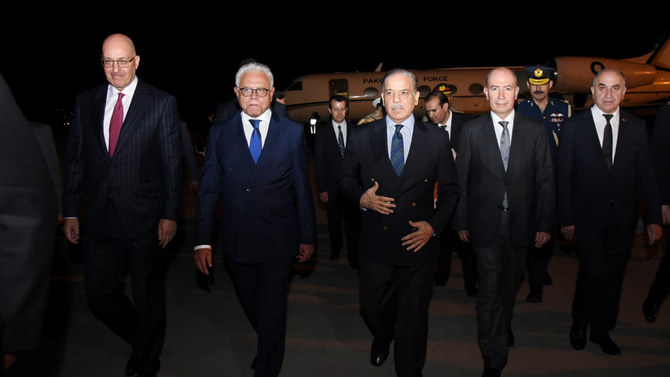
Pakistan Prime Minister Muhammad Shehbaz Sharif arrives in Ankara, Turkiye to attend inauguration ceremony of President Recep Tayyip Erdogan on June 2, 2023. (Photo courtesy: Prime Minister Office)
Short Url
Updated 03 June 2023
Follow

Pakistan PM in Ankara to attend Erdogan’s inauguration

  • Pakistan and Türkiye have historic religious, cultural and trade relations
  • PM Sharif also holds meetings with business leaders during his official visit

ISLAMABAD: Pakistan Prime Minister Shehbaz Sharif on Saturday arrived in the Turkish capital of Ankara to attend the inauguration of Recep Tayyip Erdogan who was reelected as his country’s president just a few days ago.

A third term gives Erdogan an even stronger hand domestically and internationally, and the election results will have implications far beyond Ankara. Türkiye stands at the crossroads of Europe and Asia, and it plays a key role in the North Atlantic Treaty Organization (NATO).

Erdogan, who led Türkiye as prime minister or president for 20 years, prevailed in a runoff race last weekend despite the country’s ongoing economic crisis and his government’s criticized response to a February earthquake that killed more than 50,000 people.

“Prime Minister Muhammad Shehbaz Sharif arrives in Ankara on his two-day official visit to attend the inauguration ceremony of President Recep Tayyip Erdogan,” Sharif’s office said in a statement on Saturday.


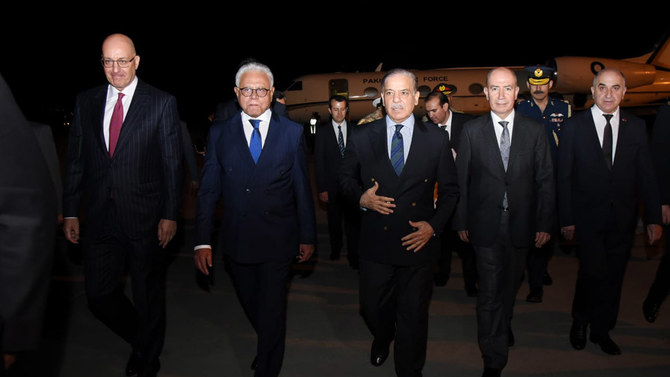
Pakistan Prime Minister Muhammad Shehbaz Sharif (2nd right) with High officials from Turkish Foreign Ministry and Pakistan's Mission in Türkiye in Ankara, Turkiye on June 2, 2023. (Photo courtesy: Prime Minister Office)

“High officials from the Turkish Foreign Ministry and Pakistan’s Mission in Türkiye received the Prime Minister upon his arrival at Esenboga Airport, Ankara.”

Sharif also held a meeting with the chairman of Limak Holding A.S., a Turkish conglomerate with major interests in construction, energy, cement, and tourism, the PM Office added. During the meeting, they discussed the investment possibility in Pakistan’s economy.

The premier also met a delegation of the Anadolu Group in Ankara.

“The prime minister appreciated Anadolu Group’s investment in Pakistan and the employment provision in the country due to it,” the official statement said, adding that Sharif had invited the Anadolu Group to further increase its spending in Pakistan.

Before leaving for Ankara, Sharif wrote in a Twitter post on Friday he would convey “the warmest greetings to President Erdogan on behalf of the government and people of Pakistan on his re-election.”

“The fraternal ties between Pakistan and Türkiye are set to deepen further in line with our shared resolve and common destiny. The upcoming 7th Meeting of the High-Level Strategic Cooperation Council in Islamabad will provide the right avenue to take the momentum of our strategic partnership forward,” he said.

“We have yet to unlock the potential of our multifaceted relationship and efforts are being made in that direction.”

Known as “reis,” or “the chief,” among his fans, the 69-year-old Erdogan is already the longest-serving leader in the Turkish republic’s history. His reelection to a five-year term that runs until 2028 extends his rule into a third decade, and he could possibly serve longer with the help of a friendly parliament.

Pakistan and Türkiye share strong bilateral religious, cultural, trade, and defense relations.


Bangladesh leader pushes for SAARC revival after meeting Indian, Pakistani dignitaries

Updated 5 sec ago
Follow

Bangladesh leader pushes for SAARC revival after meeting Indian, Pakistani dignitaries

  • Muhammad Yunus met Pakistan’s parliamentary speaker, Indian FM at Khaleda Zia’s funeral on Wednesday
  • SAARC has been dysfunctional since 2016, after India withdrew following a militant attack it blamed on Islamabad

ISLAMABAD: Bangladesh Chief Adviser Muhammad Younus this week pushed for reviving the South Asian Association for Regional Cooperation (SAARC) platform after meeting dignitaries from India, Pakistan and other parts of the region. 

SAARC has been effectively dysfunctional since 2016, when its planned Islamabad summit collapsed after India withdrew following a militant attack it blamed on Pakistan. Islamabad denied involvement, but New Delhi’s decision prompted Afghanistan, Bangladesh and Bhutan to pull out, leading to the indefinite postponement of the summit.

Younus met Pakistan’s National Assembly Speaker Ayaz Sadiq and Indian External Affairs Minister Subrahmanyam Jaishankar at former Bangladesh premier Khaleda Zia’s state funeral in Dhaka on Wednesday. The funeral also saw a handshake between the Indian and Pakistani representatives, the first high-level contact between officials of the two countries since their conflict in May. 

“During the meetings, Professor Yunus repeatedly emphasized the need to revive the South Asian Association for Regional Cooperation (SAARC),” Yunus’ account on social media platform X said.

“We witnessed a true SAARC spirit at the funeral yesterday,” the account quoted Yunus as saying. “SAARC is still alive. The SAARC spirit is still alive.”

The Bangladesh leader said apart from Jaishankar and Sadiq, representatives from South Asia who attended the funeral included Nepal’s Foreign Minister Bala Nanda Sharma, Sri Lanka’s Minister of Foreign Affairs, Employment and Tourism Vijitha Herath, and Maldives Minister of Higher Education and Labor Ali Haider Ahmed. 

Yunus said he tried to convene an informal gathering of SAARC leaders on the sidelines of the UN General Assembly in New York last year.

His statement to revive SAARC follows that of Pakistan’s Prime Minister Shehbaz Sharif, who earlier this month also called for reviving the South Asian platform. 

Sharif’s message last month came as the bloc marked the 40th anniversary of its founding charter. The Pakistani premier stressed the importance of deeper economic collaboration and collective responses to shared regional challenges such as poverty, climate-induced natural disasters, food and energy insecurity, and public-health vulnerabilities.