

UNSC condemns Sudan violence, calls on parties to honor ceasefire agreements

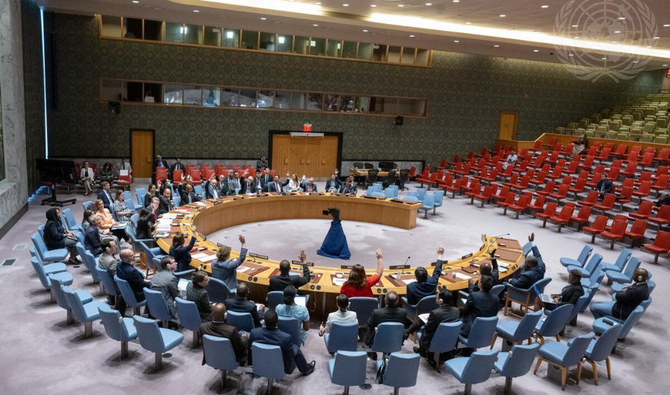
Security Council members stressed the need for an immediate ceasefire to allow for humanitarian access. (UN Photo)
Short Url
Updated 03 June 2023
Follow

UNSC condemns Sudan violence, calls on parties to honor ceasefire agreements

  • Council members urge Burhan and Dagalo to honor Jeddah Declaration and African Union Roadmap
  • More than 700 Sudanese have died and thousands have been injured in six weeks of clashes

NEW YORK: The UN security council on Friday expressed concern over the continued fighting in Sudan between the Sudanese Armed Forces and the Rapid Support Forces and condemned attacks on civilians and UN and humanitarian workers, as well as on medical workers and facilities, and the looting of humanitarian aid. 

In a statement issued after a meeting on Sudan late on Friday afternoon, council members called on the warring parties to grant humanitarians safe and unimpeded access across the country, in line with international law and UN principles. 

According to the UN, at least 730 people have been killed and 5,500 injured since the outbreak of hostilities last month. The actual toll could be much higher. 

Clashes between military leader Gen. Abdel Fattah Burhan’s Sudanese Armed Forces, or SAF, and the Rapid Support Forces, or RSF, a paramilitary group led by Gen. Mohamed Hamdan Dagalo, have continued across several parts of the country, including in the capital Khartoum, and in Zalingi, Central Darfur, Al-Fasher, North Darfur and Al-Obeid. 

Security Council members stressed the need for an immediate ceasefire to allow for humanitarian access, and to arrange for a permanent ceasefire as well as “resume the process toward reaching a lasting, inclusive, and democratic political settlement in Sudan.” 

Their statement reaffirmed the council’s support of the United Nations Integrated Transition Assistance Mission in Sudan, or UNITAMS, and urged its continued engagement in the war-ravaged country. 

UN Secretary-General Antonio Guterres on Wednesday rejected a request from Gen. Abdel Fattah Burhan to remove his office’s special envoy, Volker Perthes, who serves as the special representative for Sudan and head of UNITAMS. Guterres said that the Security Council had the final say on the fate of the mission. 

The 15-member body, tasked with the maintenance of international peace and security, underscored the need for “strengthened international coordination and continued collaboration,” and reiterated its support for African Union, or AU, efforts to establish mechanisms to address the conflict. 

They also welcomed UN and Arab League efforts toward a viable peace process and the resumption of the transition to democracy in Sudan. They also backed the AU Roadmap toward those goals. 

The Security Council statement welcomed the May 11 signature in Jeddah, Saudi Arabia, by the SAF and RSF, of the Declaration of Commitment to Protect the Civilians of Sudan — or the “Jeddah Declaration” — and called on both parties to implement its provisions. 

Council members encouraged international support for the 2020 Juba Peace Agreement, which “remains binding for all its signatories (and) must be implemented in full, in particular its provisions on a permanent ceasefire in Darfur.” 

The statement concluded by reaffirming the Security Council’s “strong commitment to the sovereignty, unity, independence, and territorial integrity of the Republic of Sudan in accordance with the Charter of the United Nations and the principle of good neighborliness, non-interference and regional cooperation.”


Aidarous Al-Zubaidi: Fugitive at large

Updated 6 sec ago
Follow

Aidarous Al-Zubaidi: Fugitive at large

  • Yemen appoints committee to probe allegations against former STC leader after the group’s collapse and his reported flight from the country
  • Preliminary findings accuse Al-Zubaidi of exploiting public office for personal gain, fueling political division and instability in south

LONDON: A special committee formed on presidential authority by Yemen’s public prosecutor’s office has made a series of findings against Maj. Gen. Aidarous Al-Zubaidi, the sacked vice-president of the country’s Presidential Leadership Council (PLC).
Al-Zubaidi, who is accused of high treason and other crimes against the state, is currently on the run.
Arab News has seen a copy of preliminary findings by the committee which reveal that Al-Zubaidi is accused of abuses of power including corruption, land grabbing and oil trading for personal gain.
On Jan. 7, the PLC issued a decree revoking Al-Zubaidi’s membership of the PLC and accusing him of high treason and other serious crimes, including forming an armed gang, killing military officers and soldiers, and undermining the country’s sovereignty.
At the same time it authorized the public prosecutor’s office to form a special committee to investigate allegations against Al-Zubaidi, empowering it to summon and arrest individuals, gather evidence and take necessary actions according to the law, with a mandate to complete the investigation quickly and to provide periodic reports to the PLC.
The committee’s preliminary findings identify a series of serious allegations against Al-Zubaidi, who is said to be responsible for multiple abuses “which have contributed to creating a state of political and popular division in the southern governorates.”
Al-Zubaidi is the leader of the Southern Transitional Council (STC). On Jan. 7, Al-Zubaidi was due to attend talks in Riyadh with a 50-member delegation from the STC, but at the last minute, he fled instead.
The committee’s findings include allegations that Al-Zubaidi is alleged to have seized large plots of land, including in the Aden Free Zone, on Al-Ummal Island, in Bir Fadl and the Ras Omran area.
The committee has also uncovered allegations that pressure was exerted on the Yemen Petroleum Company and its director, Tareq Al-Walidi, to prevent the import of fuel except through a company affiliated with Al-Zubaidi’s brother-in-law, Jihad Al-Shoudhabi, and the Minister of Transport, Abdul Salam Humaid.
For nearly two years, it is claimed, Al-Shoudhabi has been the sole supplier, earning large profits that have gone to Al-Zubaidi’s treasury.
The report also identifies commercial companies owned by Al-Shoudhabi and, “behind him,” it is claimed, Al-Zubaidi. Two are named in the report: Alahlia Exchange &  Transfers Company and Arabian Furniture Center, one of Yemen’s largest furniture companies. Both are headquartered in Aden.
All these and other “deeply regrettable acts of seizure, plunder, and financial and administrative corruption,” the committee says, “have had serious repercussions in southern circles and were a direct cause of southern division and the emergence of many grievances.”
On Thursday, a spokesman for the Saudi-led coalition in Yemen said there was reliable intelligence indicating that on the night of Jan. 7, Al-Zubaidi had departed from Aden on a ship bound for Somaliland — probably the port of Berbera, 260 kilometers south across the Gulf of Aden.
From there he is believed to have been flown on a cargo aircraft to Abu Dhabi, capital of the UAE, via Mogadishu, the coastal capital of Somalia, a flight of about 2,600 km.
Some of the crimes of which Al-Zubaidi is accused relate to the largescale military offensive launched by STC forces across southern Yemen in December.
“We know that the Southern Transitional Council worked to storm the eastern cities militarily,” a source close to the Yemeni government told Arab News.
“The pattern and scale of grave human-rights violations and acts of security and military escalation witnessed by the eastern cities in the south of the homeland — Hadhramout, Al-Mahra and Shabwah — as a result of the military incursion by the forces of the Transitional Council during the monitoring period extending from Dec. 3, are considered heinous crimes against the Yemeni people.”
According to the Yemeni Ministry of Legal Affairs and Human Rights, a total of 2,358 individual offences have been identified, including cases of extrajudicial killing and physical injuries, arbitrary arrests and captivity, enforced disappearance and displacement, and the destruction and looting of public and private property.
Backed by Saudi airstrikes, in the first week of January, the Yemeni government quickly regained the captured territories, Al-Zubaidi was sacked from the PLC and charged with treason, and the UAE announced it would withdraw its remaining troops from the country.
Following Al-Zubaidi’s disappearance on the eve of the planned talks in Riyadh, Saudi Arabia has accused the UAE of helping to smuggle the wanted man out of the country.
The same source told Arab News there is evidence that Al-Zubaidi “was receiving YER 10 billion ($42 million) monthly … deducted from the aid that Yemen was receiving.
“While Al-Zubaidi was receiving those funds, Yemeni citizens had not been receiving their lawful salaries for years, including the diplomatic corps.”
Last Thursday, Mohammed Al-Jaber, the Saudi ambassador to Yemen, announced that the Kingdom would assume responsibility for the salaries of Yemeni state employees, including military personnel, giving $90 million to cover salaries for two months.
On Friday evening, Al-Zubaidi, his whereabouts still unconfirmed, made his first public statement since his disappearance 10 days ago.
“We will no longer accept any solutions that diminish our rights or impose an unacceptable reality upon us,” he wrote in a social media post that left no doubt about his determination to undermine the internationally recognized government of Yemen.
He added: “I pledge to you ... that we will continue together until we achieve the desired national goal.
“With your determination, we will prevail. With your unity, the South will be protected, and with your will, the future state will be established.”