

UNSC condemns Sudan violence, calls on parties to honor ceasefire agreements

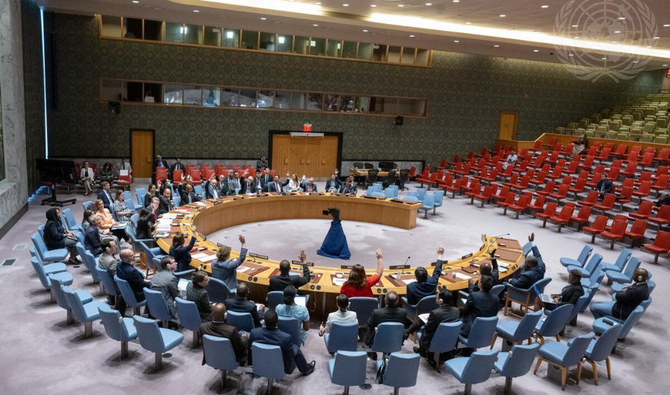
Security Council members stressed the need for an immediate ceasefire to allow for humanitarian access. (UN Photo)
Short Url
Updated 03 June 2023
Follow

UNSC condemns Sudan violence, calls on parties to honor ceasefire agreements

  • Council members urge Burhan and Dagalo to honor Jeddah Declaration and African Union Roadmap
  • More than 700 Sudanese have died and thousands have been injured in six weeks of clashes

NEW YORK: The UN security council on Friday expressed concern over the continued fighting in Sudan between the Sudanese Armed Forces and the Rapid Support Forces and condemned attacks on civilians and UN and humanitarian workers, as well as on medical workers and facilities, and the looting of humanitarian aid. 

In a statement issued after a meeting on Sudan late on Friday afternoon, council members called on the warring parties to grant humanitarians safe and unimpeded access across the country, in line with international law and UN principles. 

According to the UN, at least 730 people have been killed and 5,500 injured since the outbreak of hostilities last month. The actual toll could be much higher. 

Clashes between military leader Gen. Abdel Fattah Burhan’s Sudanese Armed Forces, or SAF, and the Rapid Support Forces, or RSF, a paramilitary group led by Gen. Mohamed Hamdan Dagalo, have continued across several parts of the country, including in the capital Khartoum, and in Zalingi, Central Darfur, Al-Fasher, North Darfur and Al-Obeid. 

Security Council members stressed the need for an immediate ceasefire to allow for humanitarian access, and to arrange for a permanent ceasefire as well as “resume the process toward reaching a lasting, inclusive, and democratic political settlement in Sudan.” 

Their statement reaffirmed the council’s support of the United Nations Integrated Transition Assistance Mission in Sudan, or UNITAMS, and urged its continued engagement in the war-ravaged country. 

UN Secretary-General Antonio Guterres on Wednesday rejected a request from Gen. Abdel Fattah Burhan to remove his office’s special envoy, Volker Perthes, who serves as the special representative for Sudan and head of UNITAMS. Guterres said that the Security Council had the final say on the fate of the mission. 

The 15-member body, tasked with the maintenance of international peace and security, underscored the need for “strengthened international coordination and continued collaboration,” and reiterated its support for African Union, or AU, efforts to establish mechanisms to address the conflict. 

They also welcomed UN and Arab League efforts toward a viable peace process and the resumption of the transition to democracy in Sudan. They also backed the AU Roadmap toward those goals. 

The Security Council statement welcomed the May 11 signature in Jeddah, Saudi Arabia, by the SAF and RSF, of the Declaration of Commitment to Protect the Civilians of Sudan — or the “Jeddah Declaration” — and called on both parties to implement its provisions. 

Council members encouraged international support for the 2020 Juba Peace Agreement, which “remains binding for all its signatories (and) must be implemented in full, in particular its provisions on a permanent ceasefire in Darfur.” 

The statement concluded by reaffirming the Security Council’s “strong commitment to the sovereignty, unity, independence, and territorial integrity of the Republic of Sudan in accordance with the Charter of the United Nations and the principle of good neighborliness, non-interference and regional cooperation.”


Gaza's living conditions worsen as strong winds and hypothermia kill 5

Updated 6 sec ago
Follow

Gaza's living conditions worsen as strong winds and hypothermia kill 5

  • Hundreds of tents and makeshift shelters were blown away or heavily damaged, the UN humanitarian office reported

DEIR AL-BALAH, Gaza Strip: Strong winter winds collapsed walls onto flimsy tents for Palestinians displaced by war in Gaza, killing at least four people, hospital authorities said Tuesday.
Dangerous living conditions persist in Gaza after more than two years of devastating Israeli bombardment and aid shortfalls. A ceasefire has been in effect since Oct. 10. But aid groups say that Palestinians broadly lack the shelter necessary to withstand frequent winter storms.
The dead include two women, a girl and a man, according to Shifa Hospital, Gaza City’s largest, which received the bodies.
The Gaza Health Ministry said Tuesday a 1-year-old boy died of hypothermia overnight, while the spokesman for the UN’s children agency said over 100 children and teenagers have been killed by “military means” since the ceasefire began.
Meanwhile, Israel’s military said it exchanged fire Tuesday with six people spotted near its troops deployed in southern Gaza, killing at least two of them in western Rafah.
Family mourns relatives killed by wall collapse
Three members of the same family — 72-year-old Mohamed Hamouda, his 15-year-old granddaughter and his daughter-in-law — were killed when an 8-meter (26-foot) high wall collapsed onto their tent in a coastal area along the Mediterranean shore of Gaza City, Shifa Hospital said. At least five others were injured.
Their relatives on Tuesday began removing the rubble that had buried their loved ones and rebuilding the tent shelters for survivors.
“The world has allowed us to witness death in all its forms,” Bassel Hamouda said after the funeral. “It’s true the bombing may have temporarily stopped, but we have witnessed every conceivable cause of death in the world in the Gaza Strip.”
A second woman was killed when a wall fell on her tent in the western part of the city, Shifa Hospital said.
Hundreds of tents and makeshift shelters were blown away or heavily damaged, the UN humanitarian office reported.
The UN and its humanitarian partners were distributing tents, tarps, blankets and clothes as well as nutrition and hygiene items across Gaza, said the UN Office for the Coordination of Humanitarian Affairs.
The majority of Palestinians live in makeshift tents since their homes were reduced to rubble during the war. When storms strike the territory, Palestinian rescue workers warn people against seeking shelter inside damaged buildings for fears of collapse. Aid groups say not enough shelter materials are entering Gaza during the truce.
In the central town of Zawaida, Associated Press footage showed inundated tents Tuesday morning, with people trying to rebuild their shelters.
Yasmin Shalha, a displaced woman from the northern town of Beit Lahiya, stood against winds that lifted the tarps of tents around her as she stitched hers back together with needle and thread. She said it had fallen on top of her family the night before, as they slept.
“The winds were very, very strong. The tent collapsed over us,” the mother of five told AP. “As you can see, our situation is dire.”
On the shore in southern Gaza, tents were swept into the Mediterranean. Families pulled what was left from the sea, while some built sand barriers to hold back rising water.
“The sea took our mattresses, our tents, our food and everything we owned,” Shaban Abu Ishaq said, as he dragged part of his tent out of the sea in the Muwasi area of Khan Younis.
Mohamed Al-Sawalha, a 72-year-old man from the northern refugee camp of Jabaliya, said the conditions most Palestinians in Gaza endure are barely livable.
“It doesn’t work neither in summer nor in winter,” he said of the tent. “We left behind houses and buildings (with) doors that could be opened and closed. Now we live in a tent. Even sheep don’t live like we do.”
Residents aren’t able to return to their homes in Israeli-controlled areas of the Gaza Strip.
Child death toll in Gaza rises
Gaza’s Health Ministry said the 1-year-old in the central town of Deir Al-Balah was the seventh fatality due to the cold conditions since winter started. Others included a baby just seven days old and a 4-year-old girl, whose deaths were announced Monday.
The ministry, part of the Hamas-run government, says more than 440 people were killed by Israeli fire and their bodies brought to hospitals since the ceasefire went into effect. The ministry maintains detailed casualty records that are seen as generally reliable by UN agencies and independent experts.
UNICEF spokesman James Elder said Tuesday at least 100 children under the age of 18 — 60 boys and 40 girls — have been killed since the truce began due to military operations, including drone strikes, airstrikes, tank shelling and use of live ammunition. Those figures, he said, reflect incidents where enough details have been compiled to warrant recording, but the total toll is expected to be higher. He said hundreds of children have been wounded.
While “bombings and shootings have slowed” during the ceasefire, they have not stopped, Elder told reporters at a UN briefing in Geneva by video from Gaza City. “So what the world now calls calm would be considered a crisis anywhere else,” he said.
Gaza’s population of more than 2 million people has been struggling to keep the cold weather and storms at bay while facing shortages of humanitarian aid and a lack of more substantial temporary housing, which is badly needed during the winter months. It’s the third winter since the war between Israel and Hamas started on Oct. 7, 2023, when militants stormed into southern Israel and killed around 1,200 people and abducted 251 others into Gaza.
Gaza’s Health Ministry says more than 71,400 Palestinians have been killed in Israel’s retaliatory offensive.