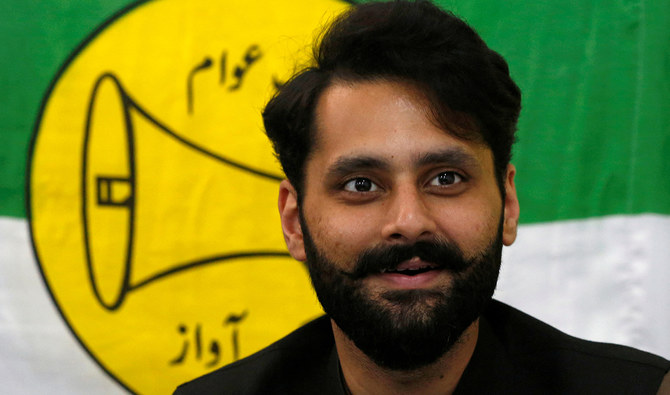

KARACHI/ISLAMABAD: Family of a prominent Pakistani human rights activist, Jibran Nasir, confirmed his safe return to his family on Friday after he was forcibly taken away by over a dozen unidentified men in southern Karachi city a day before.
Nasir, a well-known lawyer, has a reputation for criticizing Pakistan’s leading political parties, rightwing religious factions, and the country’s powerful military. He contested the 2013 and 2018 general elections as an independent candidate but only managed to secure a few hundred votes each time.
He became increasingly critical of the army on social media after it announced to try the supporters of former prime minister Imran Khan under military laws for attacking its installations and torching government buildings on May 9.
Nasir’s wife, actress Mansha Pasha, said on Thursday her husband was “picked up” by about 15 men, dressed in plain clothes, from a road leading to their residence after their car was intercepted by a white Vigo vehicle.
“Jibran Nasir has returned home,” Talha Rehman, his cousin, told Arab News without divulging further details. “Currently, he is with his family and will contact the media on his own.”
Earlier in day, Nasir’s family and friends held a demonstration in the city, seeking his immediate release and requesting the government to find the culprits behind his disappearance.
“We are here at the Karachi Press Club today demanding his release, demanding the government to find the culprits, whoever they may be, we do not know who these people are, we would like clarity on that, we would like clarity on where his whereabouts are,” his cousin said.
Dozens of people joined Nasir’s family and gathered outside the press club to protest his disappearance.
“If he has committed a crime, is there a charge,” Rehman asked. “When do they plan to charge him? Is there a maleficent group, a gang, or a mafia behind it? The police should come into action and help us.”
He added Nasir’s family and supporters were looking toward the police, the provincial authorities, the federal government, and different state institutions to secure his release.
Nasir’s wife also reiterated that her husband was forcibly taken by unidentified armed men against his will and her appeals while speaking to Arab News on phone.
“I would like to send this message out to [everyone] to demand his release,” she said.
Khan’s Pakistan Tehreek-e-Insaf (PTI) party sought Nasir’s release, saying his “abduction” was against the country’s constitution.
“Law of the jungle must not prevail in Pakistan,” PTI’s official Twitter account wrote in a post.
Feminist rights movement, Aurat March, also called for Nasir’s release, condemning the incident.
“We strongly condemn his abduction (which is a clear violation of citizen rights) & urge the govt & LEAs [law enforcement agencies] to ensure his immediate + unconditional safe release,” it announced on the social media platform.
As a rights activist, Nasir raised alarm over the crackdown against PTI and incarceration of its leaders and supporters, which resulted in several of Khan’s aides leaving the party and distancing themselves from him since May 9.
The government denied reports it was illegally abducting dissenters while maintaining only those who partook in violence and vandalism on May 9 were dealt with under the law.
The continuing political turmoil has exacerbated Pakistan’s economic crisis, with inflation at record highs and fears of default looming large, as the South Asian country has so far failed to revive a stalled $6.5 billion loan program signed with the International Monetary Fund (IMF).