CAPE TOWN: South Africa attempted to shift attention away from its stance on the Ukraine conflict on Friday, as it hosted a BRICS meeting overshadowed by questions about a possible visit to the country by Russian President Vladimir Putin.
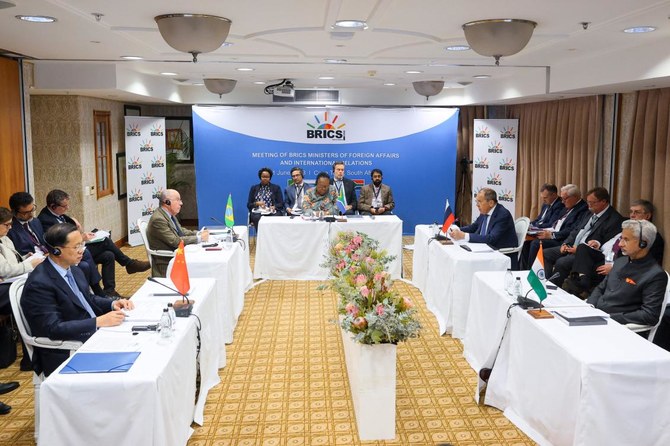
Top diplomats from Brazil, Russia, India, China and South Africa met in Cape Town for a second day of talks on the bloc’s ambition to provide an alternative to a western-led global order.
However the question of whether Putin would attend a subsequent gathering of the bloc in August, having been invited before an ICC arrest warrant was issued, has dominated this week’s meeting.
Putin is wanted by the International Criminal Court over accusations that Russia unlawfully deported Ukrainian children.
A member of the ICC with strong trade and economic relations with the United States and Europe, South Africa would be expected to arrest him if he sets foot in the country.
The issue has put Pretoria in a tight diplomatic spot, and ministers largely dodged a barrage of questions about Putin during the first day of discussions.
On Friday, South African Foreign Minister Naledi Pandor sought to shift focus away from Putin and the war in Ukraine.
“As countries gathered in this room today... we all represent together a significant majority of the world’s territory, population and economy,” Pandor said.
Representatives of about a dozen other nations, including Iran, Saudi Arabia, Cuba and Kazakhstan, attended in person or virtually, for a “Friends of BRICS” session.
On Thursday, BRICS ministers welcomed what they said was the interest expressed by numerous countries to join the bloc.
“We in this room need to determine a plan of action for our countries and for the world,” Pandor said in opening remarks on Friday.
“We cannot allow a conflict in one part of the world to replace the ambition of eradicating global poverty as the world’s greatest global challenge,” she added, in an apparent reference to the war in Ukraine.
Russia’s invasion of its neighbor has sent food and energy prices soaring in much of the world, exacerbating food insecurity in poor countries.
Pandor took a swing at western nations, saying the world has “faltered in cooperation” since rich countries’ “attention and resources” have been “diverted” by the war.
“The plight of the poor is forgotten and the great powers are engaged in world conflict,” she said. “We need to turn this around.”


South Africa avoids Vladimir Putin arrest dilemma at BRICS meeting
https://arab.news/mdjkg
South Africa avoids Vladimir Putin arrest dilemma at BRICS meeting

- Top diplomats from Brazil, Russia, India, China and South Africa meet for talks on the bloc’s ambition to provide an alternative to a western-led global order


Bangladesh’s religio-political party open to unity govt
- Opinion polls suggest that Jamaat-e-Islami will finish a close second to the Bangladesh Nationalist Party in the first election it has contested in nearly 17 years
DHAKA: A once-banned Bangladeshi religio-political party, poised for its strongest electoral showing in February’s parliamentary vote, is open to joining a unity government and has held talks with several parties, its chief said.
Opinion polls suggest that Jamaat-e-Islami will finish a close second to the Bangladesh Nationalist Party in the first election it has contested in nearly 17 years as it marks a return to mainstream politics in the predominantly Muslim nation of 175 million.
Jamaat last held power between 2001 and 2006 as a junior coalition partner with the BNP and is open to working with it again.
“We want to see a stable nation for at least five years. If the parties come together, we’ll run the government together,” Jamaat chief Shafiqur Rahman said in an interview at his office in a residential area in Dhaka, days after the party created a buzz by securing a tie-up with a Gen-Z party.
Rahman said anti-corruption must be a shared agenda for any unity government.
The prime minister will come from the party winning the most seats in the Feb. 12 election, he added. If Jamaat wins the most seats, the party will decide whether he himself would be a candidate, Rahman said.
The party’s resurgence follows the ousting of long-time Prime Minister Sheikh Hasina in a youth-led uprising in August 2024.
Rahman said Hasina’s continued stay in India after fleeing Dhaka was a concern, as ties between the two countries have hit their lowest point in decades since her downfall.
Asked about Jamaat’s historical closeness to Pakistan, Rahman said: “We maintain relations in a balanced way with all.”
He said any government that includes Jamaat would “not feel comfortable” with President Mohammed Shahabuddin, who was elected unopposed with the Awami League’s backing in 2023.