NAHA, Japan: Heavy rains intensified by Tropical Storm Mawar fell on Japan’s main archipelago Friday, halting trains and transit and threatening floods and mudslides in south and western regions.
Warnings were issued in parts of western and central Japan, with up to 35 centimeters of rain forecast over the 24 hours through Saturday morning. Residents in vulnerable areas, including those in Wakayama, Kochi in the west and Nagano in central Japan, were warned of the potential for flooding and mudslides and advised to go to evacuation centers if possible.
Television footage showed swollen rivers in residential area in the Wakayama city, including one where brown water rose as high as the bottom of a bridge over it.
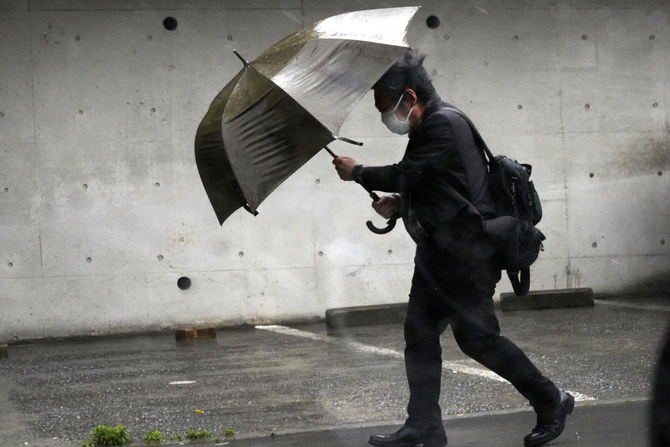
In Tokyo, the few pedestrians on the rainy streets clutched umbrellas as winds blew tree branches around. Afternoon classes were also canceled at some schools in Tokyo.
Shinkansen super-express trains were suspended or delayed between Tokyo and Okayama in western Japan due to heavy rain, according to the Central Japan Railway Co. Flights and ferries in southern Japan also were canceled due to continuing strong winds.
Mawar remained well offshore in the Pacific Ocean, but its winds were strong enough as it passed Okinawa to cause injuries. An older woman who fell had a serious head injury in Nishihara city, while the injuries to seven other people were slight.
The tropical storm had sustained winds blowing up to 82kph Friday afternoon and was blowing east-northeast at 25kph, the Japan Meteorological Agency said. It was near Amami-Oshima Island, about 1,500 kilometers southwest of Tokyo.
The warm and damp air from the tropical storm was intensifying seasonal rains, and a linear band of heavy rain was hovering over the islands, the meteorological agency said.
Mawar largely skirted Taiwan and the Philippines earlier this week. It sent waves crashing into Taiwan’s east coast and brought heavy rains to the northern Philippines, though no major damage was reported.
Mawar was the strongest typhoon to hit Guam in more than two decades. As of Wednesday, only 28 percent of power had been restored and about half the water system was operational, according to the Federal Emergency Management Agency.
There have been long lines for gas, and officials estimate it will be four to six weeks before power is fully restored. FEMA did not yet know exactly how many homes were destroyed.


Tropical Storm Mawar intensifies rains for Japan, threatens floods and mudslides in south and west
https://arab.news/jmabz
Tropical Storm Mawar intensifies rains for Japan, threatens floods and mudslides in south and west

- Warnings were issued in parts of western and central Japan, with up to 35 centimeters of rain forecast over the 24 hours through Saturday morning


Ahead of strikes, Trump was told Iran attack is high risk, high reward
- Experts caution that the unfolding conflict could take dangerous turns and the first official said the Pentagon’s planning did not appear to guarantee the outcome of any conflict
WASHINGTON: Ahead of the US attack on Iran, President Donald Trump received briefings that not only delivered blunt assessments about the risk of major US casualties but also touted the prospect of a geopolitical shift in the Middle East in favor of US interests, a US official told Reuters. The launch of what the Pentagon called Operation Epic Fury on Saturday plunged the Middle East into a new and unpredictable conflict. The US and Israeli militaries struck sites across Iran, triggering retaliatory Iranian attacks against Israel and nearby Gulf Arab countries.
The official, who spoke on condition of anonymity, said the briefers described the operation to the president as a high-risk, high-reward scenario that could present a once-in-a-generation opportunity for change in the region.
HIGHLIGHTS
• Trump briefings included risks, opportunities in Middle East
• Diplomatic efforts with Iran fail to avert military confrontation
• Iran vows retaliation, targets US and Israeli interests
Trump himself appeared to echo that sentiment when he acknowledged the stakes at the onset of the operation, saying “the lives of courageous American heroes may be lost.”
“But we’re doing this not for now, we’re doing this for the future, and it is a noble mission,” Trump said in a video address announcing the start of major combat operations.
“For 47 years, the Iranian regime has chanted death to America and waged an unending campaign of bloodshed and mass murder ... We’re not gonna put up with it any longer.”
The briefings from Trump’s national security team help explain how the president decided to pursue arguably the riskiest US military operation since the invasion of Iraq in 2003.
Ahead of the strikes, Trump received multiple briefings from officials, including CIA Director John Ratcliffe, US General Dan Caine, the chairman of the Joint Chiefs of Staff, US Secretary of State Marco Rubio and Defense Secretary Pete Hegseth.
On Thursday, Admiral Brad Cooper, who leads US forces in the Middle East as the head of Central Command, flew to Washington to join discussions in the White House Situation Room.
A second US official said that before the strikes, the White House had been briefed on risks associated with operations against Iran, including retaliatory strikes on multiple US bases in the region by Iranian missiles that could overwhelm defenses, as well as Iranian proxies attacking US troops in Iraq and Syria.
The official said that despite the massive military buildup by the United States, there were limits to the air defense systems that had been rushed into the region.
Experts caution that the unfolding conflict could take dangerous turns and the first official said the Pentagon’s planning did not appear to guarantee the outcome of any conflict.
Trump called on Iranians to topple the government but that is easier said than done, said Nicole Grajewski with the Carnegie Endowment for International Peace.
“The Iranian opposition is pretty fragmented. It’s unclear what the population is willing to do in terms of rising up,” Grajewski said.
Both US officials requested anonymity due to the sensitivity of the internal discussions.
The White House did not immediately respond to requests for comment. The Pentagon declined to comment.
TRUMP’S SWEEPING GOALS
In the weeks leading up to the attack, Trump ordered a major military buildup in the Middle East. Reuters reported military planning to carry out a sustained campaign against Iran, if that is what the president chose. Plans included targeting individual officials, officials said.
An Israeli official said Iran’s Supreme Leader Ayatollah Ali Khamenei and President Masoud Pezeshkian were both targeted but the result of the strikes was unclear. Speaking on Saturday, Israeli Prime Minister Benjamin Netanyahu said there were many signs indicating that Khamenei “is no longer” and called on Iranians to “take to the streets to finish the job.”
Trump made clear on Saturday that his objectives in Iran were sweeping, saying he would end the threat posed by Tehran to the United States and give Iranians a chance to topple their rulers. To accomplish this, he outlined plans to lay waste to much of Iran’s military as well as deny it the ability to build a nuclear weapon. Iran denies seeking a nuclear weapon.
“We are going to destroy their missiles and raze their missile industry to the ground... We’re going to annihilate their navy,” he said. “We’re going to ensure that the region’s terrorist proxies can no longer destabilize the region or the world and attack our forces.”
Trump’s decision demonstrates an increasing risk appetite, far greater than when he ordered US special operations forces into Venezuela last month to seize that country’s president in an audacious raid.
The unfolding campaign against Iran is also riskier than when Trump ordered US forces to bomb Iran’s nuclear sites in June.
Iran’s Revolutionary Guards threatened all US bases and interests in the region and said Iran’s retaliation would continue until “the enemy is decisively defeated.”
Experts warn that Iran has many options for retaliation, including missile strikes but also drones and cyber warfare.
Daniel Shapiro, a former senior Pentagon official for Middle East issues, said that despite the US and Israeli strikes, Tehran would still be capable of causing some pain.
“Iran has many more ballistic missiles that can reach US bases than the US has interceptors ... some Iranian weapons will get through,” said Shapiro, also a former US ambassador to Israel. “(The strikes are) a major gamble.”


