

Third Indian inmate dies in Pakistani jail in a month, raising alarm about prison conditions

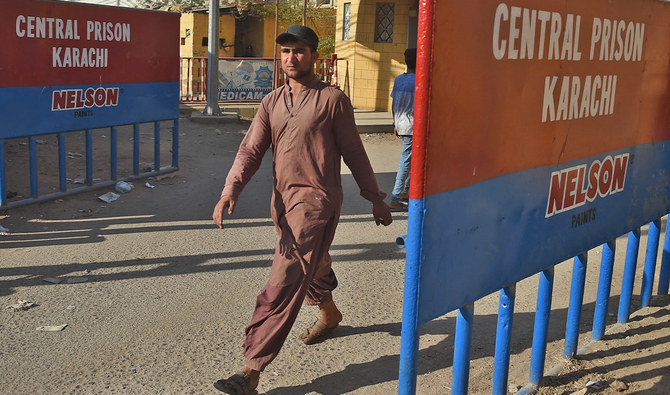
A man walks out of the central prison in Karachi, Pakistan, on January 29, 2021. (Photo courtesy: AFP/File)
Short Url
Updated 30 May 2023
Follow

Third Indian inmate dies in Pakistani jail in a month, raising alarm about prison conditions

  • Indian prisoner Balo passes away in Mali prison due to health complications, confirms official
  • Indian, Pakistani prisoners languish in prisons for years for violating territorial waters mistakenly

KARACHI: An Indian fisherman named Balo passed away while being detained at the Malir prison in Pakistan’s southern port city of Karachi last week, a jail official confirmed on Monday, making it the third Indian inmate within a month who died in the same jail.

Fishermen from both India and Pakistan are frequently detained on charges of violating territorial waters of each other’s countries. Pakistan’s and India’s borders are not clearly defined in the Arabian Sea and many fishing boats lack the technology needed to be certain of their precise location. The fishermen often languish in jail even after serving their term, as poor diplomatic ties between the two arch-rivals mean fulfilling official requirements can take a long time.

Balo, son of Jetha, was arrested for crossing into Pakistan’s territorial waters, and subsequently sent to Malir prison in 2020. On May 22, while receiving treatment at the National Cardiovascular Diseases institute, the Indian prisoner passed away, Malir prison’s Superintendent Muhammad Arshad said.

“The body is currently being kept in Edhi cold storage,” Arshad told Arab News, adding that jail authorities were waiting for legal formalities to be completed before handing it over to his relatives.

On May 8, 50-year-old Indian fisherman Soma Deva died in the same prison after suffering from a lung and heart disease. According to jail authorities, Deva’s condition deteriorated over a period of time, adding that he was admitted to a hospital and provided treatment before he died. His death closely followed the demise of another Indian inmate Zulfiqar, who passed away in Malir prison on May 6. His death was confirmed by Faisal Edhi, chairman of the Edhi foundation, which keeps the deceased inmates’ bodies in its morgue.

Although Arshad says the hospital extends medical help to inmates inside the prison and at major hospitals, at least four Afghan nationals have also passed away during their detention in Malir prison since November 2022.

Faiz Muhammad, who arrived in Pakistan from Afghanistan to have his ailing his sister-in-law treated, passed away in Malir prison after being diagnosed with hypertension, diabetes, and depression following a severe ear infection earlier this year.

Taj Muhammad, another Afghan inmate who was detained in January 2022, died nine months later, while Afghan inmate Abdul Khalil died in December after being taken into custody in November 2022. Additionally, Wali Khan, a fourth Afghan who was arrested in November, died in late January 2023.

The alarming number of deaths have raised suspicion on how inmates are treated inside the prison and whether or not they are provided adequate treatment facilities.


Pakistan reviews austerity measures amid Middle East crisis, urges strict nationwide implementation

Updated 11 March 2026
Follow

Pakistan reviews austerity measures amid Middle East crisis, urges strict nationwide implementation

  • Deputy Prime Minister Ishaq Dar chairs review meeting of austerity steps
  • Officials briefed on salary cuts, school closures, four‑day week, petrol conservation

ISLAMABAD: Pakistan’s government on Wednesday assessed progress on a sweeping set of austerity measures introduced to mitigate the country’s economic strain from sharply rising global oil prices and supply disruptions linked to the ongoing war in the Middle East.

Prime Minister Shehbaz Sharif this week announced a series of austerity steps, including a four‑day work week for government offices, requiring 50  percent of staff to work from home, cutting fuel allowances for official vehicles by half, grounding up to 60  percent of the government fleet and closing all schools for two weeks to conserve fuel amid the global oil crisis.

The measures were unveiled in response to global oil market volatility triggered by the conflict involving the United States, Israel and Iran, which has disrupted supply routes such as the Strait of Hormuz and pushed crude prices sharply higher, straining Pakistan’s heavily import‑dependent energy sector.

“The meeting stressed the importance of strict and transparent adherence to the austerity measures, promoting fiscal responsibility and prudent use of public resources,” Deputy Prime Minister and Foreign Minister Senator Mohammad Ishaq Dar said in a statement.

He was chairing a meeting of the Committee for Monitoring and Implementation of Conservation and Additional Austerity Measures, constituted under the directions of the PM, bringing together federal and provincial officials to review execution of the broad cost‑cutting plan. 

Dar emphasized the government’s commitment to enforcing the PM’s austerity steps nationwide. The committee’s review also covered reductions in departmental expenditure, deductions from salaries of senior officials earning over Rs. 300,000 ($1,120), and coordination with provincial administrations to ensure uniform implementation of the plan.

Participants at the meeting reiterated that all ministries and divisions must continue strict monitoring and reporting, with transparent oversight mechanisms, as Pakistan navigates the economic pressures from the prolonged Middle East crisis and its fallout on global energy and trade markets.