

Political stalemate to continue as Pakistan’s top court indefinitely adjourns election delay case

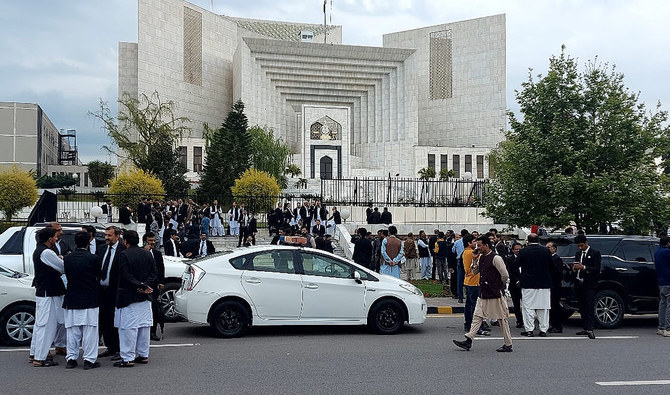
In this picture, taken on April 3, 2023, Pakistani lawyers gather outside the Supreme Court during the hearing of a case related to the postponement of Punjab polls in Islamabad. (AN Photo)
Short Url
Updated 29 May 2023
Follow

Political stalemate to continue as Pakistan’s top court indefinitely adjourns election delay case

  • The development comes after the attorney general says a recent legislation has changed scope of the case and its review
  • The government and the judiciary along with Khan’s party have been at loggerheads over Punjab, Khyber Pakhtunkhwa polls

ISLAMABAD: The Supreme Court (SC) of Pakistan on Monday adjourned hearing of a case pertaining to delay in the Punjab provincial assembly elections until June 1, local media reported, as the political stalemate in the South Asian country continues to linger.

The coalition government led by Prime Minister Shehbaz Sharif and the country’s top court have been at loggerheads since the latter took up cases of delays in elections in the Punjab and Khyber Pakhtunkhwa (KP) provinces, whose legislative assemblies were dissolved by ex-PM Imran Khan and allies in January to force the government to announce early national elections.

The government accuses the Supreme Court of being partial toward the ex-premier. The tiff spiraled into an ugly confrontation this month when Khan’s arrest in a graft case was ruled illegal by an SC bench headed by Chief Justice Umar Ata Bandial. The government and allies subsequently accused the top judge of bias and the Pakistan Democratic Alliance, an alliance of 13 political parties backing Sharif’s ruling party, staged a protest in front of the top court.

On Monday, a three-member bench, led by Chief Justice Bandial, resumed hearing the case relating to elections in Punjab, weeks after the top court ordered elections in Pakistan’s most populous province on May 14. At the outset of the hearing, Attorney General Mansoor Usman Awan said the recently passed Supreme Court (Review of Judgments and Orders) Act 2023 had changed the scope of the suo motu case and a review filed by the election regulator against the verdict.

“As per the new law, the scope of review and appeal are the same now,” Pakistan’s Dawn newspaper quoted Awan as telling the court, who contended that as per the law, the review could only be heard by a larger bench and raised objections to the three-judge panel hearing the case.

The Supreme Court (Review of Judgments and Orders) Act 2023, which was passed earlier this month, provides litigants the right to appeal in suo motu cases, extends the scope of review by forming a larger bench, besides increasing the “limitation period” for filing a review from 30 days to 60 days to protect the fundamental rights of the citizens under articles 10-A and 25 of the constitution.

The government maintains the legislation is aimed at facilitating and strengthening the Supreme Court in exercising its powers to review judgments and orders, but critics and the opposition see it as an attempt to reverse the disqualification of former premier Nawaz Sharif, elder brother of incumbent Pakistan PM Sharif, who was disqualified from holding a public office in 2017.

The top judge asked the attorney general if the other party in the case, Khan’s PTI, had been informed about the review of judgments law, to which Awan said PTI attorney Ali Zafar was on vacation, according to the Dawn report.

Chief Justice Bandial then adjourned the proceedings till Thursday, June 1, saying, “We understand that a new law has been passed … the PTI will also be made aware of it.”

The development comes amid a months-long political crisis in the South Asian country, with Khan demanding elections in Punjab and KP that account for more than half of Pakistan’s population.

The government maintains that it is not feasible for the country embroiled in an economic crisis to separately hold provincial elections. Pakista historically holds the provincial and national elections at the same time.

Multiple rounds of talks between Khan’s party and the government have taken place to finalize a consensus date for elections, but failed to yield any result.


UN torture expert decries Pakistan ex-PM Khan’s detention

Updated 12 December 2025
Follow

UN torture expert decries Pakistan ex-PM Khan’s detention

  • Khan’s party alleges government is holding him in solitary confinement, barring prison visits
  • Pakistan’s government rejects allegations former premier is being denied basic rights in prison

GENEVA: Pakistan’s former prime minister Imran Khan is being held in conditions that could amount to torture and other inhuman or degrading treatment, the United Nations’ special rapporteur on torture warned Friday.

Alice Jill Edwards urged Pakistan to take immediate and effective action to address reports of the 73-year-old’s inhumane and undignified detention conditions.

“I call on Pakistani authorities to ensure that Khan’s conditions of detention fully comply with international norms and standards,” Edwards said in a statement.

“Since his transfer to Adiala Jail in Rawalpindi on September 26, 2023, Imran Khan has reportedly been held for excessive periods in solitary confinement, confined for 23 hours a day in his cell, and with highly restricted access to the outside world,” she said.

“His cell is reportedly under constant camera surveillance.”

Khan an all-rounder who captained Pakistan to victory in the 1992 Cricket World Cup, upended Pakistani politics by becoming the prime minister in 2018.

Edwards said prolonged or indefinite solitary confinement is prohibited under international human rights law and constitutes a form of psychological torture when it lasts longer than 15 days.

“Khan’s solitary confinement should be lifted without delay. Not only is it an unlawful measure, extended isolation can bring about very harmful consequences for his physical and mental health,” she said.

UN special rapporteurs are independent experts mandated by the Human Rights Council. They do not, therefore, speak for the United Nations itself.

Initially a strong backer of the country’s powerful military leadership, Khan was ousted in a no-confidence vote in 2022, and has since been jailed on a slew of corruption charges that he denies.

He has accused the military of orchestrating his downfall and pursuing his Tehreek-e-Insaf (PTI) party and its allies.

Khan’s supporters say he is being denied prison visits from lawyers and family after a fiery social media post this month accusing army leader Field Marshal Asim Munir of persecuting him.

According to information Edwards has received, visits from Khan’s lawyers and relatives are frequently interrupted or ended prematurely, while he is held in a small cell lacking natural light and adequate ventilation.

“Anyone deprived of liberty must be treated with humanity and dignity,” the UN expert said.

“Detention conditions must reflect the individual’s age and health situation, including appropriate sleeping arrangements, climatic protection, adequate space, lighting, heating, and ventilation.”

Edwards has raised Khan’s situation with the Pakistani government.