5.2 earthquake jolts parts of Pakistan, no loss reported 

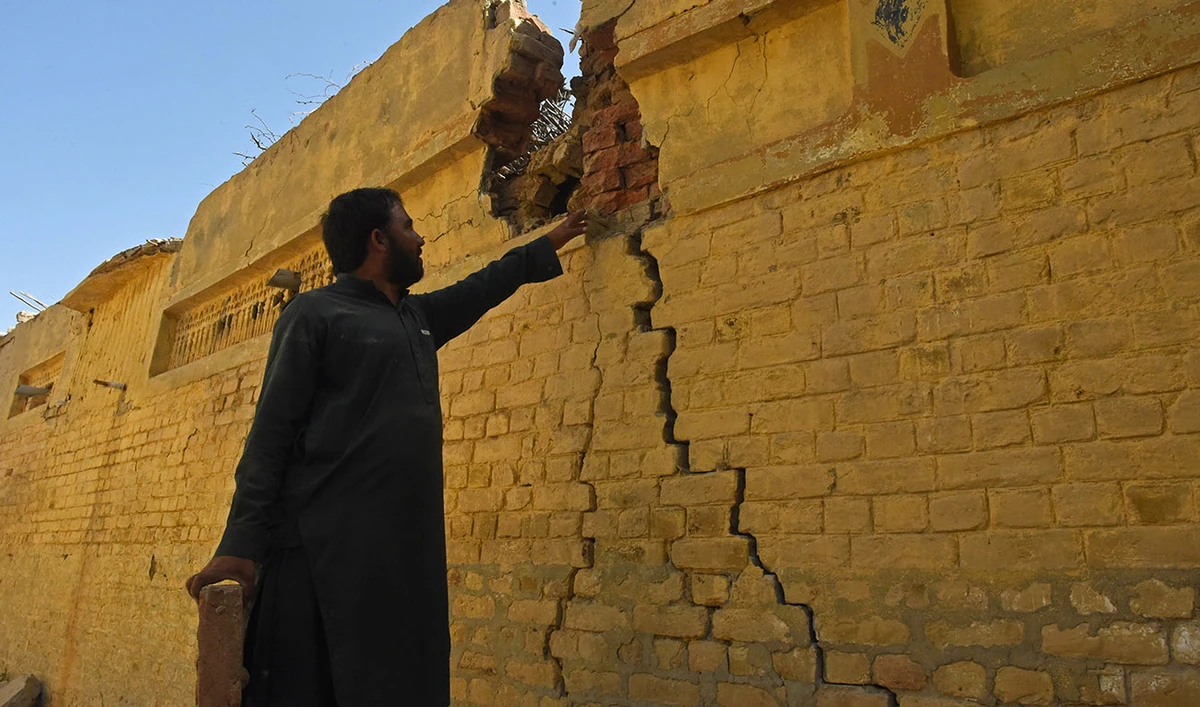
A resident checks a damaged wall of his house following an earthquake in the remote mountainous district of Harnai on October 7, 2021. (AFP/File)
Short Url
Updated 28 May 2023
Follow

5.2 earthquake jolts parts of Pakistan, no loss reported 

  • Tremors felt in Islamabad, Rawalpindi and the northwestern Khyber Pakhtunkhwa province 
  • The earthquake struck at a depth of 223 kilometers with its epicenter located in Afghanistan 

ISLAMABAD: A magnitude 5.2 earthquake shook the Pakistani capital of Islamabad and northwestern parts of the country on Sunday morning, according to US Geological Survey (USGS), with no loss of life or property reported in its wake. 

The earthquake struck at a depth of 223 kilometers with its epicenter located 35 kilometers southeast of the Jurm district in Afghanistan, said the USGS, a US government agency that tracks seismic activity the world over. 

Tremors were felt in Islamabad, Rawalpindi and adjacent areas as well as in the northwestern Khyber Pakhtunkhwa (KP) province that borders Afghanistan. 

“Earthquake shocks were felt in different districts of Khyber Pakhtunkhwa,” the provincial disaster management authority (PDMA) said in a statement. 

“The PDMA control room has not yet received information about any kind of loss.” 

The Pakistan Meteorological Department, however, reported the intensity of the earthquake to be 6.0. 

In March, a strong earthquake rattled Islamabad and northwestern parts of Pakistan, killing at least nine people and injuring around 50 others in the country’s northwest. 

The center of the magnitude 6.5 quake was also located 40 kilometers (25 miles) south-southeast of Jurm, Afghanistan. 


Pakistan reviews austerity measures amid Middle East crisis, urges strict nationwide implementation

Updated 11 March 2026
Follow

Pakistan reviews austerity measures amid Middle East crisis, urges strict nationwide implementation

  • Deputy Prime Minister Ishaq Dar chairs review meeting of austerity steps
  • Officials briefed on salary cuts, school closures, four‑day week, petrol conservation

ISLAMABAD: Pakistan’s government on Wednesday assessed progress on a sweeping set of austerity measures introduced to mitigate the country’s economic strain from sharply rising global oil prices and supply disruptions linked to the ongoing war in the Middle East.

Prime Minister Shehbaz Sharif this week announced a series of austerity steps, including a four‑day work week for government offices, requiring 50  percent of staff to work from home, cutting fuel allowances for official vehicles by half, grounding up to 60  percent of the government fleet and closing all schools for two weeks to conserve fuel amid the global oil crisis.

The measures were unveiled in response to global oil market volatility triggered by the conflict involving the United States, Israel and Iran, which has disrupted supply routes such as the Strait of Hormuz and pushed crude prices sharply higher, straining Pakistan’s heavily import‑dependent energy sector.

“The meeting stressed the importance of strict and transparent adherence to the austerity measures, promoting fiscal responsibility and prudent use of public resources,” Deputy Prime Minister and Foreign Minister Senator Mohammad Ishaq Dar said in a statement.

He was chairing a meeting of the Committee for Monitoring and Implementation of Conservation and Additional Austerity Measures, constituted under the directions of the PM, bringing together federal and provincial officials to review execution of the broad cost‑cutting plan. 

Dar emphasized the government’s commitment to enforcing the PM’s austerity steps nationwide. The committee’s review also covered reductions in departmental expenditure, deductions from salaries of senior officials earning over Rs. 300,000 ($1,120), and coordination with provincial administrations to ensure uniform implementation of the plan.

Participants at the meeting reiterated that all ministries and divisions must continue strict monitoring and reporting, with transparent oversight mechanisms, as Pakistan navigates the economic pressures from the prolonged Middle East crisis and its fallout on global energy and trade markets.