

5.2 earthquake jolts parts of Pakistan, no loss reported 

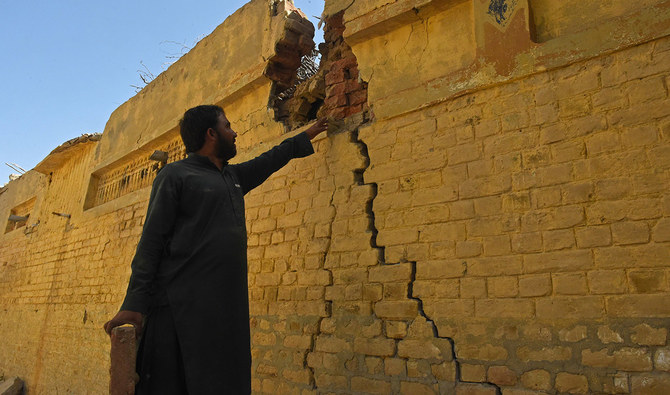
A resident checks a damaged wall of his house following an earthquake in the remote mountainous district of Harnai on October 7, 2021. (AFP/File)
Short Url
Updated 28 May 2023
Follow

5.2 earthquake jolts parts of Pakistan, no loss reported 

  • Tremors felt in Islamabad, Rawalpindi and the northwestern Khyber Pakhtunkhwa province 
  • The earthquake struck at a depth of 223 kilometers with its epicenter located in Afghanistan 

ISLAMABAD: A magnitude 5.2 earthquake shook the Pakistani capital of Islamabad and northwestern parts of the country on Sunday morning, according to US Geological Survey (USGS), with no loss of life or property reported in its wake. 

The earthquake struck at a depth of 223 kilometers with its epicenter located 35 kilometers southeast of the Jurm district in Afghanistan, said the USGS, a US government agency that tracks seismic activity the world over. 

Tremors were felt in Islamabad, Rawalpindi and adjacent areas as well as in the northwestern Khyber Pakhtunkhwa (KP) province that borders Afghanistan. 

“Earthquake shocks were felt in different districts of Khyber Pakhtunkhwa,” the provincial disaster management authority (PDMA) said in a statement. 

“The PDMA control room has not yet received information about any kind of loss.” 

The Pakistan Meteorological Department, however, reported the intensity of the earthquake to be 6.0. 

In March, a strong earthquake rattled Islamabad and northwestern parts of Pakistan, killing at least nine people and injuring around 50 others in the country’s northwest. 

The center of the magnitude 6.5 quake was also located 40 kilometers (25 miles) south-southeast of Jurm, Afghanistan. 


Rating firm S&P says it won’t rush Iran war downgrades, sees risks for countries like Pakistan

Updated 12 March 2026
Follow

Rating firm S&P says it won’t rush Iran war downgrades, sees risks for countries like Pakistan

  • Agency says it is monitoring indebted energy importers as higher oil prices strain finances
  • Gulf economies seen better placed to weather shock, though Bahrain flagged as vulnerable

LONDON: S&P Global ‌said it would not make any knee-jerk sovereign rating cuts following the outbreak of war in the ​Middle East, but warned on Thursday that soaring oil and gas prices were putting a number of already cash-strapped countries at risk.

The firm’s top analysts said in a webinar that the conflict, which has involved US and Israeli strikes ‌against Iran and Iranian ‌strikes against Israel, ​US ‌bases ⁠and Gulf ​states, ⁠was now moving from a low- to moderate-risk scenario.

Most Gulf countries had enough fiscal buffers, however, to weather the crisis for a while, with more lowly rated Bahrain the only clear exception.

Qatar’s banking sector could ⁠also struggle if there were significant ‌deposit outflows in ‌reaction to the conflict, although there ​was no evidence ‌of such strains at the moment, they ‌said.

“We don’t want to jump the gun and just say things are bad,” S&P’s head global sovereign analyst, Roberto Sifon-Arevalo, said.

The longer the crisis ‌was prolonged, though, “the more difficult it is going to be,” he ⁠added.

Sifon-Arevalo ⁠said Asia was the second-most exposed region, due to many of its countries being significant Gulf oil and gas importers.

India, Thailand and Indonesia have relatively lower reserves of oil, while the region also had already heavily indebted countries such as Pakistan, Bangladesh and Sri Lanka whose finances would be further hurt by rising energy prices.

“We ​are closely monitoring ​these (countries) to see how the credit stories evolve,” Sifon-Arevalo said.