

Pakistan’s religious affairs minister meets aviation authorities to ensure better Hajj travel facilities

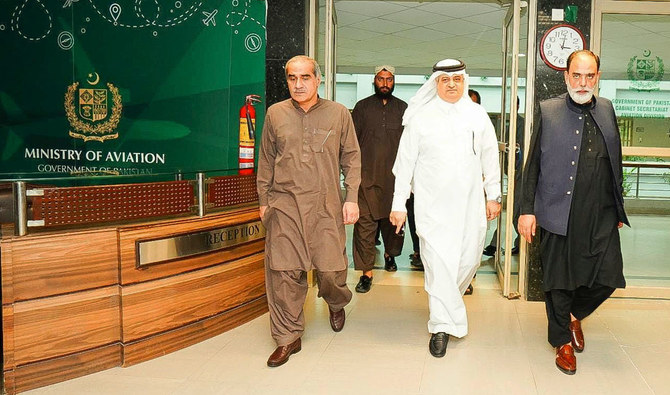
The photo taken on May 26, 2023, shows Pakistan's minister for religious affairs Senator Talha Mehmood (right), with Saudi Arabia’s Ambassador to Pakistan Nawaf bin Saeed Al-Maliki (center), and the Pakistani aviation minister Khawaja Saad Rafiq in Islamabad, Pakistan. (Photo courtesy: religious affairs ministry)
Short Url
Updated 26 May 2023
Follow

Pakistan’s religious affairs minister meets aviation authorities to ensure better Hajj travel facilities

  • Minister holds discussion about difficulties faced by Pakistani pilgrims during air travel to the kingdom
  • Aviation authorities inform about current facilities available to pilgrims, propose enhancements to them

ISLAMABAD: Pakistan’s religious affairs minister Senator Talha Mehmood on Friday held a meeting with the country’s aviation minister to discuss the provision of better facilities for Pakistani pilgrims traveling to Saudi Arabia for Hajj this year, said an official statement.

This kingdom reinstated Pakistan’s pre-pandemic Hajj quota of 179,210 pilgrims and scrapped the upper age limit of 65 in January. About 80,000 Pakistanis are expected to perform the pilgrimage under the government scheme this year while the rest will be facilitated by private tour operators.

The first batch of Pakistani pilgrims arrived in the holy city of Madinah on May 22, while the last flight would depart from Pakistan on June 20. According to the religious affairs ministry, these pilgrims will depart for Makkah after spending about eight days in Madinah.

“Federal Minister for Religious Affairs Senator Talha Mehmood, along with Saudi Arabia’s Ambassador to Pakistan Nawaf bin Saeed Al-Maliki, held a meeting with the Federal Aviation Minister Khawaja Saad Rafiq on Friday,” said the statement issued by the religious affairs ministry.

“Consultations were held regarding the difficulties faced by Pakistani pilgrims during their air travel to Saudi Arabia, while a discussion on [ways] to provide better facilities to the pilgrims was also held.”

According to the state-owned Associated Press of Pakistan (APP) news agency, the Pakistani aviation minister informed about the current facilities available to pilgrims while proposing enhancements to further improve their experience.

“He highlighted the importance of coordination between the two countries to ensure the successful implementation of these improvements,” the APP added.

Meanwhile, a private company that helps the kingdom’s mission in Pakistan by providing visa management facility on its behalf announced on Friday it had extended its operations to facilitate Hajj applicants with biometrics.

“Gerry’s Saudi Visa extends operations this weekend, on May 27th and 28th, from 9:00 am to 5:00 pm, to facilitate the completion of [pilgrims’] biometric applications,” it said in a notification.

Hajj is an obligatory religious ritual for adult Muslims who are physically and financially capable of carrying it out. It involves visiting the holy cities of Makkah and Madinah at least once in a lifetime and takes place during the last month of the lunar Islamic calendar called Dhu Al-Hijjah.


Bahraini commander witnesses Pakistan Navy passing-out parade in Karachi

Updated 18 sec ago
Follow

Bahraini commander witnesses Pakistan Navy passing-out parade in Karachi

  • Rear Admiral Ahmed Mohamed bin Ali says it is a matter of immense pleasure for him to review commissioning of personnel at his alma mater
  • The training you have received has prepared you to step into a challenging yet deeply satisfying career, he tells young officers, midshipmen

ISLAMABAD: Rear Admiral Ahmed Mohamed Ebrahim Al bin Ali, commander of Royal Bahrain Naval Force, witnessed passing-out parade of Pakistan Navy’s 124th Midshipmen and 32nd Short Service Commission Course in Karachi, where he spoke with the newly inducted officers.

The passing-out parade was held at the Pakistan Naval Academy, at which Commandant Commodore Zia-ur-Rehman congratulated 90 midshipmen and 38 cadets who had completed short service commission after going through academic and training phases.

In his address, Rear Admiral Ali said it was a matter of immense pleasure for him to review the commissioning of personnel at his alma mater, the Pakistan Naval Academy, which he had joined as a cadet in February 1983.

“You must be confident and self-assured that you have been trained at one of the best naval academies of the region. The training you have received at Pakistan Naval Academy has prepared you to step into a challenging yet deeply satisfying career,” he told the young officers and midshipmen.

“It has equipped you with essential military and academic skills and you should spare no effort to build up on these to achieve excellence in your professions.”

Pakistan armed forces have long been training cadets and officers from friendly countries. Currently, the Pakistan Naval Academy is training future officers from Bahrain, Djibouti, Iraq, Sri Lanka and Turkiye.

The Bahraini commander said that being here as the chief guest had taken him back to yesteryears and he would have flashbacks of the familiar sounds and aura of this naval academy.

“I cannot help but marvel at the wonderful transformation that has taken place since my days,” he said.

Pakistan and Bahrain have maintained close diplomatic, security, trade and defense relations and have undertaken joint training and security initiatives, besides regular high-level exchanges.

Bahrain’s Read Admiral Ali met Pakistan Naval Chief Admiral Naveed Ashraf earlier this week, according to Pakistan Navy. They discussed matters of mutual interest, regional maritime security and avenues for bilateral naval cooperation.

Earlier in Sept., Pakistan and Bahrain agreed to enhance cooperation in naval training and regional maritime security operations. During the same month, the Bahraini Chief of Defense Staff Lt. Gen. Thiab Saqer Abdulla Al-Nuaimi met with Pakistan’s Air Chief Marshal Zaheer Ahmed Baber Sidhu and expressed Bahrain’s interest in learning from the PAF’s experience in multi-domain operations.