

Pakistan says has no desire to join any bloc, calls China ‘strategic partner’

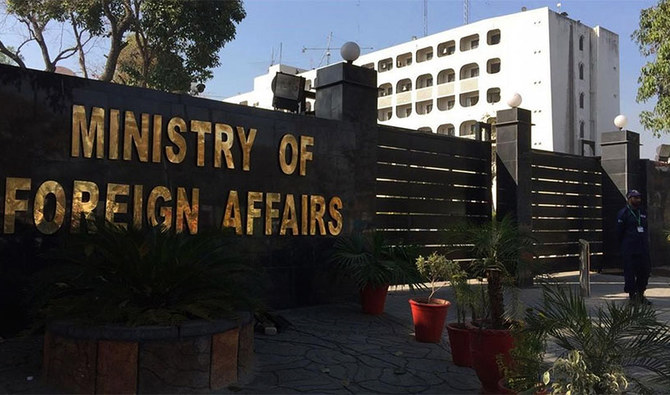
In this picture, taken on April 15, 2023, a security personnel stands guard outside the Pakistan's Foreign Ministry building in Islamabad. (Photo courtesy: Radio Pakistan)
Short Url
Updated 26 May 2023
Follow

Pakistan says has no desire to join any bloc, calls China ‘strategic partner’

  • Statement comes at time of growing proximity between China, Russia amid criticism from West over Ukraine
  • Pakistan describes the US as a longtime ‘friend’ with multidimensional ties and cooperation in several areas

ISLAMABAD: Pakistan neither believes in the bloc politics and nor it has any desires to join any bloc, its Foreign Office (FO) said on Thursday, describing China as an all-weather strategic partner.

The statement comes at a time of growing proximity between China and Russia amid criticism of their relationship in the West as the war in Ukraine drags on.

Russia’s prime minister signed a set of agreements with China on Wednesday during a trip to Beijing, describing bilateral ties at an unprecedented high, despite criticism of their relationship in the West as the war in Ukraine drags on.

Pakistan, which has historic ties with China and has long been an ally of the United States (US), has refuted speculation that Islamabad had joined any of the two blocs.

“Pakistan has a consistent policy that we do not believe in bloc politics. We have an All-Weather Strategic Cooperative Partnership with China. It is a relationship that has grown from strength to strength over the last several decades and both countries are committed to this relationship,” Mumtaz Zahra Baloch, an FO spokesperson, told a weekly press briefing.

“Similarly, Pakistan has excellent relations with a large number of countries around the world, in the Middle East, in Asia Pacific, in Europe and in Africa. The United States especially, is one of the oldest friends and partner of Pakistan and the biggest export market.”

Pakistan and the US relations have “multidimensional” ties and both countries cooperate with each other in several areas, according to the spokesperson.

“Pakistan-US relations are multidimensional with several areas of cooperation with Pakistani Americans acting as a bridge between Pakistan and the United States,” she said. “We have no desire to take sides or to join one bloc or the other.”

Apart from China, Pakistan has been leaning toward Russia for the last one year, trying to secure cheaper energy imports from Moscow. With the war in Ukraine in its second year and Russia increasingly feeling the weight of Western sanctions, Moscow is relying on Beijing for support, far more than China on Russia, feeding on Chinese demand for oil and gas.

The pressure from the West has shown no sign of easing, with the Group of Seven’s weekend declarations singling both countries out on a series of issues including Ukraine. The G7 agreed to tighten sanctions against Moscow and urged China to press Russia to withdraw its forces from Ukraine.

Beijing has rejected Western attempts to link its partnership with Moscow to Ukraine, insisting the relationship does not violate international norms, China has the right to collaborate with whichever country it chooses, and their cooperation is not targeted at any third countries.


Pakistan concludes 60-hour joint military exercise featuring 19 states, including Saudi Arabia, US

Updated 8 sec ago
Follow

Pakistan concludes 60-hour joint military exercise featuring 19 states, including Saudi Arabia, US

  • Exercise also featured participation from Turkiye, Uzbekistan, Bangladesh, Egypt, Jordan and Qatar, says military’s media wing
  • Says exercise is designed to enhance professional military skills through exchange of innovative ideas, tactical experiences

ISLAMABAD: A 60-hour-long joint military exercise organized by Pakistan’s army concluded this week at the eastern city of Kharian, featuring participation from 19 countries including Saudi Arabia and the US, the military’s media wing said. 

The 9th International Pakistan Army Team Spirit (PATS) Competition is a 60-hour-long patrolling exercise, which the Pakistani military says is designed to enhance professional military skills through the exchange of innovative ideas, tactical experiences and best practices among participating teams. 

The exercise was held from Feb. 5-9 in the semi-mountainous terrains of Pakistan’s eastern Punjab province, providing participants a “realistic and challenging operational environment.” Pakistan’s Chief of Defense Forces (CDF) Field Marshal Syed Asim Munir attended the closing ceremony of the exercise on Monday and presented awards to participants.

“Over the years, PATS has evolved into a prestigious and highly competitive military exercise, recognized for promoting professional excellence and mutual learning among participating nations,” the Inter-Services Public Relations (ISPR), the military’s media wing, said in a statement. 

“The forum continues to strengthen military-to-military cooperation and understanding, while fostering camaraderie and team spirit in a demanding operational setting.”

This year’s exercise featured participants from 19 countries including Saudi Arabia, Bahrain, Bangladesh, Belarus, Egypt, Iraq, Jordan, Malaysia, Maldives, Morocco, Nepal, Qatar, Sri Lanka, Turkiye, USA and Uzbekistan, the ISPR said.

Indonesia, Myanmar and Thailand attended the exercise as observers while 16 domestic teams from the Pakistan Army and Pakistan Navy, along with observers from the Pakistan Air Force also participated in the event.

Munir appreciated participating teams for their “exceptional professionalism, physical and mental endurance, operational competence and high morale” displayed during the exercise, the military’s media wing said.

“He emphasized the importance of such multinational engagements in enhancing collective preparedness and adapting to the evolving character of modern warfare,” the ISPR added. 

Pakistan routinely holds joint air, ground and sea exercises with regional countries and traditional allies to foster interoperability to counter threats to global peace.