Pakistan welcomes Syria's readmission to Arab League

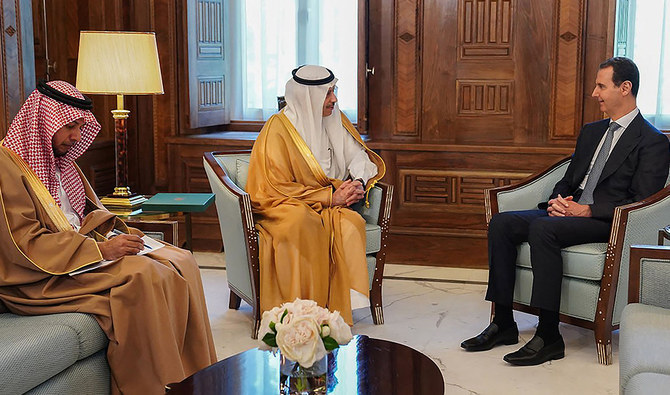
This handout picture released by the Syrian Presidency Telegram account on May 10, 2023 shows Syrian President Bashar al-Assad meeting with Saudi's ambassador to Jordan, Nayef bin Bandar Al-Sudairy, in Damascus. (Photo courtesy: Syrian Presidency via AFP)
Short Url
Updated 26 May 2023
Follow

Pakistan welcomes Syria's readmission to Arab League

  • Syria was readmitted to the Arab League earlier this month after 11 years
  • Pakistan welcomes Saudi Arabia, Iran's normalization of ties, Yemen peace measures

ISLAMABAD: Pakistan's foreign ministry spokesperson on Thursday welcomed Syria's readmission into the Arab League, hoping that peace measures in the Middle East would promote prosperity in the region. 

Syria was readmitted to the Arab League after 11 years this month, with the country's president, Bashar al-Assad attending the summit in Jeddah last week. 

The development took place after Iran and Saudi Arabia's historic move to restore diplomatic relations in March. The kingdom has also pushed for peace measures in Yemen to bring about an end to the conflict there. 

"Pakistan has welcomed the recent developments in our region, where countries are normalizing relations," the foreign office spokesperson said during a weekly press briefing. 

"We also welcome the return of Syria to the Arab League fold." 

The spokesperson hoped normalization of ties among these countries would bring "new opportunities" for progress and prosperity for Pakistanis and the people of the region. 

Pakistan enjoys cordial relations with Saudi Arabia, the UAE, and other Middle Eastern countries and has often offered to mediate for peace between countries locked in conflict in the region.

Middle Eastern countries such as Saudi Arabia and the UAE are not only important investment partners for Pakistan but are also a source of billions of dollars in remittances for the South Asian country.


Pakistan, seven Muslim nations back Palestinian technocratic body, stress Gaza-West Bank unity

Updated 15 January 2026
Follow

Pakistan, seven Muslim nations back Palestinian technocratic body, stress Gaza-West Bank unity

  • The National Committee for the Administration of the Gaza Strip was announced on January 14
  • Muslim nations call for consolidation of the ceasefire and unimpeded humanitarian aid into Gaza

ISLAMABAD: Pakistan and seven other Muslim-majority countries on Thursday welcomed the formation of a temporary Palestinian technocratic body to administer Gaza, stressing that it must manage daily civilian affairs while preserving the institutional and territorial link between the Gaza Strip and the West Bank amid the ongoing peace efforts.

In a joint statement, the foreign ministers of Pakistan, Egypt, Jordan, Saudi Arabia, Qatar, Türkiye, Indonesia and the United Arab Emirates said the newly announced National Committee for the Administration of the Gaza Strip would play a central role during the second phase of a broader peace plan aimed at ending the war and paving the way for Palestinian self-governance.

“The Ministers emphasize the importance of the National Committee commencing its duties in managing the day-to-day affairs of the people of Gaza, while preserving the institutional and territorial link between the West Bank and the Gaza Strip, ensuring the unity of Gaza, and rejecting any attempts to divide it,” the statement said.

The committee, announced on Jan. 14, is a temporary transitional body established under United Nations Security Council Resolution 2803 and is to operate in coordination with the Palestinian Authority, the ministers said.

The statement said the move forms part of the second phase of US President Donald Trump’s Comprehensive Peace Plan for Gaza, which the ministers said they supported, praising Trump’s efforts to end the war, ensure the withdrawal of Israeli forces and prevent the annexation of the occupied West Bank.

The top leaders of all eight Muslim countries attended a meeting with Trump in New York last September, shortly before he unveiled the Gaza peace plan.

The ministers also called for the consolidation of the ceasefire, unimpeded humanitarian aid into Gaza, early recovery and reconstruction and the eventual return of the Palestinian Authority to administer the territory, leading to a just and sustainable peace based on UN resolutions and a two-state solution on pre-1967 lines with East Jerusalem as the Palestinian capital.