

Pakistani startup, with mainly local and Middle East users, makes it to Silicon Valley Elite 200

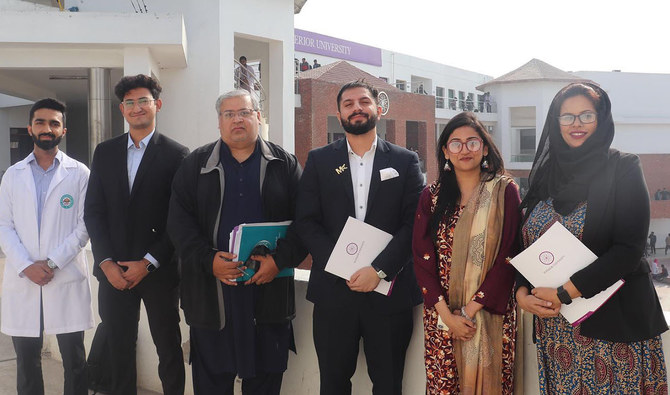
The photo posted on May 16, 2022, shows the founder of MedAngle Dr. Dr. Muhammad Azib (center) with his team at Azra Naheed Medical College in Lahore, Pakistan. (Photo courtesy: MedAngle/Facebook)
Short Url
Updated 25 May 2023
Follow

Pakistani startup, with mainly local and Middle East users, makes it to Silicon Valley Elite 200

  • Dr. Muhammad Azib launched MedAngle, an innovative edtech firm in the field of medical sciences, in 2017
  • Over 62,000 medical students have been using the platform, most of them based in Pakistan and the Middle East

ISLAMABAD: The top official of a Pakistani startup, which found itself among the 2023 Global Silicon Valley (GSV) Elite 200 EdTech Companies this month, said on Wednesday he was planning to introduce a dedicated operating system to encourage technology-based education for aspiring medical professionals.

Launched in 2017, MedAngle is a digital platform for students of medical sciences and aims to help them explore, learn, practice, retain and review a wide range of concepts in their field through multiple-choice and verbal questions, along with detailed clinical studies. It was included among the prestigious GSV list which recognizes the contributions of top technology firms from across the world.

The founder of the startup, Dr. Muhammad Azib, a 29-year-old graduate of Dow University of Health Sciences in Karachi, said he wanted to assist aspiring medical professionals through innovative use of technology. Azib himself has participated in the Transcend Fellowship in Silicon Valley and the MIT-Harvard Medical School Global Healthcare Innovation and Stanford Graduate School of Business Seed Spark programs in recent years.

“After the success of our platform, we are now building an operating system for health education,” he told Arab News in an exclusive phone interview from Chicago. “No matter which medical or dental school a student is attending, our software will help everyone in any country or any medical school.”

Azib said his company wanted the operating system to assist students and medical professionals at all stages of their education and practice.

“Our platform is for everyone, whether they are students of medical, dental, veterinary, physiotherapy, or any other related field,” he added.

The MedAngle official said Pakistan was among the top five countries in the world in terms of the number of doctors it produced every year, but there was no personalized online medical education platform, not only in Pakistan but also in other developing countries.

“So, we got this idea to start a platform for future doctors, not only in Pakistan but also in other emerging economies,” he added.

Azib said MedAngle was the first Pakistani startup to be named in the top edtech companies in the world. He pointed out the GSV was the biggest international platform, representing the number one technology-based education services.

“GSV contacted us last year, and then we were shortlisted in January this year,” he said. “They announced our listing in April at an event in the United States.”

Azib said over 62,000 students were already using MedAngle service.

“Its subscription is currently by invitation only because we are trying to personalize it for every student according to their institution,” he said, adding the platform users had answered built-in questions over 50 million times.

“Out of these 62,000 members, around 10 percent belong to Middle Eastern countries,” he added. “We have a diverse team of 150 medical professionals globally, mostly from Pakistan and the United Arab Emirates.”

Speaking about the subscription cost, Azib said his company wanted to keep it low so every medical student could easily afford it.

“We tried to keep our platform affordable to all students, and the subscription charges are just Rs199 per month, which is less than a dollar,” he said.


JazzCash signs deal with Binance in UAE to explore regulated crypto adoption in Pakistan

Updated 24 min 59 sec ago
Follow

JazzCash signs deal with Binance in UAE to explore regulated crypto adoption in Pakistan

  • MoU focuses on awareness and development of compliant virtual-asset solutions in Pakistan
  • Pakistan introducing licensing regime for crypto firms as it formalizes digital-asset oversight

ISLAMABAD: Pakistani financial-technology platform JazzCash has signed a memorandum of understanding with global cryptocurrency exchange Binance in the United Arab Emirates to explore cooperation on virtual-asset use and education in Pakistan, the company said on Wednesday.

The agreement sets a framework for discussions on awareness campaigns and future digital-asset products that would comply with Pakistan’s emerging crypto regulations. The move signals growing engagement between global blockchain companies and Pakistani fintechs as authorities shift toward formal licensing of the sector.

Pakistan has spent the past year drafting rules to regulate the fast-expanding market for digital coins and tokens, requiring virtual-asset service providers to obtain government approval. Officials say the transition is aimed at curbing money-laundering and terror financing risks, boosting transparency and encouraging responsible innovation.

“JazzCash has always championed technologies that expand financial access while promoting secure and inclusive participation in the digital economy," JazzCash Chief Executive Officer Murtaza Ali said. 

“By entering into this exploratory MoU with Binance, we are advancing our efforts to understand how global digital-asset trends can support Pakistan’s evolving regulatory landscape. We aim to engage responsibly, support regulatory progress, and advance opportunities that build trust, transparency and innovation for our customers.”

The MoU does not establish a commercial partnership, but marks one of the most high-profile engagements between Pakistan’s fintech sector and a global crypto exchange as the country moves toward regulated digital-asset adoption.

Binance welcomed the cooperation, framing it as part of Pakistan’s shift toward regulated digital-asset activity.

"With regulatory frameworks like [Pakistan Virtual Assets Regulatory Authority] PVARA paving the way, this collaboration represents a significant step toward expanding financial inclusion and empowering more people to access the benefits of blockchain technology in a secure and compliant environment," Binance Chief Marketing Officer Rachel Conlan said.

Earlier this month, Binance executives met Pakistani finance officials to discuss digital-payments reform, blockchain-skills training and the potential for Web3-linked jobs. Pakistan also set up the Pakistan Crypto Council and formed PVARA this year to license and supervise crypto-asset service providers.