

Pakistan's political uncertainty, IMF loan delay widens exchange rate gap in currency markets — dealers

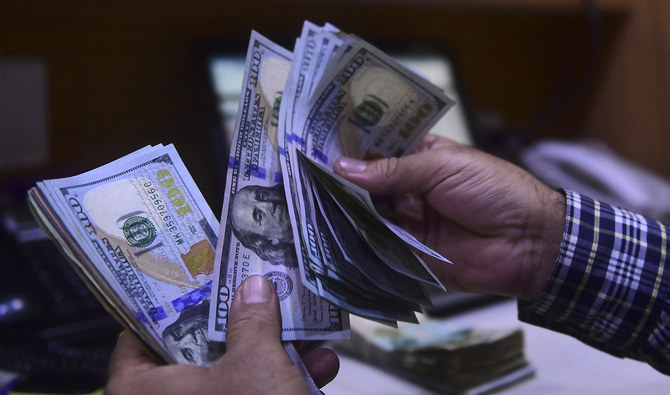
A dealer counts US dollars at a money exchange market in Karachi, Pakistan on March 2, 2023. (AFP/File)
Short Url
Updated 24 May 2023
Follow

Pakistan's political uncertainty, IMF loan delay widens exchange rate gap in currency markets — dealers

  • Exchange rate gap widens by Rs22, Rs33 in Pakistan's legal and illegal markets
  • Analysts say persistent gap to hit remittances through official channels

KARACHI: Fueled by political uncertainty and doubts regarding the International Monetary Fund (IMF) loan revival, the rupee-dollar disparities in Pakistan’s interbank and open markets on Wednesday widened by Rs22, with analysts saying the widening gap was an alarming development for the country's remittance inflows through official channels.  

There are three distinct exchange rate markets in Pakistan for currency transactions, and all three have significant disparities in buying and selling rates. 

The rupee closed at Rs309 in the open market and Rs287 in the interbank market against the US dollar on Wednesday, with a difference of Rs22, according to the Exchange Companies Association of Pakistan (ECAP). 

In the third market, known as the grey or illegal market, the disparity in exchange rates is even greater compared to the open and interbank markets. Currency dealers said the rupee is being traded at around Rs320 in the grey market, causing about a Rs33 gap when compared with the interbank market's rate. 

Dealers attributed the widening exchange rate disparities to the dollar crunch in the country and the high demand for import payments. 

“Importers are arranging dollars for payment from the grey market where the demand for the greenback rate has spiked,” Zafar Sultan Paracha, general secretary of ECAP, told Arab News.   

“The Hawala and grey market are flourishing as buyers and sellers are also resorting to the illicit market to benefit from the huge gap.”  

Another reason why currency trading was gaining traction in illegal markets was due to the low rates being offered by money transfer companies, Paracha said. 

“These companies are giving up to Rs15 lower than the official rate or the interbank exchange rate,” Paracha said.  “People are not coming to us for buying and selling, they are going to the grey market as they are getting the best rates.”  

Currency dealers and analysts also attributed the exchange rate disparities to a spike in demand from Hajj pilgrims, and Pakistan's increasingly volatile political situation. 

Analysts said exchange rates were also fluctuating due to uncertainty surrounding the future of the IMF program, as doubts remain whether the international lender would revive the program or replace it with a new one. 

“This IMF program-related uncertainty has also widened the gap between open and interbank market rates,” Tahir Abbas, head of research at Arif Habib Limited, told Arab News.  

Pakistan has been facing delays in securing the latest tranche of a $6.5 billion loan from the IMF. Despite implementing tough conditions, the Fund and Pakistani authorities have not been able to finalize a 9th review of the program that would lead to the disbursement of $1.1 billion in funds that would help unlock financing from other donors and friendly countries. 

Dealers and analysts said the high, attractive exchange rates in open and illegal markets would dent Pakistan's inflow of remittances through official channels.  

“It is detrimental for remittance inflows through official channels and if the gap continues to persist, the inflow of remittances will be hit,” Abbas said. “The remittances inflows are already slowing down.” 

The South Asian country has already received 13% lower remittances in April 2023, recorded at $2.2 billion, data from the central bank showed. 

Remittances fell by 13% during the first ten months of the current fiscal year, FY23, as compared to the same period last year.


Pakistan to promote mineral sector at Saudi forum this month with 13 companies

Updated 02 January 2026
Follow

Pakistan to promote mineral sector at Saudi forum this month with 13 companies

  • Delegation will take part in the Future Minerals Forum in Riyadh from Jan. 13-15
  • Petroleum minister will lead Pakistan, participate in a 90-minute country session

ISLAMABAD: Around 13 Pakistani state-owned and private companies will attend the Future Minerals Forum (FMF) in Saudi Arabia from Jan. 13 to 15, an official statement said on Friday, as the country seeks to ramp up global engagement to develop its mineral resources.

The FMF is an international conference and investment platform for the mining sector, hosted by mineral-rich countries to attract global investors, companies and governments.

Petroleum Minister Ali Pervaiz Malik confirmed Pakistan’s participation in a meeting with the Saudi envoy, Nawaf bin Said Al-Malki.

Pakistan hosts one of the world’s largest copper-gold zones. The Reko Diq mine in southwestern Balochistan, with an estimated 5.9 billion tons of ore, is partly owned by Barrick Gold, which calls it one of the world’s largest underdeveloped copper-gold deposits. Its development is expected to boost Pakistan’s struggling economy.

“Upon an invitation of the Government of the Kingdom of Saudi Arabia, the Federal Minister informed the Ambassador that Pakistan will fully participate in the upcoming Future Minerals Forum (FMF), scheduled to be held in Riyadh later this month,” Pakistan’s Press Information Department (PID) said in an official statement.

The Pakistani minister will lead his country’s delegation at the FMF and take part in a 90-minute country showcase session titled “Unleashing Potential: Accelerating Pakistan’s Mineral Revolution” along with local and foreign investors.

Pakistan will also establish a dedicated pavilion to highlight the vast potential of its rich geological landscape to the global mineral community.

The Saudi envoy welcomed Pakistan’s decision to participate in the forum and discussed enhancing bilateral cooperation in the minerals and energy sectors during the meeting.

According to the statement, he highlighted the potential for cooperation between Saudi Arabia and Pakistan in the minerals and energy sectors, expressing confidence that the FMF would provide a platform to expand collaboration.
Pakistan’s mineral sector, despite its rich reserves of salt, copper, gold and coal, contributes only 3.2 percent to the country’s GDP and just 0.1 percent to global mineral exports.

However, many countries, including the United States, have shown interest in Pakistan’s underdeveloped mineral sector, particularly in copper, gold and other critical resources.

In October, Pakistan dispatched its first-ever shipment of rare earth and critical minerals to the United States, according to a Chicago-based US public relations firm’s report.