


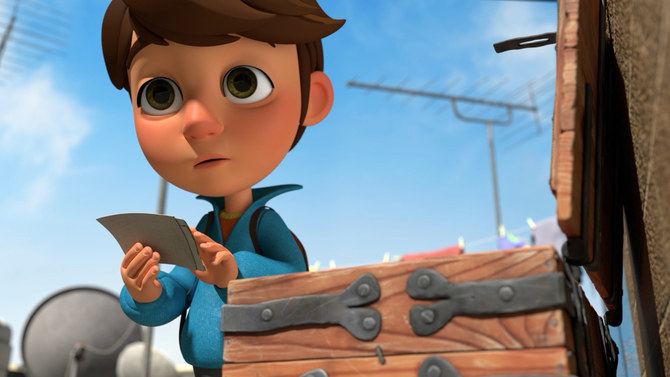

AMMAN: Cynthia Madanat Sharaiha’s life-long passion for all things art has manifested itself onto the silver screen.
Although she studied engineering, a combination of the digital revolution and regional upheavals has moved her into making films with a message.
Her latest project, “Saleem,” a 3-D animated feature, has been selected to participate in the Annecy International Animation Film Festival, the movie’s debut festival nomination.
Made with her husband and partner, executive producer Shadi Sharaiha, and produced by Jordanian company Digitales, along with more than 100 Jordanian and international artists, the flick highlights issues related to children’s mental health through the story of a Middle Eastern child forced to flee his home due to war.
During a press conference in Paris, Annecy festival artistic director, Marcel Jean, described the film as “a surprise we did not expect.”
He said: “We were captivated by the sensibility and delicacy of the film. I strongly encourage people to explore the work at the festival this year.”
Deadline reported the selection of “Saleem” for the festival as a “rare participation from the Middle East.”
Sharaiha’s movie was not born out of thin air. Working with mental health experts and seasoned children’s content writers, Digitales produced the “Our Family Life” animation series, a collection of short videos surrounding the Abu Sanad family and addressing social and family themes.
The series became a hit on YouTube amassing 624 million viewers and more than 2 million subscribers. The animation worked well in Arab communities because the characters looked and sounded similar to the people they addressed.
The arrival in Jordan of more than 1 million refugees fleeing war in Syria, sparked the idea to highlight the mental health problems faced by refugees and displaced children, and the interactions with host communities.
In partnership with local and international organizations, Digitales began working on “Saleem,” alongside a digital project looking at the mental health of children around the world affected by traumatic events, using animation and storytelling weaved with therapeutic themes.
“Saleem” was chosen out of 3,338 entries from 112 countries to compete in next month’s Annecy festival against 11 other films in the Contrechamp category.
It tells an uplifting and touching story about a nine-year-old boy called Saleem, who lost his father and was forced to flee with his mother, brother, and sister from his war-torn city. His life changes when a pigeon reveals a map that leads him on a discovery adventure for a treasure he did not expect to need.
Director Sharaiha said: “The film comes from the heart of Jordan carrying a story that we hope will touch the hearts of everyone around the world who watches it.
“We went through a personal journey that took us through our childhood memories and experiences, which helped us empathize with Saleem and see the world through his eyes.
“We felt his pain, fear, and frustration, as well as his strength and hope which grew with the passage of the story.”
She pointed out that the film told not only Saleem’s story but that of millions of marginalized and vulnerable children globally.
“This film shows their plight and highlights the courage that is generated within them, even in the most difficult circumstances,” she added.
Her husband noted the challenges of producing the film, that had taken four years to make.
He said: “We are proud that Jordan produced a film of this quality and impact — talented Jordanian artists, alongside international artists who worked for major studios, such as Disney, and DreamWorks, and others.
“These international artists joined our team because of their belief in the value of this artwork. This collaboration enriched the quality of the film and was a wonderful opportunity for our local talents to work alongside and engage with these international artists.”
Mohannad Al-Bakri, managing director of the Royal Film Commission Jordan, said: “Animation has the power to educate as well as entertain and engage the viewer, thus attracting a large audience.
“The selection of ‘Saleem’ at the prestigious Annecy film festival is a remarkable achievement that the Jordanian film industry can be proud of.”
Digitales is an emerging Jordanian company producing animation and influential digital content and has won several international awards for its work. It is led by a team that specializes in creating family and child-friendly content.
Front Row Filmed Entertainment will distribute “Saleem” exclusively in Arab countries, while I Am a Film will be responsible for festival distribution.


