

Ex-PM Khan says there are ‘80 percent chances’ he will be arrested on Tuesday

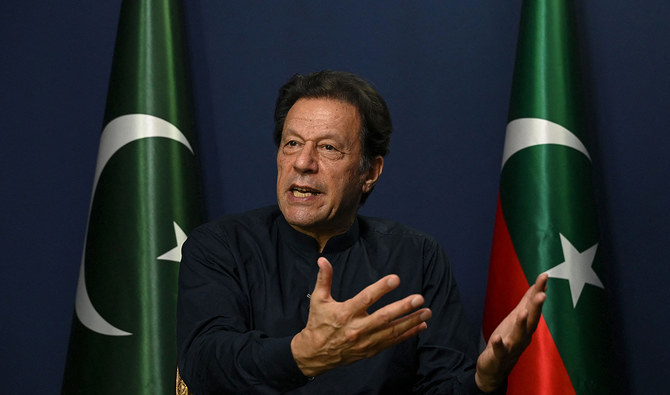
Former Pakistan's Prime Minister Imran Khan gestures as he speaks during an interview with AFP at his residence in Lahore on May 18, 2023. (Photo courtesy: AFP)
Short Url
Updated 21 May 2023
Follow

Ex-PM Khan says there are ‘80 percent chances’ he will be arrested on Tuesday

  • Ever since his ouster from office, Khan was booked in a slew of cases he says are politically motivated
  • Khan alleges 10,000 of his supporters are languishing in jails, says there is no rule of law in the country

ISLAMABAD: Former prime minister Imran Khan said on Sunday that there is an eighty percent chance that he would be arrested again on Tuesday when he appears for multiple bail hearings in Pakistan’s capital Islamabad.

Ever since he was dismissed from office via a parliamentary vote in April 2022, over 100 cases have been registered against Khan in various Pakistani courts. The charges against the former prime minister range from corruption to terrorism and sedition, which he says are politically motivated.

Violent protests broke out after the Pakistan Tehreek-e-Insaf (PTI) leader was arrested on May 9 from an Islamabad court on charges of corruption. Angry Khan supporters targeted government buildings and military installations, including the house of a senior army official, smashed buses and blocked roads. The protests came to an end after the Supreme Court declared his arrest “illegal” on May 12 and granted Khan a two-week bail in multiple cases.

Speaking to CNN’s Fareed Zakaria during an interview, Khan claimed that over 10,000 of his supporters across the country are in jails on trumped-up charges, including his party’s senior leadership. The former premier feared he would be next.

“On Tuesday, I’m going to make an appearance for various bails in Islamabad,” Khan said. “Eighty percent chances are that I will be arrested. So right now, there is no rule of law,” he added.

Khan’s remarks come at a time of heightened tensions between the former premier and Pakistan’s powerful military. The government and military have said the May 9 rioters would be tried by military courts for attacking army installations, a move that has been decried by Khan and human rights organizations in Pakistan.

The PTI leader, who has been calling for snap elections across the country after his party and an ally dissolved its governments in Khyber Pakhtunkhwa and Punjab provinces, has alleged that the government is afraid of his rising popularity and is hence not obeying the top court’s orders to hold elections in Punjab. 

“And because they [the government] are scared that the PTI and I would be back in power, everything is being done to dismantle our democracy,” Khan said.

Khan, once considered a close ally of the military, had a falling out with the powerful institution last year after he accused ex-army chief General Qamar Javed Bajwa of not intervening to save his government.

Khan has since then mounted attacks against the army, even blaming a senior intelligence official for trying to have him killed last year and orchestrating the assassination of slain TV anchor Arshad Sharif.

When asked whether Khan thinks he could take on the army and win, the former premier said regardless of the outcome, “the country loses.”

“I mean, Pakistan needs a powerful army,” Khan said, adding that Muslim countries around the world are suffering from devastation due to the absence of a strong army.

“So, I’m a firm believer that the country needs a strong defense, it needs to be able to defend itself as it did during the War on Terror,” he added.


IMF warns against policy slippage amid weak recovery as it clears $1.2 billion for Pakistan

Updated 4 sec ago
Follow

IMF warns against policy slippage amid weak recovery as it clears $1.2 billion for Pakistan

  • Pakistan rebuilt reserves, cut its deficit and slowed inflation sharply over the past one year
  • Fund says climate shocks, energy debt, stalled reforms threaten stability despite recent gains

ISLAMABAD: Pakistan’s economic recovery remains fragile despite a year of painful stabilization measures that helped pull the country back from the brink of default, the International Monetary Fund (IMF) warned on Thursday, after it approved a fresh $1.2 billion disbursement under its ongoing loan program.

The approval covers the second review of Pakistan’s Extended Fund Facility (EFF) and the first review of its climate-focused Resilience and Sustainability Facility (RSF), bringing total disbursements since last year to about $3.3 billion.

Pakistan entered the IMF program in September 2024 after years of weak revenues, soaring fiscal deficits, import controls, currency depletion and repeated climate shocks left the economy close to external default. A smaller stopgap arrangement earlier that year helped avert immediate default, but the current 37-month program was designed to restore macroeconomic stability through strict monetary tightening, currency adjustments, subsidy rationalization and aggressive revenue measures.

The IMF’s new review shows that Pakistan has delivered significant gains since then. Growth recovered to 3 percent last year after shrinking the year before. Inflation fell from over 23 percent to low single digits before rising again after this year’s floods. The current account posted its first surplus in 14 years, helped by stronger remittances and a sharp reduction in imports. And the government delivered a primary budget surplus of 1.3 percent of GDP, a key program requirement. Foreign exchange reserves, which had dropped dangerously low in 2023, rose from US$9.4 billion to US$14.5 billion by June.

“Pakistan’s reform implementation under the EFF arrangement has helped preserve macroeconomic stability in the face of several recent shocks,” IMF Deputy Managing Director Nigel Clarke said in a statement after the Board meeting.

But he warned that Islamabad must “maintain prudent policies” and accelerate reforms needed for private-sector-led and sustainable growth.

The Fund noted that the 2025 monsoon floods, affecting nearly seven million people, damaging housing, livestock and key crops, and displacing more than four million, have set back the recovery. The IMF now expects GDP growth in FY26 to be slightly lower and forecasts inflation to rise to 8–10 percent in the coming months as food prices adjust.

The review warns Pakistan against relaxing monetary or fiscal discipline prematurely. It urges the State Bank to keep policy “appropriately tight,” allow exchange-rate flexibility and improve communication. Islamabad must also continue raising revenues, broadening the tax base and protecting social spending, the Fund said.

Despite the progress, Pakistan’s structural weaknesses remain severe.

Power-sector circular debt stands at about $5.7 billion, and gas-sector arrears have climbed to $11.3 billion despite tariff adjustments. Reform of state-owned enterprises has slowed, including delays in privatizing loss-making electricity distributors and Pakistan International Airlines. Key governance and anti-corruption reforms have also been pushed back.

The IMF welcomed Pakistan’s expansion of its flagship Benazir Income Support Program, which raises cash transfers for low-income families and expands coverage, saying social protection is essential as climate shocks intensify. But it warned that high public debt, about 72 percent of GDP, thin external buffers and climate exposure leave the country vulnerable if reform momentum weakens.

The Fund said Pakistan’s challenge now is to convert short-term stabilization into sustained recovery after years of economic volatility, with its ability to maintain discipline, rather than the size of external financing alone, determining the durability of its gains.