

UK’s abandonment of Sudan could create dangerous precedent for refugee rights: charity

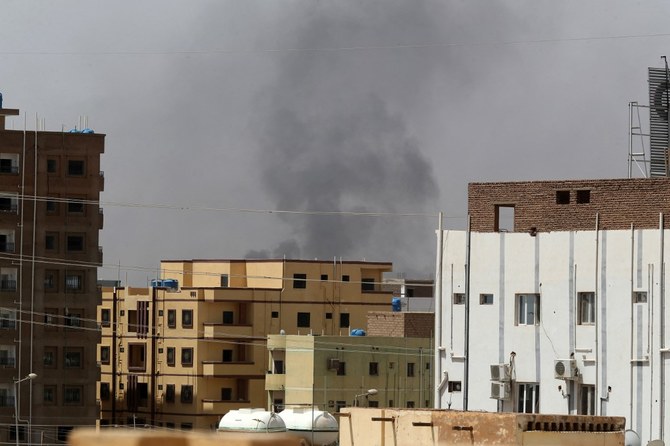
Clashes broke out between the Sudanese Armed Forces and the paramilitary Rapid Support Forces in mid-April, and the fighting has only intensified since (AFP)
Short Url
Updated 21 May 2023
Follow

UK’s abandonment of Sudan could create dangerous precedent for refugee rights: charity

  • Choose Love has ‘simple’ message for British govt: ‘Don’t turn your back on people seeking safety’
  • What began as a national crisis is becoming a regional one, deputy CEO tells Arab News

LONDON: The UK’s decision to “turn its back” on Sudan could create a dangerous precedent that sees the rights of refugees “lost to history,” a refugee charity has warned.

Urging the British government to reverse course and create a new visa system to assist those fleeing violence in Sudan in the same way it has done for Ukrainians, Choose Love’s Deputy CEO Emma Stevenson told Arab News that the charity has a “simple” request of the UK: “Don’t turn your back on people seeking safety.”

She added: “Even if just a few countries follow the UK government’s lead and deny asylum to those fleeing conflict and persecution, the rights of refugees and the fundamental legal right to claim asylum could be lost to history.”

Clashes broke out between the Sudanese Armed Forces and the paramilitary Rapid Support Forces in mid-April, and the fighting has only intensified since.

Hundreds of people have been killed in the crossfire and at least 200,000 — but potentially as many as 1 million — have been displaced, yet the UK has remained steadfast in its refusal to offer a visa scheme specifically for Sudanese affected by the conflict.

A petition has been launched, which at the time of writing had gained 27,000 signatures. Were it to hit 100,000, the government would have to consider it for parliamentary debate.

Responding to the petition, the government reiterated that “there are no plans to create a visa scheme for family members of British citizens and settled migrants affected by the unrest.”

It added: “We recognise some people displaced by the fighting may wish to join family in the UK, and where those family members do not have a current UK visa, they can apply for one via one of our standard visa routes, which remain available.”

The government said it is “monitoring the situation in Sudan closely to ensure that it is able to respond appropriately.”

On the international stage, Djibouti’s Foreign Minister Mahamoud Ali Youssouf said those attending Friday’s Arab League Summit in Jeddah had to take advantage of this “unique opportunity” to resolve the conflict.

Saudi Arabia has been heavily involved in trying to bring about peace, having brokered several ceasefires.

But with each one broken, Stevenson is circumspect on the short-term prospects for a resolution.

“There’s little sign the violence will cease any time soon, with things becoming increasingly desperate as the fighting intensifies,” she said.

“People are trapped with no access to food, water, electricity or medicine, and are having to make the terrifying decision of whether they should evacuate, leaving everything behind and walking into an uncertain future, or stay at the risk of being caught in the crossfire.”

Absent Western government support, and with the situation in Sudan deteriorating by the day, many Sudanese have been left to find escape routes to the borders internally.

Resultantly there has been a surge in the cost of bus tickets, pricing many people out of any hope of escape, while those fortunate enough to have reached the borders are leading to what began as a national crisis becoming a regional one, Stevenson said.

“This will place even more strain on faltering humanitarian infrastructure in northeast Africa,” she added.

“With more people having no means of escape, it’s now essential that we do everything we can to support those fleeing as well as those who are internally displaced or trapped in their homes. Our absolute priority is supporting displaced people and those most vulnerable.”

Asked what the international community could do short of offering evacuation routes, Choose Love has said there is “no substitute” for water, healthcare and basic services.

“Humanitarian support is trickling into Khartoum and the wider region, but it must reach the disabled, pregnant, elderly and all disadvantaged groups. The most vulnerable must never be forgotten,” Stevenson said.

She added that the UK’s abandonment of its legal obligations as a party to the UN Refugee Convention to protect those fleeing conflict without discrimination to race, religion or country has been compounded by the government’s “rapid response” and ongoing support for those fleeing war in Ukraine, a marked contrast to the position taken toward those facing comparable circumstances in northeast Africa.

“We’re of course supportive of the rapid response the UK government put in place for people fleeing the war in Ukraine,” Stevenson said.

“It shows what can be done when there’s the political will to do so, and we’d urge the government to apply their asylum policies in a consistent and humanitarian way, regardless of country of origin.”


Vance to meet Danish and Greenlandic officials in Washington as locals say Greenland is not for sale

Updated 4 sec ago
Follow

Vance to meet Danish and Greenlandic officials in Washington as locals say Greenland is not for sale

  • Greenlanders say the Arctic island, which is a semiautonomous region of Denmark is not for sale
  • Denmark’s prime minister has warned that taking the island by force could end the NATO alliance
NUUK: Along the narrow, snow-covered main street in Greenland’s capital, international journalists and camera crews stop passersby every few meters (feet) asking them for their thoughts on a crisis which Denmark’s prime minister has warned could potentially trigger the end of NATO.
Greenland is at the center of a geopolitical storm as US President Donald Trump is insisting he wants to own the island — and the residents of its capital Nuuk say it is not for sale. Trump said he wants to control Greenland at any cost and the White House has not ruled out taking the island by force.
US Vice President JD Vance will meet Denmark’s foreign minister Lars Løkke Rasmussen and his Greenlandic counterpart Vivian Motzfeldt in Washington on Wednesday to discuss the Arctic island, which is a semiautonomous territory of the United States’ NATO ally Denmark.
Tuuta Mikaelsen, a 22-year-old student, told The Associated Press in Nuuk that she hoped American officials would get the message to “back off.”
Greenland’s Prime Minister Jens-Frederik Nielsen told a news conference in the Danish capital Copenhagen on Tuesday that, “if we have to choose between the United States and Denmark here and now, we choose Denmark. We choose NATO. We choose the Kingdom of Denmark. We choose the EU.”
Asked later Tuesday about Nielsen’s comments, Trump replied: “I disagree with him. I don’t know who he is. I don’t know anything about him. But, that’s going to be a big problem for him.”
A strategically important territory
Greenland is strategically important because as climate change causes the ice to melt, it opens up the possibility of shorter trade routes to Asia. That also could make it easier to extract and transport untapped deposits of critical minerals which are needed for computers and phones.
Trump also said he wants the island to expand America’s security and has cited what he says is the threat from Russian and Chinese ships as a reason to control it.
But both experts and Greenlanders question that claim.
“The only Chinese I see is when I go to the fast food market,” Lars Vintner, a heating engineer told AP. He said he frequently goes sailing and hunting and has never seen Russian or Chinese ships.
His friend, Hans Nørgaard, agreed, adding “what has come out of the mouth of Donald Trump about all these ships is just fantasy.”
Denmark has said the US — which already has a military presence — can boost its bases on Greenland. For that reason, “security is just a cover,” Vintner said, suggesting Trump actually wants to own the island to make money from its untapped natural resources.
Nørgaard told AP he filed a police complaint in Nuuk against Trump’s “aggressive” behavior because, he said, American officials are threatening the people of Greenland and NATO. He suggested Trump was using the ships as a pretext to further American expansion.
“Donald Trump would like to have Greenland, (Russian President Vladimir) Putin would like Ukraine and (Chinese President) Xi Jinping would like to have Taiwan,” Nørgaard said.
Mikaelsen, the student, said Greenlanders benefit from being part of Denmark, which provides free health care, education and payments during study.
“I don’t want the US to take that away from us,” she said.
Ahead of Wednesday’s meeting, Naaja Nathanielsen, Greenland’s minister for business and mineral resources said it’s “unfathomable” that the United States is discussing taking over a NATO ally and urged the Trump administration to listen to voices from the Arctic island’s people.
More diplomatic efforts
Following the White House meeting, Løkke Rasmussen and Motzfeldt, along with Denmark’s ambassador to the US, are due to meet with senators from the Arctic Caucus in the US Congress. Sen. Angus King, an independent from Maine, is to host the gathering.
It comes as two other lawmakers — Sen. Jeanne Shaheen, a New Hampshire Democrat, and Sen. Lisa Murkowski, an Alaska Republican — have introduced bipartisan legislation that would prohibit the use of funds from the US Defense or State departments to annex or take control of Greenland or the sovereign territory of any NATO member state without that ally’s consent or authorization from the North Atlantic Council.
A bipartisan delegation of lawmakers is also heading to Copenhagen at the end of the week to meet with Danish and Greenlandic officials.
Last week, Denmark’s major European allies joined Frederiksen in issuing a statement declaring that Greenland belongs to its people and that “it is for Denmark and Greenland, and them only, to decide on matters concerning Denmark and Greenland.”
On Wednesday, French Foreign Minister Jean-Noël Barrot told broadcaster RTL that his country plans to open a consulate in Greenland on Feb. 6. He said the decision had been taken to open the diplomatic outpost when President Emmanuel Macron visited last summer.