

Pakistan’s defense minister says people tried in military courts will reserve right to appeal

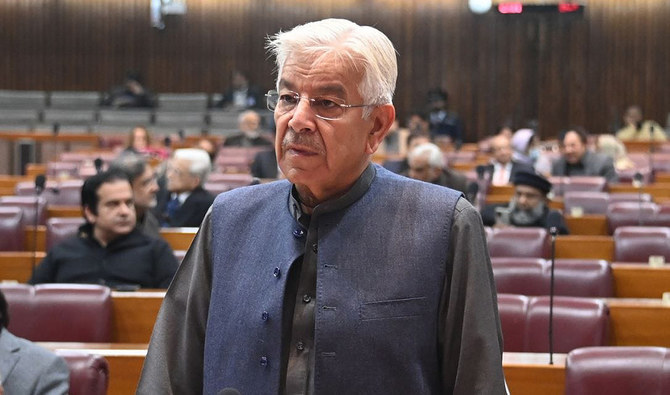
This photo, taken on January 31, 2023, shows Pakistani Defense Minister Khawaja Asif addressing the National Assembly of Pakistan in Islamabad. (Photo courtesy: Twitter/NAofPakistan)
Short Url
Updated 20 May 2023
Follow

Pakistan’s defense minister says people tried in military courts will reserve right to appeal

  • Khawaja Asif says the violent protests that broke out after ex-PM Khan’s arrest amounted to ‘war’ against the state
  • Khan was arrested on graft charges on May 9, causing violent protests in which people torched military properties

ISLAMABAD: Pakistan’s defense minister Khawaja Asif said on Friday people who indulged in violent protests after former prime minister Imran Khan’s arrest and torched military installations would have the right to appeal the verdict after being tried in military courts.

The minister’s statement was quoted by the state-owned Associated Press of Pakistan (APP) news agency after he gave interview to a Middle Eastern news channel.

Asif said some of the top political leaders in the country had faced incarcerations in the past, but their party supporters and activists had refrained from extreme violence.

“Such actions are tantamount to waging a war against Pakistan,” the APP quoted him as saying in an interview with Al Jazeera. “Those who attacked military installations, military bases and residences of military personnel, their trials will be held under military courts according to the procedure given in the constitution.”

He added that those who were tried by the military authorities would still “have the right to appeal to the high courts and the Supreme Court.”

“My leader [Nawaz Sharif] and many people of my political party were arrested, but we never did politics of violence,” he continued. “We have never attacked military and civilian installations on arrests.”

Asif acknowledged there were political difference between the government and ex-PM Khan’s party.

“But that does not mean that government and public properties should be attacked,” he added.

The former prime minister was arrested on corruption charges from a court in Islamabad on May 9. Within the next few hours, protests broke out in different parts of the country, with people carrying Khan’s party flags storming government building, including military properties, and setting them alight.

The government and the country’s powerful army believe the demonstrations were planned and organized.

Khan and his top party leaders have condemned the vandalism, though they continue to face a tough political situation.


ADB, Pakistan sign over $300 million agreements to undertake climate resilience initiatives

Updated 30 December 2025
Follow

ADB, Pakistan sign over $300 million agreements to undertake climate resilience initiatives

  • Pakistan ranks among nations most vulnerable to climate change and has seen erratic changes in weather patterns
  • The projects in Sindh and Punjab will restore nature-based coastal defenses and enhance agricultural productivity

ISLAMABAD: The Pakistani government and the Asian Development Bank (ADB) have signed more than $300 million agreements to undertake two major climate resilience initiatives, Pakistan’s Press Information Department (PID) said on Tuesday.

The projects include the Sindh Coastal Resilience Sector Project (SCRP), valued at Rs50.5 billion ($180.5 million), and the Punjab Climate-Resilient and Low-Carbon Agriculture Mechanization Project (PCRLCAMP), totaling Rs34.7 billion ($124 million).

Pakistan ranks among nations most vulnerable to climate change and has seen erratic changes in its weather patterns. In 2022, monsoon floods killed over 1,700 people, displaced another 33 million and caused over $30 billion losses, while another 1,037 people were killed in floods this year.

The South Asian country is ramping up climate resilience efforts, with support from the ADB and World Bank, and investing in climate-resilient infrastructure, particularly in vulnerable areas.

“Both sides expressed their commitment to effectively utilize the financing for successful and timely completion of the two initiatives,” the PID said in a statement.

The Sindh Coastal Resilience Project (SCRP) will promote integrated water resources and flood risk management, restore nature-based coastal defenses, and strengthen institutional and community capacity for strategic action planning, directly benefiting over 3.8 million people in Thatta, Sujawal, and Badin districts, according to ADB.

The Punjab project will enhance agricultural productivity and climate resilience across 30 districts, improving small farmers’ access to climate-smart machinery, introducing circular agriculture practices to reduce residue burning, establishing testing and training facilities, and empowering 15,000 women through skills development and livelihood diversification.

Earlier this month, the ADB also approved $381 million in financing for Pakistan’s Punjab province to modernize agriculture and strengthen education and health services, including concessional loans and grants for farm mechanization, Science, Technology, Engineering and Mathematics (STEM) education, and nursing sector reforms.