

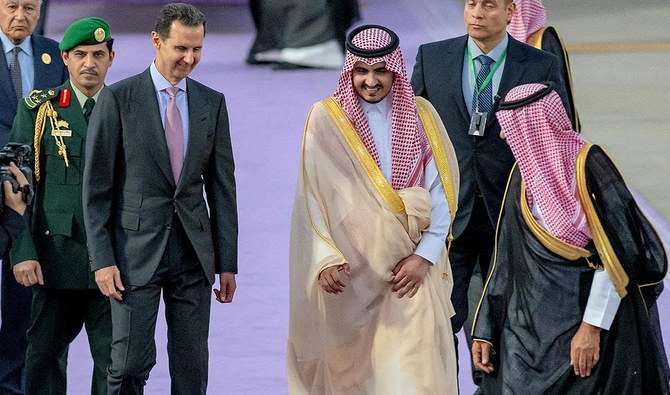

JEDDAH: President Bashar Assad of Syria arrived in Jeddah on Thursday to take part in the Arab League summit, his first visit to the Kingdom since Syria’s conflict began in 2011.
Assad’s attendance at the summit on Friday seals Syria’s return to the Arab fold after a 12-year suspension,and opens a new chapter in relations after more than a decade of tensions.
The 22-member league recently reinstated Syria and is now poised to welcome Assad back into its ranks. The Syrian president was officially invited to attend the summit last week.Saudi Arabia cut ties with Assad’s government in 2012 in response to the brutal crackdown on pro-democracy protests that triggered the civil war, which has killed more than 500,000 people and displaced millions. It was also the reason Syria was suspended from the Arab League.
The steps leading to Syria’s reintegration into the Arab fold go back to at least 2018, but the process picked up speed after two deadly earthquakes struck Syria and Turkey in February, prompting an influx of aid from the region.
After the quakes, Saudi Foreign Minister Prince Faisal bin Farhan said a consensus was building in the Arab world that a new approach to Syria requiring negotiations with Damascus would be needed to address humanitarian crises.
Assad’s arrival was preceded by that of several Arab leaders and heads of state. First to arrive was Egyptian President Abdel Fattah El-Sisi, followed by Lebanon’s Prime Minister Najib Mikati, Palestinian President Mahmoud Abbas, Bahrain’s King Hamad, the President of Yemen’s Presidential Leadership Council Rashad Al-Alimi, Mauritanian President Mohamed Ould Ghazouani, Oman’s Deputy Prime Minister for International Relations and Cooperation Affairs Sayyid Asaad bin Tarik Al-Said, and Tunisian President Kais Saied.
After arriving in Jeddah, Bahrain’s king said the summit was a “good occasion” for leaders to consult, exchange opinions, and enhance joint coordination in order to support Arab action.
The summit coincides with a desire for greater unity and sense of purpose in the Arab world. Saudi Arabia’s growing authority and its support for “home-grown” solutions to regional problems have provided much of the impetus for this collective call for cooperation, analysts told Arab News.
“Since its establishment in 1945, all previous Arab League summits had been marred by regional crises and much disagreement within the pan-Arab body to the point that many of those meetings had been either canceled or yielded no tangible outcomes,” said Omar Ayasrah, a Jordanian lawmaker and political analyst.
“But the summit in Jeddah seems to be different. It has been preceded by a number of Saudi-led initiatives and practical steps aimed first at laying down positive grounds for the meeting and consequently building a unified Arab position on regional crises and the necessary collective framework to address them.”


