

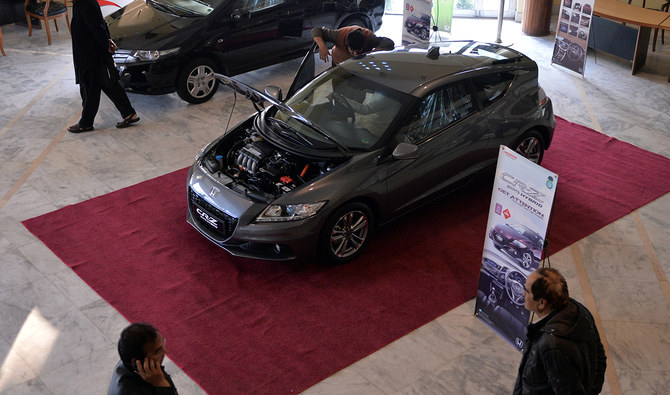

KARACHI: Pakistani car dealers appeared divided on Thursday over a reduction in car prices after the expiry of 100 percent regulatory duty (RD) on the import of vehicles, with some citing depreciation of the local currency against dollar as a “major obstacle” in its way.
Pakistan allowed import of used cars not older than 3 years, and in some cases up to five years older, under the transfer of residence, gift and baggage schemes. The vehicles, mostly imported from Japan, were sold in the local market after payment of duty and taxes.
However, the Pakistani government had in May last year imposed a ban on the import of over 600 luxury and non-essential goods, including cars, cellular phones and home appliances, for 10 months to stop the outflow of dollars. The notification imposing regulatory duties and additional customs duties (ACDs) expired on March 31.
Its expiry rekindled hopes among buyers of a major relief in prices of imported cars of up to 1,800cc and last week, Commerce Minister Naveed Qamar also warned car dealers of strict action if the prices of imported vehicles were not reduced after the removal of the regulatory duty.
But Pakistani car dealers hold different views regarding the price reduction, with a number of them calling the dollar-rupee parity a hurdle to cuts in prices of imported vehicles.
“Prior to the regulatory duty, there were around 300-400 percent duties being charged and the vehicle that would cost Rs1 million had gone up to Rs2 million which led to a business halt,” Mian Shoaib Ahmed, chairman of All Pakistan Car Dealers and Importers Association, told Arab News.
“When the RD was imposed, the dollar rate was Rs170 and now as they have removed the RD, dollar rate is Rs285 so ultimately there seems no price difference as the [cost] price has increased,” he said, terming last week’s warning by the commerce minister a “political statement.”
The Pakistani currency has depreciated by almost 30 percent since May 2022, when the government had banned imports of luxury items.
Ahmed said there was a shortage of cars due to the demand-supply gap in the market. The competition after the arrival of new shipments would determine fresh prices of imported vehicles, he added.
“It is premature to say that there would be any impact on the prices of vehicles or they will be reduced,” Ahmed said.
“In the next two months, when shipments will arrive that usually takes 6-8 weeks, the impact would be known provided the currency exchange remains at the current level. Otherwise, the prices will increase.”
Hajji Muhammad Shahzad, chairman of All Pakistan Motor Dealers’ Association, also downplayed the possibility of price reduction due to the prevailing rupee-dollar parity.
“For instance, eight months back the purchasing price of a vehicle was $5,000 that would translate into around Rs1 million but now it has gone up to Rs1.5 million, so where this half a million rupees of impact would go,” Shahzad asked.
He conceded that prices of vehicles should reduce, but insisted that the rupee-dollar parity was the main hurdle in the way of major price cuts.
“Prior to the imposition of RD, Mira (one of the most sought-after Japanese used cars in Pakistan) was available for Rs2.2 million, but after the imposition of RD the price jumped to Rs3.2 million,” Shahzad said.
“The price should be reduced by Rs1 million but as the dollar rate has gone up, the price cut may be around Rs100,000 or Rs200,000 after arrival of new shipments.”
Shahzad categorically ruled out any major price cuts in response to removal of RD.
“Rs0.8 to Rs1 million price reduction that is in the minds of the people would not occur due to the currency depreciation,” he said.
While car dealers dismiss the possibility of significant cuts after the removal of duties, some importers remain optimistic about a considerable reduction in prices.
“Prices of below 1,000cc cars will be reduced by around Rs0.8 million, while those of above 1,000cc vehicles will be reduced by around Rs1.2 million,” Mehmud Baig, an importer and dealer, told Arab News.
Baig said the price reduction would have been around Rs1 million for small cars and Rs2 million for bigger vehicles, had the local currency not depreciated significantly.
Pakistan has been facing an economic meltdown, with its foreign exchange reserves depleting, currency weakening and inflation hovering at historic highs.
Pakistani consumers said the weak price-fixing and enforcement mechanism had led to the creation of “cartels” in the country and they were openly challenging the state’s writ.
“The government must discourage cartelization in the country and ensure that full benefit of the measures, taken to cut prices of vehicles as well as other commodities, are passed on to consumers,” said Mazhar Ali, a consumer and researcher.


