

To tackle militancy in southern Pakistan, police teach ‘aggressive’ dogs new tricks 

The still image taken from a video shows attack dogs during training at the Sindh police canine unit in Karachi, Pakistan on May 19, 2023. (AN Photo)
Short Url
Updated 19 May 2023
Follow

To tackle militancy in southern Pakistan, police teach ‘aggressive’ dogs new tricks 

  • Police in southern Sindh province are training attack dogs to be first responders in militant attacks 
  • Training attack dogs to deal with militants can be a challenging and dangerous task, says instructor 

KARACHI: The next time a militant attack takes place in Pakistan’s southern Sindh province, the assailants may be in for a surprise. Rather than an armed law enforcer, the attacker may have to contend with something far more intimidating and ferocious: an attack dog. 

Four law enforcers and one civilian were killed when Pakistani Taliban militants stormed a tightly guarded police compound in the country’s southern port city of Karachi in February. A gunbattle raged for several hours as security forces went floor-to-floor, chasing the militants. 

The incident, unfortunate as it was, got Sindh Police thinking and helped them come up with an ingenuine way to tackle militants: using attack dogs as first responders. 

“Previously, we [Sindh Police] only had sniffer dogs but after the KPO [Karachi Police Office] attack, our Inspector General of Police introduced the policy to purchase aggressive dogs and utilize them,” Irfan Mukhtar Bhutto, senior superintendent of police (SSP) of the Special Security Branch, told Arab News. 
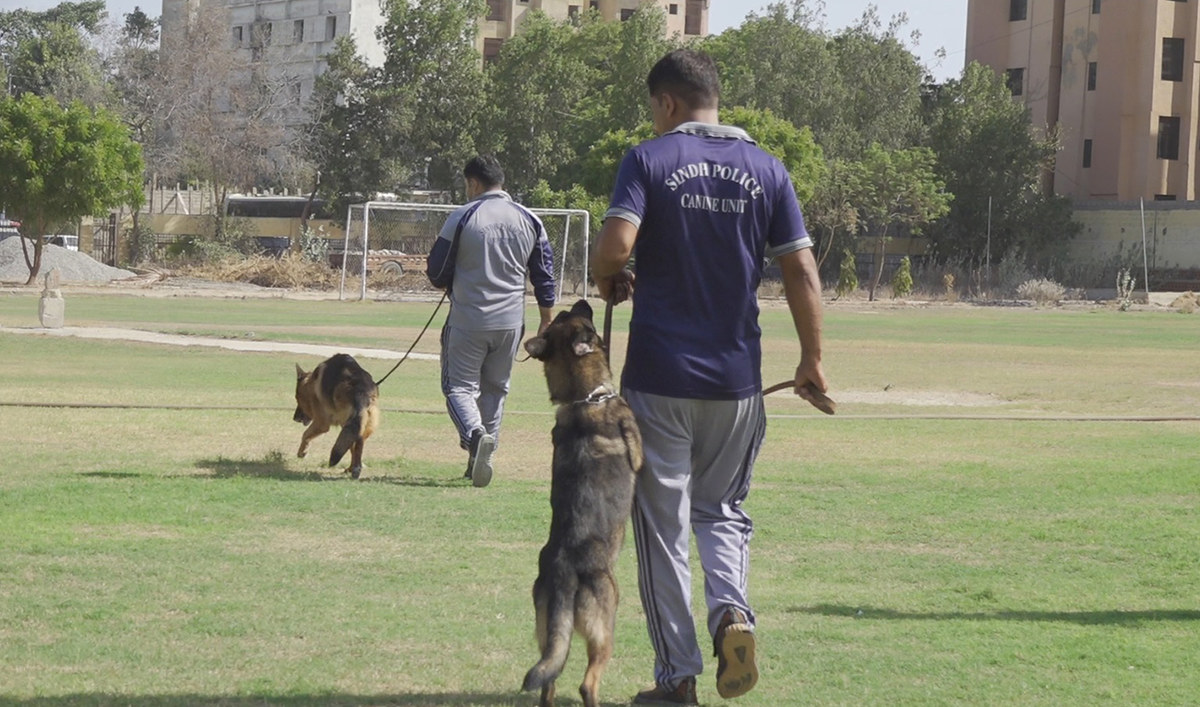


The still image taken from a video shows attack dogs during training at the Sindh police canine unit in Karachi, Pakistan on May 19, 2023. (AN Photo)

The Special Security Branch of Sindh Police handles counterterrorism and security operations. 

“We have purchased Rottweiler dogs, Alsatians [German Shepherds], and Belgian Shepherds,” Bhutto said, adding that while Sindh Police’s Canine Unit currently has 37 dogs, they intend to buy an additional 150 more. 

The attack dog may be the first responder to an attack but won’t certainly be the only one heading into combat. 

“If a terrorist attacks, we will release our dog first [to attack him] with a sniper who will hit the terrorist,” Bhutto explained. 

So how are the dogs selected? 

“Just as we select soldiers, we also choose dogs based on their wisdom, capabilities, sharpness of mind, activeness, and intelligence,” Shahzeb Khan, an instructor at Sindh Police’s Canine Unit, told Arab News. 

The first step involves building a relationship with the dog, Khan says, adding that once the dogs reciprocate that love, they are introduced to obedience training and later, to technical training. Each dog has a trainer, or handler, who is responsible for its food, grooming, bathing, and other activities. 

The training, though, can not only be tricky but also dangerous. 

“Undoubtedly, it is a challenging task to establish a framework for an animal, to make it obedient, especially when dealing with these ferocious creatures that have aggression embedded in their psychology,” Khan said. 

He added that while training a “war dog,” a trainer has to act as an attacker and a target, which results in sustaining injuries often. 

The dogs are trained in a way that allows them to tap into their effective sense of smell and hearing to neutralize the target, Khan said. 

“Different buildings consist of various rooms, and we are unaware of the exact location or hiding spots of our enemies,” Khan said. “However, these [dogs] can detect their presence using their [sense of] hearing and smell. They will stealthily launch an attack at that precise location,” he explained. 

Khan, however, admitted that a dog can’t protect itself like a human and that a canine’s life and response depend upon the handler on duty with it. 

“If he [the dog] is advancing to protect us, it is our duty to ensure its protection and provide it with support at the back,” he said. 

“They have one thing in mind: the owner has given an order, and we have to complete the task.” 


Peace can only prevail if Afghanistan renounces support for ‘terrorism’— Pakistan defense chief

Updated 12 sec ago
Follow

Peace can only prevail if Afghanistan renounces support for ‘terrorism’— Pakistan defense chief

  • Pakistan’s chief of defense forces visits South Waziristan district bordering Afghanistan
  • Pakistan says has killed 481 Afghan Taliban operatives since clashes began last Thursday

ISLAMABAD: Pakistan’s Chief of Defense Forces Field Marshal Syed Asim Munir said on Wednesday that peace with Afghanistan can only prevail if Kabul renounces support for “terrorism” and “terrorist” organizations, the military’s media wing said as the two countries remain locked in conflict. 

Fighting between the two neighbors, the worst in decades, broke out last Thursday night after Afghan forces attacked Pakistan’s military installations along their shared border. Afghanistan said its attacks were in response to earlier airstrikes by Pakistan against alleged militant hideouts in its country. 

Pakistan accuses Afghanistan of sheltering militant outfits such as the Tehreek-e-Taliban Pakistan (TTP) on its soil who have launched attacks against Pakistani civilians and security forces in recent years. Kabul denies the allegations. 

Munir visited Wana town in Pakistan’s South Waziristan district to review the security situation and troops’ operational preparedness at the Afghan border, the Pakistani military’s media wing said in a statement. 

“The Field Marshal reiterated that peace could only prevail between both sides if the Afghan Taliban renounced their support for terrorism and terrorist organizations,” the Inter-Services Public Relations (ISPR) said. 

The military chief said the use of Afghan soil by militant outfits to launch attacks against Pakistan was unacceptable, vowing that “all necessary measures” would be taken to neutralize cross-border threats. 

During the visit, Munir was briefed by military commanders about ongoing intelligence-based operations and measures being taken by the military to manage the border with Afghanistan.

He was also briefed about “Operation Ghazab Lil Haq” or “Wrath for the Truth,” the name Pakistan has given to its military operation against Afghan forces, the ISPR said. 

The Pakistani military chief spoke to troops deployed in the area, praising their vigilance, professional conduct and high morale, the ISPR said. 

Pakistan’s Information Minister Attaullah Tarar said on Wednesday that the military has killed 481 Taliban operatives, injured more than 690 and destroyed 226 Afghan checkposts since clashes began. 

Arab News has been unable to verify claims by both sides about the damages they claim to have inflicted on each other.

Afghanistan has signaled it is open for dialogue but Pakistan rejected the offer, saying it would continue its military operations till its objectives were achieved. 

Since the conflict began, diplomatic efforts have intensified with several countries, including global bodies such as the European Union and United Nations, urging restraint and calling for talks.

Turkish President Recep Tayyip Erdogan told Pakistani Prime Minister Shehbaz Sharif that ⁠Ankara would help ⁠reinstate a ceasefire, the Turkish Presidency said on Tuesday, as other countries that had offered to mediate have since been hit by the conflict in the Gulf.