


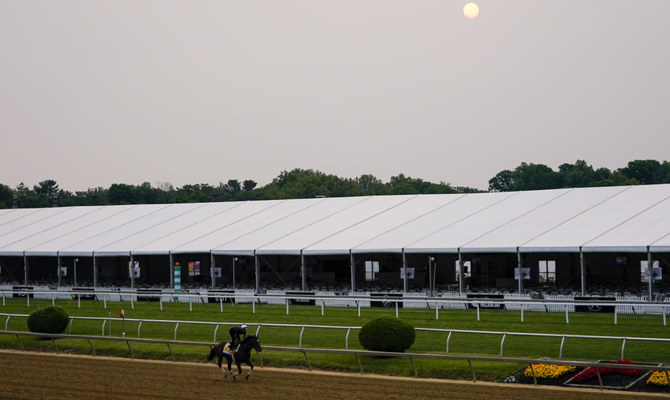
BALTIMORE: Brad Cox sent 21 horses he trains to Churchill Downs in the days leading up to the Kentucky Derby and all came back from their races healthy with no problems.
Still, Cox is worried. Seven horses died in a span of 10 days at and around the famous track, thrusting horse racing into a familiar, negative spotlight during Triple Crown season. The sport, which is as popular as ever, is facing intense scrutiny over the health of its animal athletes.
“The sales are strong, and the purses are strong, people are still involved — hopefully we can keep it going,” Cox said this week while preparing for the Preakness. “I think people are doing a good job of trying to keep their horses sound, healthy, happy and performing well. That’s the main thing. I’ve got a lot of questions about Derby week and what all happened there.”
He’s not alone. Industry leaders say racing is at a critical juncture, even though horse deaths are at their lowest number since they began being tracked, money is flowing and new national medication and anti-doping rules are set to take effect next week. The hope is to clean up the sport, making it fairer for those involved and perhaps more acceptable to skeptics.
“When it comes to passion about the horse and all of that, we’ve got a really vibrant industry,” Horseracing Safety and Integrity Authority CEO Lisa Lazarus told The Associated Press. “We’re at a crossroads because of essentially what happened in the leadup to the Derby weekend, on Derby day, and obviously incidents over the last few years that shows that there’s nothing more important for the sustainability of our industry than ensuring that we’re taking the best care possible of our horses and the people who ride them.”
The authority (HISA) is a federally mandated agency established to set uniform regulations across the US. Its racetrack safety program has been in place since July 1, and the Antidoping and Medication Control Program that was delayed and challenged in court is set to start Monday.
In the big picture, it may already be working.
According to the Jockey Club’s Equine Injury Database, the rate of 1.25 fatalities per 1,000 starts (or fewer than 13 horses out of each 10,000 who race) in 2022 is the lowest since record-keeping of that number began in 2009. According to University of Bristol professor Tim Parkin, the final six months of last year was “the safest six-month period on record.”
Those in charge of the sport understand the progress that has been made fades into the background when there is a high-profile cluster of deaths like those in Kentucky this spring, at Santa Anita in California in 2019 and at Aqueduct in New York in 2011-12.
National Thoroughbred Racing Association president and CEO Tom Rooney said he knows there is a culture of accepting the risk of injuries and deaths inherent in horse racing but acknowledged the need to address the criticism.
“With the advancements in social media and cable news, every single fatality is probably more pronounced now than it ever has been,” Rooney said. “There’s nowhere for us to hide, nor should there be, except to get better and to keep getting better and to show that we have done everything that we can absolutely minimize the risk to horses.”
Craig Bernick, an owner and breeder at Glen Hill Farm in Florida who is also part of the Thoroughbred Idea Foundation, said infighting within the business — and “too many lawyers” in important positions — has prevented real change. Still, he pointed out, “There have been improvements out of most of (horse racing’s) catastrophes.”
A task force spurred by the deaths at Aqueduct more than a decade ago led to a series of reforms in the Mid-Atlantic region that reduced fatalities there by 35 percent. New safety measures have also been put in place since the deaths at Santa Anita four years ago.
Dr. Dionne Benson has been at the forefront of many of those steps since taking over in the aftermath of the Santa Anita situation as chief veterinary officer for the Stronach Group, which owns and operates tracks in California, Florida and Maryland — the latter of which annually hosts the Preakness at Pimlico Racecourse in Baltimore. Benson and Stronach’s 1/ST Racing chief operating officer, Aidan Butler, point to the company’s investment in standing positron emission tomography machines as one innovation that has reduced fatalities.
“It basically allows us to observe injuries to a place on their leg where it had never been seen before and was responsible for quite a few of the fractures that we’d had historically,” Benson said.
Racing fatalities at Santa Anita are down 79 percent from 2019 to 2022. They’re down more than 85 percent at Pimlico, where Kentucky Derby winner Mage on Saturday is favored to win the second Triple Crown race of the year.
Among the preventative measures in place in Baltimore is a series of pre-race drug tests and checkups by independent veterinarians. Benson and a surgeon will look at each Preakness horse and those in a couple of other big races this weekend, and a Maryland Racing Commission vet must clear each one to run.
“There’s an actual formulated set of protocols and operating principles. They work, and they work really, really well,” Butler said. “For the big days, obviously they’re in effect. But then growing to all of our racing jurisdictions to make sure things that work are implemented far and wide and then hopefully other racing jurisdictions that aren’t anything to do with us, per se, can adopt them and see what’s working and make the industry safe across the board.”
Safer and more equitable. Before Rooney took over as head of the NTRA, he recalled, a well-known trainer pleaded with him to make sure racing rules were the same from Florida to New York to Kentucky and beyond. HISA, which is the first national commission in the sport’s long history, aims to do that; Lazarus said the medication and doping regulations will be stricter than any currently in place.
There has been pushback, but Lazarus said she has noticed more acceptance since the deaths in Kentucky. Given that race purses are at an all-time high and almost $25 billion was bet on horse racing in the US over the past two years, there’s incentive for agreement to grow the sport
“If we can make the sport stronger, if we can make the product better by wrapping it in safety and integrity, there’s no question that it’s going to prosper financially,” Lazarus said. “I think we’re really going to be able to show that kind of secure industry where the public has trust and feels good that the horses are taken well care of, it’s going to mean more people invest in horse racing.”


