
ISLAMABAD: Prominent legal experts and a leading rights group on Wednesday urged the Pakistani government to refrain from trying civilians involved in the recent countrywide protests in military courts, saying that the process remains "shrouded in mystery" and the scope of the application of military laws on civilians is "very limited."
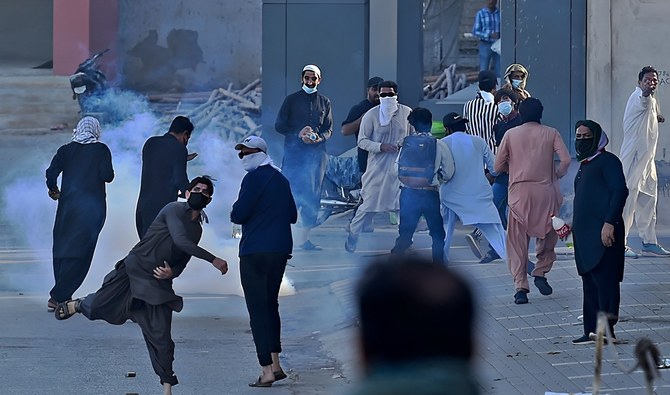
Nationwide protests saw military installations in Pakistan's Punjab and Khyber Pakhtunkhwa provinces attacked by hundreds of supporters of former prime minister Imran Khan last Tuesday, after he was arrested from an Islamabad court on graft charges.
Angered by the protests which saw a state broadcaster's building vandalized, buses smashed, a top army official’s house ransacked and other assets attacked, Pakistan's military announced earlier this week it would try protesters under military laws.
“The scope of application of military laws on civilians essentially remains very limited and cannot be supported as the whole process remains shrouded in mystery,” Barrister Reza Ali told Arab News, referring to earlier judgments of the Supreme Court and the high courts regarding the Army Act.
Speaking about the application of military laws on civilians, Ali said the JAG (Judge, Advocate, General) branch of the armed forces can register a case against a civilian in a police station under the Army Act and the Official Secrets Act to take them into custody for trial.
Reza said a civilian could be tried in a military court where a “clear nexus of civilians with armed forces” is established. Even then, he said, the higher judiciary can intervene to ensure a free trial is conducted and justice is done.
“In principle, we oppose the trial of civilians in military courts because their application remains largely limited to persons of the armed forces,” he said. “Civilians should be tried in normal courts even for serious offenses like terrorism, for transparency.
“The procedure and process of the military courts to try a civilian is better known to the army itself as the trials are held behind closed doors,” he said.
In military trials in Pakistan, civilians are not given access to courts, and even the accused are denied some of their basic rights such as hiring a lawyer of their choice.
Irfan Qadir, a former attorney general of Pakistan, said military courts can try those involved in attacks on military installations but added that the accused had the legal right to appeal against convictions in a higher court.
“Protesters got into army buildings, torched military installations, and threatened senior army officers during the attack, therefore it is quite natural to try them in military courts,” he told Arab News.
“Military courts already exist under the Army Act, and there is no need to get parliamentary approval for any fresh prosecutions,” he said, admitting that the scope of military courts was limited in trying civilians.
Advocate Ali Hussain Bhatti said trying civilians under military laws would damage Pakistan’s reputation worldwide, adding that therefore, the accused should be tried by non-military courts.
“Proceedings in military courts always remain questionable, therefore it is not advisable to try civilians there,” he told Arab News. “Military courts are constituted specifically under the Army Act to prosecute armed forces personnel.
"Their application on the civilians doesn’t seem logical at all.”
Rights groups have also expressed alarm over the military's announcement to try supporters of ex-PM Khan under military laws. Amnesty International on Tuesday described it as a "purely intimidation act" that is contrary to international law.
The Human Rights Commission of Pakistan (HRCP) said trying civilians under military laws would be against fundamental rights, due legal process, and transparency.
“We believe that in military courts confessions are obtained through coercion and the trial remains largely unfair and biased,” Farah Zia, a director at the HRCP, told Arab News.
“Civilians should be tried for any crime in normal courts and under ordinary laws which remain well defined and cover all crimes including terrorism,” she added.