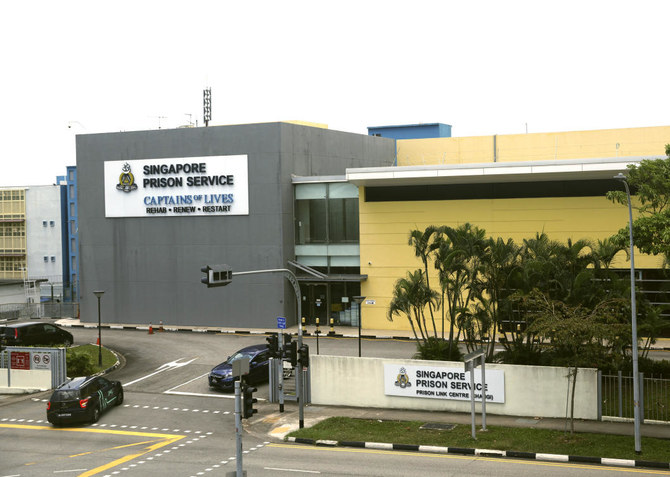
KUALA LUMPUR: Singapore on Wednesday hanged another citizen for trafficking cannabis, the second in three weeks, as it clung firmly to the death penalty despite growing calls for the city-state to halt drug-related executions.
The 37-year-old man was executed after his last-ditch bid to reopen his case was dismissed by the court Tuesday without a hearing, said activist Kokila Annamalai of the Transformative Justice Collective, which advocates for abolishing the death penalty in Singapore.
The man, who was not named as his family has asked for privacy, had been imprisoned for seven years and convicted in 2019 for trafficking around 1.5 kilograms of cannabis, she said. His bid to reopen his case was based on DNA evidence and fingerprints that tied him to a much smaller amount, which he admitted to possessing, but the court rejected it, she added. Under Singapore laws, trafficking more than 500 grams of cannabis may result in the death penalty.
“If we don’t come together to stop it, we fear that this killing spree will continue in the weeks and months to come,” she said. Some 600 prisoners are on death row in the city-state, mostly for drug-related offenses, she added.
Singapore executed 11 people last year for drug offenses after a two-year hiatus due to the COVID-19 pandemic. The hanging of one particular Malaysian believed to be mentally disabled sparked an international outcry and brought the country’s capital punishment under scrutiny for flouting human rights norms.
Three weeks ago, Singaporean Tangaraju Suppiah, 46, was hanged in the first execution this year for trafficking 1 kilogram of cannabis although he was not caught with the drugs. Prosecutors said phone numbers traced him as the person responsible for coordinating the delivery of the drugs, which he denied.
Human rights groups, British mogul Richard Branson and the United Nations have urged Singapore to halt executions for drug-related offenses as increasing evidence shows the death penalty is ineffective as a deterrent. But Singapore authorities insist that all prisoners get due process of law and that capital punishment remains “part of Singapore’s comprehensive harm prevention strategy which targets both drug demand and supply.”
Apart from Singapore, Amnesty International said Indonesia carried out 112 drug-related executions last year by firing squad after a hiatus since 2016. In contrast, neighboring Thailand has legalized cannabis while Malaysia has ended the mandatory death penalty for serious crimes.

Singapore hangs second citizen for trafficking cannabis despite calls to halt executions
Short Url
https://arab.news/w45xn
Singapore hangs second citizen for trafficking cannabis despite calls to halt executions
- Man had been imprisoned for seven years and convicted in 2019 for trafficking around 1.5 kilograms of cannabis
- Singapore executed 11 people last year for drug offenses after a two-year hiatus due to the COVID-19 pandemic
Cambodia demands Thailand withdraw troops, week into border truce
PHNOM PENH: Cambodia called on neighboring Thailand on Saturday to pull out its forces from areas Phnom Penh claims as its own, one week since a truce halted deadly clashes along their disputed border.
The decades-old dispute between the Southeast Asian neighbors erupted into military clashes several times last year, with fighting in December killing dozens of people and displacing around one million on both sides.
The two countries agreed a truce on December 27, ending three weeks of clashes.
Cambodia says that during that period, Thailand seized several areas across four border provinces.
In a statement on Saturday, Phnom Penh’s foreign ministry demanded the withdrawal of “all Thai military personnel and equipment from the territory of the Kingdom of Cambodia to positions fully consistent with the legally established boundary.”
The Thai army has rejected claims it had used force to seize Cambodia territory, insisting its forces were present in areas that had always belonged to Thailand.
The Cambodian foreign ministry also called on Thailand to immediately end “all hostile military activities” along the frontier and “within Cambodian territory.”
The two nations’ border conflict stems from a dispute over the colonial-era demarcation of their 800-kilometer (500-mile) border, where both sides claim territory and centuries-old temple ruins.
On Friday, Cambodia’s Information Minister Neth Pheaktra accused Thailand of launching the “illegal annexation” of the border village of Chouk Chey.
The Thai army disputed Phnom Penh’s narrative, and Prime Minister Anutin Charnvirakul said his country “has never breached another country’s sovereignty and has acted in line with international regulations.”
Anutin was speaking on Friday while visiting troops deployed to the border province of Surin.
The decades-old dispute between the Southeast Asian neighbors erupted into military clashes several times last year, with fighting in December killing dozens of people and displacing around one million on both sides.
The two countries agreed a truce on December 27, ending three weeks of clashes.
Cambodia says that during that period, Thailand seized several areas across four border provinces.
In a statement on Saturday, Phnom Penh’s foreign ministry demanded the withdrawal of “all Thai military personnel and equipment from the territory of the Kingdom of Cambodia to positions fully consistent with the legally established boundary.”
The Thai army has rejected claims it had used force to seize Cambodia territory, insisting its forces were present in areas that had always belonged to Thailand.
The Cambodian foreign ministry also called on Thailand to immediately end “all hostile military activities” along the frontier and “within Cambodian territory.”
The two nations’ border conflict stems from a dispute over the colonial-era demarcation of their 800-kilometer (500-mile) border, where both sides claim territory and centuries-old temple ruins.
On Friday, Cambodia’s Information Minister Neth Pheaktra accused Thailand of launching the “illegal annexation” of the border village of Chouk Chey.
The Thai army disputed Phnom Penh’s narrative, and Prime Minister Anutin Charnvirakul said his country “has never breached another country’s sovereignty and has acted in line with international regulations.”
Anutin was speaking on Friday while visiting troops deployed to the border province of Surin.
© 2026 SAUDI RESEARCH & PUBLISHING COMPANY, All Rights Reserved And subject to Terms of Use Agreement.