

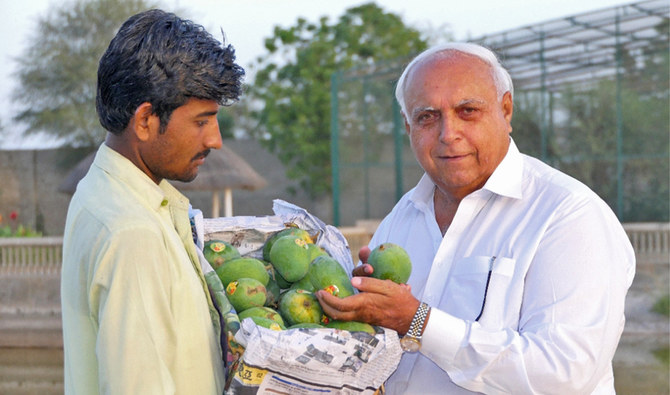

UMERKOT, Sindh: A Pakistani agriculturalist has set up a genome garden where he is cultivating 250 varieties of mango with the aim of facilitating research about the suitability of different types of the fruit and devising more practical strategies to meet its demand in the local and international markets.
Pakistan is the world’s fifth-largest producer of mangoes after India, China, Thailand and Indonesia, with annual harvests of around 1.8 million tons. While most of the produce is consumed locally, it is also one of the top exporters of the succulent fruit, especially to the Middle East, UK, US and some European Union (EU) countries.
Now, Mir Amanullah Khan Talpur, a 70-year-old grower from Sindh’s Umerkot district, believes his project could hold the key for future mango producers and traders.
“As per my knowledge, this is one of the unique [mango] genome gardens [in Pakistan],” he told Arab News at the site of his project. “We will keep the data of each variety of the plant so that our future generations can know which variety is suitable and what is its performance.”

The picture taken on May 8, 2023, shows farmers working at a mango genome garden in Morjhango farms in Sindh's Umerkot district. (AN photo by Zulfiqar Kunbhar)
Talpur has collected 95 varieties so far, including 35 imported from abroad, and his target is to plant 250 varieties by the end of the year. The rationale behind the project is to gather diverse mango varieties from different countries, provinces, and local selections, known as chance seedlings.
The project was launched in March 2021 and covers seven acres of land. While some plants have already been grafted, others are still awaiting the process. Talpur aims to compile the results within three years and preserve the findings for future generations of farmers.
His genome garden includes exotic varieties of mangoes such as Thailand’s Mahachanok, Japan’s Miyazaki, India’s Noor Jehan and Anmol, the Philippines’ Rainbow and Carabao, and Australia’s Sensation.
“Miyazaki is among the most expensive mangoes in the world,” Talpur said. “It is about Rs400,000 [$1,400] per kilogram. It is a Japanese variety. Other countries have also developed it so we have brought it here for its future farming.”

A worker wraps a scion of a new mango variety in Morjhango farm in Umerkot district, Sindh on May 08, 2023. (AN photo by Zulfiqar Kunbhar)
Talpur’s farm is located on the edge of the Thar desert, providing a distinct sub-climate pocket with a unique system and weather conditions. He said the EU had conducted research on mangoes from this region and granted the local Sindhri variety the esteemed status of a superior quality mango.
Experts highlighted the importance of developing new mango varieties that can withstand higher-than-usual temperatures to meet the challenge of climate change.
“The temperature in the mango belt in Sindh nowadays is above 40 Celsius,” Dad Muhammad Baloch, director of the Sindh Horticulture Research Institute in Mirpurkhas, told Arab News. “Some of the local varieties cannot bear so much heat. Therefore, we need more heat-resistant varieties.”
Rana Asif Hayat Tipu, a mango consultant from Multan, said Pakistan’s mango exports are around 120,000 metric tons, with a significant portion going to the Gulf market. He said it was also important to develop varieties which had a greater shelf life.
“Pakistan’s leading variety with maximum shelf life is Sindhri, which is about 18 days. By contrast, if we send our mangoes to South American states, it requires 25 to 30 days,” he told Arab News.
“Pakistan exports its mangoes to Europe only by air. However, if we send it through the sea, we can take our annual mango export to 400,000 metric tons.”
“So, in this scenario we need more research and Amanullah Talpur’s initiative could be vital in this sense,” Tipu added.


