

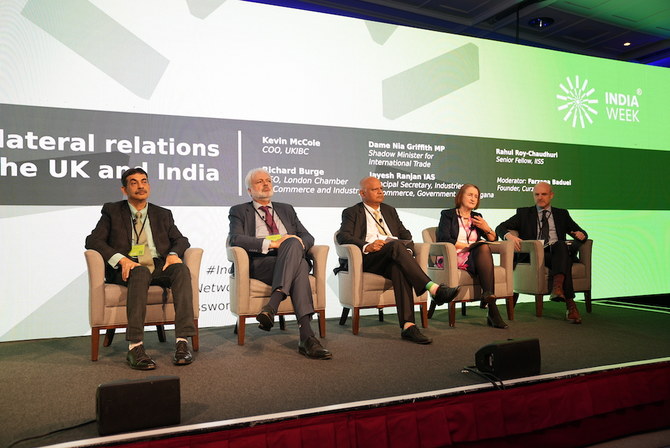
Indian business and policy leaders join Western delegates at inaugural India Week in UK

UK-based global advisory firm the Economic Policy Group organized the inaugural India Week in the UK. (Supplied)
Short Url
Updated 16 May 2023
Follow

Indian business and policy leaders join Western delegates at inaugural India Week in UK

  • Global advisory firm the Economic Policy Group said it organized event to create a global conversation about India’s increasingly important role in the world economy
  • ‘India’s economic-growth rate is the highest among major economies (and its) inflation rate is lower than that of the UK, the US and other major economies,’ the organization said

LONDON: More than 100 business and policy leaders from India joined 800 delegates from the UK, Europe and the US at the inaugural India Week, organizers said on Tuesday.

UK-based global advisory firm the Economic Policy Group said on Tuesday it had staged the event, which took place last week in England, to create a global conversation about the increasingly important role of India in the world economy, and that a wide range of cross-party policymakers had attended.

“Now the most populous country in the world, India’s economic-growth rate is the highest among major economies today (and) India’s inflation rate is lower than that of the UK, the US and other major economies,” the organization said. “As the Western world diversifies its supply chains and geopolitical dependencies away from China, India stands to benefit.”

India Week began on May 7 with an event in Leicestershire, followed by an education conference and awards ceremony in Oxford. It moved to London on May 11 and 12, where the schedule included an “Ideas for India” conference, and two official dinners, one at the House of Commons and the other with K. T. Rama Rao, India’s minister for municipal administration and urban development; industries and commerce; and information technology, electronics and communications of Telangana. Telangana is a state in southern India, the capital of which is Hyderabad.

“KTR, as he is known, highlighted the remarkable progress made by Telangana in the last nine years (and) was optimistic that by doing things right, what China could achieve in 30 years, India could do in less than 20 years,” the Economic Policy Group said.

Rama Rao said: “As India, we have to focus on the fundamentals and basics the way Telangana did. We need to focus on the farmer, the youth, while creating a future that is based in innovation and making India a leader in the fourth Industrial Revolution.”

During the Telangana delegation’s visit to the UK for the event, Rama Rao and Anthony McCarthy, chief information officer of the London Stock Exchange Group, signed a memorandum of understanding for the establishment of a Technology Center of Excellence in Hyderabad expected to create up to 1,000 jobs.

Nigel Huddleston, the British minister of state for international trade, said he was “delighted to speak to our friends from India during India Week and highlight how a free-trade agreement can benefit both nations.”

He added: “A UK-India trade deal is a huge opportunity for both sides, and could boost our £36 billion ($44.9 billion) trading relationship and pull down barriers to trade.”

Ruth Cadbury, Labour’s shadow minister for international trade, said: “The conference showed the close links between our two countries and the important work we can do around energy security and trade.”

Pratik Dattani, the managing director of Economic Policy Group, said: “India is the world’s largest democracy, most populous country and has the fastest economic growth rate among major economies.

“During India Week, we saw interest from governments from across India in engaging foreign investors to bring new ideas, innovation and investment into their cities.”


Shamima Begum’s case revived after top European court’s intervention

Shamima Begum left east London aged 15 and traveled to Daesh-held territory in Syria in 2015. (File/AFP)
Updated 11 sec ago
Follow

Shamima Begum’s case revived after top European court’s intervention

  • European Court of Human Rights challenges British govt’s citizenship deprivation order
  • Begum, 26, left London as a teenager to marry a Daesh fighter, with concerns she was trafficked

LONDON: The longtime appeal by Shamima Begum to return to the UK has been revived after the European Court of Human Rights challenged the British government’s block on her return.

The 26-year-old, who left east London aged 15 and traveled to Daesh-held territory in Syria in 2015, had her British citizenship stripped by the then home secretary, Sajid Javid, The Times reported.

The Strasbourg court’s intervention means the UK must now consider if it acted unlawfully under the framework of the European Convention of Human Rights in stripping her citizenship in 2019.

Begum traveled with two friends to Syria. There, she became a child bride to Dutch national Yago Riedijk and had three children who all died as infants.

The court is examining whether the 2019 decision breached the ECHR’s Article Four, which prohibits slavery, servitude and forced labor.

As part of the examination, it could be found that the UK failed in its duty to identify Begum as a potential victim of trafficking and protect her from harm.

Begum’s journey to Syria made national headlines in the UK. The Times newspaper later discovered her whereabouts at a prison camp in Syria operated by Kurdish security forces, where she remains today.

In stripping her citizenship, Javid said the decision was “conducive to the public good.”

He also argued she was eligible for Bangladeshi nationality through her parents, to avoid rendering her stateless.

However, Bangladesh has said repeatedly that Begum is not a citizen of the country.

Begum’s lawyers, from the firm Birnberg Peirce, filed a submission to the Strasbourg court which argued that the UK failed to ask fundamental questions before stripping her citizenship, including concerns over child trafficking.

Gareth Peirce said the UK could now confront previously ignored questions as a result of the court’s intervention, providing “an unprecedented opportunity.”

She added: “It is impossible to dispute that a 15-year-old British child was lured and deceived for the purposes of sexual exploitation.

“It is equally impossible not to acknowledge the catalogue of failures to protect a child known to be at risk.”

The Strasbourg court’s move meant that it was “impossible now not to have real hope of a resolution,” she said, adding that the Begum case raised profound questions about the UK’s responsibility to victims of grooming and trafficking.

Despite years of litigation, Begum has failed to overturn the citizenship deprivation order. She has stated her desire to return to Britain.

In 2020, the Special Immigration Appeals Commission found that conditions in the camp where she is held, Al-Roj, were inhuman and degrading, but that national security considerations prevented any change to her case.

Later, the Supreme Court ruled that Begum was ineligible to return to Britain to take part in the appeal against her citizenship deprivation.

The Strasbourg court could reject appeals by Begum’s lawyers after considering the UK Home Office’s response to its questions.

If the latest appeal is upheld, however, ministers would have to “take account” of the court’s judgment. The court’s rulings are technically binding but lack an enforcement mechanism.

The Strasbourg court is now set to consider written submissions from both sides before deciding whether the case should proceed to a full hearing. A final judgment could take many months.

A Home Office spokesman said: “The government will always protect the UK and its citizens. That is why Shamima Begum — who posed a national security threat — had her British citizenship revoked and is unable to return to the UK.

“We will robustly defend any decision made to protect our national security.”

Maya Foa, CEO of Reprieve, a charity that has campaigned for the return of women and children from Syria, said: “This case only reached the European court because successive UK governments failed to take simple steps to resolve a common problem.

“While our security allies have all been bringing their people home, Britain has been burying its head in the sand. Casting British men, women and children into a legal black hole is a negligent policy that betrays a lack of faith in our justice system.”