

Pakistan says Lahore OIC trade fair to provide 'great opportunity' for local businesses and entrepreneurs

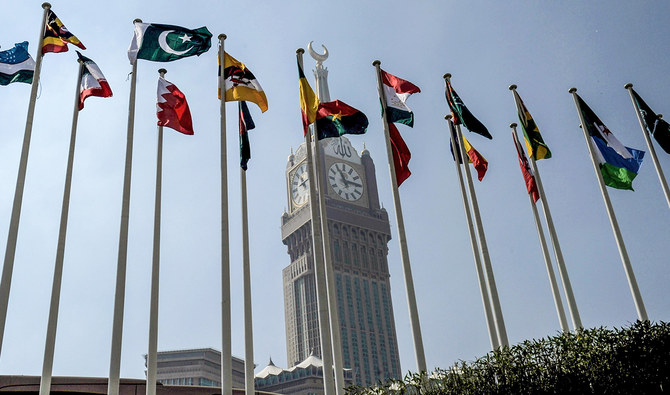
A picture taken on November 17, 2016 shows the national flags of the members of Organisation of Islamic Cooperation (OIC) states flying in front of the clock of the Abraj al-Bait Towers which overlooks the Grand Mosque in the holy city of Mecca. (AFP/File)
Short Url
Updated 16 May 2023
Follow

Pakistan says Lahore OIC trade fair to provide 'great opportunity' for local businesses and entrepreneurs

  • The 18th edition of the annual OIC Trade Fair will take place in Lahore from June 16 till June 18 
  • Official says event will help businessmen from different countries showcase products, services

ISLAMABAD: Pakistan’s permanent representative to the Organization of Islamic Cooperation (OIC) said on Tuesday the upcoming OIC Trade Fair in Lahore would not only unveil lucrative business opportunities for businesses and entrepreneurs, but also highlight the Islamic world’s economic potential. 

The is the 18th edition of the OIC Trade Fair, scheduled to take place in the eastern Pakistani city of Lahore from June 16 to June 18. The last edition of the Islamic countries’ trade event was held in Dakar, Senegal in June last year.

With a rich history of showcasing economic prowess and cultural diversity of participating member countries, the OIC Trade Fair has become a significant platform for fostering trade relations and promoting international cooperation. 

“The OIC trade fair aims to highlight the Islamic world’s economic potential and would provide a platform for businesses and entrepreneurs to showcase their products and services,” Fawed Sher, Pakistan’s permanent representative to the OIC, told Arab News over the phone from Jeddah. 

He said the event would serve as a forum for networking and exchange of ideas among participants from different countries. 

“We are grateful to the OIC General Secretariat and the Islamic Center for the Development of Trade (ICDT) for their support in organizing the Lahore fair and look forward to welcoming participants from across the Islamic world,” Sher added. 

Hamzah Gilani, a spokesperson for the Pakistani consulate in Jeddah, said the much-anticipated event in Lahore would provide trade and investment opportunities to the participating countries. 

“It will also provide a great opportunity for Pakistani businesses to showcase their products and services to a wider audience,” Gilani told Arab News. 

He encouraged all interested parties to participate in the event and take advantage of the many opportunities it would present for businesses across the OIC member states. 


At UNSC, Pakistan warns competition for critical minerals could fuel global conflict

Updated 6 sec ago
Follow

At UNSC, Pakistan warns competition for critical minerals could fuel global conflict

  • The demand for critical minerals has surged worldwide due to rapid expansion of electric vehicles, advanced electronics and clean energy technologies
  • Pakistan’s representative says all partnerships in critical minerals sector must be ‘cooperative and not exploitative’ and respect national ownership

ISLAMABAD: Ambassador Asim Iftikhar Ahmad, Pakistan’s permanent representative to the United Nations (UN), has warned that intensifying global competition over critical minerals could become a new driver of global conflict, urging stronger international cooperation and equitable access to resources vital for the world’s energy transition.

The warning comes as demand for critical minerals and rare earth elements surges worldwide due to the rapid expansion of electric vehicles, advanced electronics and clean energy technologies, with governments and companies increasingly competing to secure supply chains while raising concerns that this may lead to geopolitical rivalries in the coming years.

Speaking at a Security Council briefing on ‘Energy, Critical Minerals, and Security,’ Ahmad said experience showed that the risks of instability increased where mineral wealth intersected with weak governance, entrenched poverty and external interference.

“Access to affordable, reliable and sustainable energy is essential for development, stability and prosperity. The global transition toward renewable energy, electric mobility, battery storage and digital infrastructure has sharply increased the demand for critical minerals,” he said.

“This upsurge has generated new geopolitical and geo-economic pressures. If not managed responsibly, competition over natural resources can affect supply chains, aggravate tensions, undermine sovereignty and contribute to instability.”

In several conflict-affected settings, he noted, illicit extraction, trafficking networks and opaque financial flows have fueled armed conflict and violence, weakened state institutions and deprived populations of legitimate revenues.

“The scramble for natural resources and its linkage to conflict and instability is therefore not new,” Ahmad told UNSC members at the briefing. “Pakistan believes that natural resources must serve as instruments of economic development and shared prosperity, and not coercion or conflict.”

He urged the world to reaffirm the right of peoples to permanent sovereignty over their natural resources, saying all partnerships in the critical minerals sector must be cooperative and not exploitative, respect national ownership, ensure transparent contractual arrangements and align with host countries’ development strategies.

“In order to prevent the exploitation of mineral-producing countries and regions, particularly in fragile and conflict-affected settings, support their capacity-building for strengthening domestic regulatory institutions, combating illicit financial flows, ensuring environmental safeguards, and promoting equitable benefit-sharing with local communities,” he asked member states.

“Promote equitable participation in global value chains. Developing countries must be enabled to move beyond extraction toward processing, refining and downstream manufacturing. Technology transfer, skills development and responsible investment are essential to avoid perpetuating structural imbalances.”