Saudi deputy interior minister in Pakistan to sign Route to Makkah agreement for Hajj pilgrims 

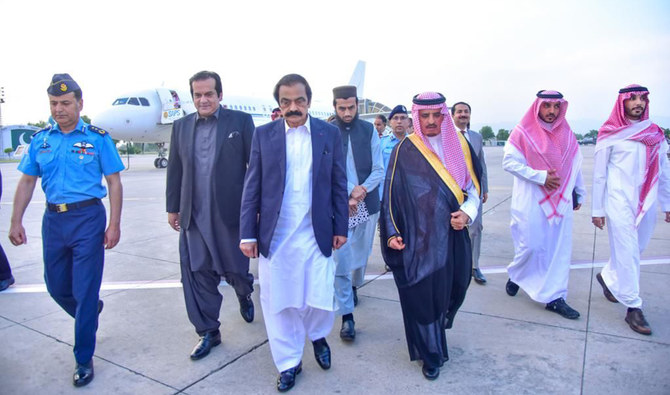
Saudi Deputy Interior Minister Dr. Nasser bin Abdulaziz Al-Daoud (third right) upon his arrival in Pakistan on May 16, 2023. (Photo courtesy: Pakistan Ministry of Interior)
Short Url
Updated 16 May 2023
Follow

Saudi deputy interior minister in Pakistan to sign Route to Makkah agreement for Hajj pilgrims 

  • Under the project, Hajj pilgrims are provided visas, other services at airports of their respective countries 
  • Last year, Pakistani pilgrims traveled through the Makkah Route initiative for the second consecutive year 

ISLAMABAD: Saudi Arabia’s deputy interior minister, Dr. Nasser bin Abdul Aziz Al-Dawood, on Tuesday arrived in the Pakistani capital of Islamabad for the signing of the Route to Makkah project agreement, the Pakistani interior ministry said. 

The Makkah Route initiative is part of Saudi Arabia’s Guests of God Service Program, which King Salman bin Abdulaziz Al-Saud inaugurated in 2019 as part of the Saudi Vision 2030. As per the initiative, Hajj pilgrims are issued visas, and provided other services, such as baggage facilities, at their respective countries’ airports. 

Pakistan’s Interior Minister Rana Sanaullah welcomed the Saudi deputy interior minister upon arrival at the Noor Khan air base on a two-day visit to the South Asian country. 

“During his visit, the Saudi deputy interior minister will sign the agreement of Route to Makkah project,” the Pakistani interior minister said in a statement. 

Hajj is a spiritual journey that every Muslim adult must undertake once in his lifetime to the holy sites in Makkah and Madinah, if they are financially and physically able to do so. It is one of the five pillars of the Islamic faith. 

Last year, Pakistani pilgrims traveled through the Makkah Route initiative for the second consecutive year. The agreement of the program, which also includes Malaysia, Indonesia, Morocco, and Bangladesh, is renewed every year. 

“The Saudi deputy interior minister will also meet Prime Minister Shehbaz Sharif, federal minister for narcotics control and the army chief,” the interior ministry added. 

This year, Saudi Arabia has reinstated Pakistan’s pre-pandemic Hajj quota of 179,210 pilgrims and scrapped the upper age limit of 65. Around 80,000 Pakistani pilgrims are expected to perform Hajj this year under the government scheme, while the rest will be facilitated by private tour operators, according to the authorities. 

Hajj flights from Pakistan to Saudi Arabia will start on May 21 and the last flight carrying pilgrims would leave on June 21, according to the Pakistani religious affairs ministry. 


Pakistan reviews austerity measures amid Middle East crisis, urges strict nationwide implementation

Updated 11 March 2026
Follow

Pakistan reviews austerity measures amid Middle East crisis, urges strict nationwide implementation

  • Deputy Prime Minister Ishaq Dar chairs review meeting of austerity steps
  • Officials briefed on salary cuts, school closures, four‑day week, petrol conservation

ISLAMABAD: Pakistan’s government on Wednesday assessed progress on a sweeping set of austerity measures introduced to mitigate the country’s economic strain from sharply rising global oil prices and supply disruptions linked to the ongoing war in the Middle East.

Prime Minister Shehbaz Sharif this week announced a series of austerity steps, including a four‑day work week for government offices, requiring 50  percent of staff to work from home, cutting fuel allowances for official vehicles by half, grounding up to 60  percent of the government fleet and closing all schools for two weeks to conserve fuel amid the global oil crisis.

The measures were unveiled in response to global oil market volatility triggered by the conflict involving the United States, Israel and Iran, which has disrupted supply routes such as the Strait of Hormuz and pushed crude prices sharply higher, straining Pakistan’s heavily import‑dependent energy sector.

“The meeting stressed the importance of strict and transparent adherence to the austerity measures, promoting fiscal responsibility and prudent use of public resources,” Deputy Prime Minister and Foreign Minister Senator Mohammad Ishaq Dar said in a statement.

He was chairing a meeting of the Committee for Monitoring and Implementation of Conservation and Additional Austerity Measures, constituted under the directions of the PM, bringing together federal and provincial officials to review execution of the broad cost‑cutting plan. 

Dar emphasized the government’s commitment to enforcing the PM’s austerity steps nationwide. The committee’s review also covered reductions in departmental expenditure, deductions from salaries of senior officials earning over Rs. 300,000 ($1,120), and coordination with provincial administrations to ensure uniform implementation of the plan.

Participants at the meeting reiterated that all ministries and divisions must continue strict monitoring and reporting, with transparent oversight mechanisms, as Pakistan navigates the economic pressures from the prolonged Middle East crisis and its fallout on global energy and trade markets.