

Pakistan's equity market down by $77 billion in six years amid enduring political instability

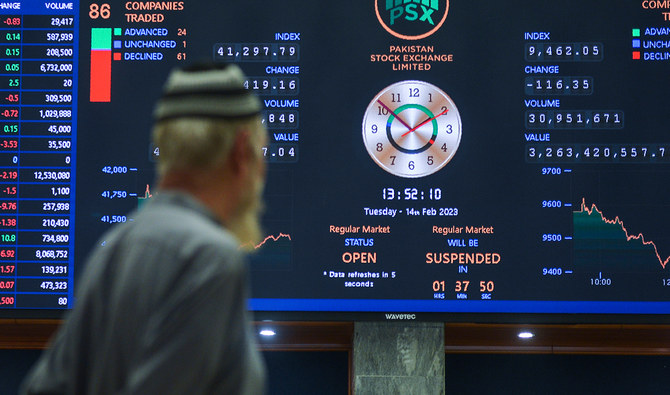
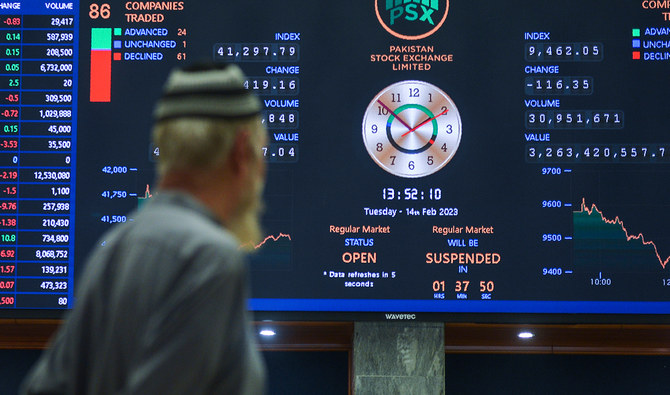
A broker looks at an index board showing the latests share prices at the Pakistan Stock Exchange in Karachi on February 14, 2023. (AFP)
Short Url
Updated 16 May 2023
Follow

Pakistan's equity market down by $77 billion in six years amid enduring political instability

  • Market capitalization of listed companies declined by 37.3 percent since ex-PM Khan’s ouster from power last year
  • Analysts say stocks trading at low multiples, warn of situation where the country may find it difficult to repay its debts

KARACHI: The Pakistan Stock Exchange (PSX) has lost market capitalization by $77.7 billion or 78 percent in the past six years, according to official data, making experts attribute the decline to political instability that led weakened the country’s economic fundamentals.

Pakistan’s equity market made history in May 2017 when benchmark KSE100 index crossed 52,000 points, raising the market capitalization – or the cumulative value of the shares of companies listed on the bourse – to an all-time high of $99.52 billion.

However, this number dropped to $76.30 billion in May 2018 due to the deterioration of political and economic situation ahead of the general elections, with further decline in subsequent years.

“The fall in market capitalization is mainly because of the political instability that badly affected the economic fundamentals of the country because political managers, in order to consolidate their own power in the country, borrowed money,” Muhammad Sohail, the chief executive officer of Topline Securities, said on Tuesday. “Because of this excessive borrowing, Pakistan is now facing a debt repayment crisis.”

The market cap declined further to $47.52 billion in 2019, $40.23 billion in 2020 but jumped to $52.05 billion in 2021 against the backdrop of improving liquidity and macroeconomic indicators.

After the ouster of former prime minister Imran Khan in April 2022, however, the political and economic conditions started deteriorating again, resulting in a decline that took it down to $21.83 billion in the ongoing month.

Samiullah Tariq, research director at the Pakistan-Kuwait Investment Company, said the KSE100 index, which stood at 53,000 in 2017, was now trading around 40,000. He noted the market value determined by PSX capitalization had also lowered in rupee terms since 2017.

“In terms of dollars, the exchange rate was Rs105 [in 2017] and it is now trading at Rs285,” he said. “In terms of dollars, the decline was even more pronounced. Interest rate was around 7.5 percent at that time but now it is about 21 percent.”

Analysts said former prime minister Imran Khan’s Pakistan Tehreek-e-Insaf (PTI) administration could not bring stability to the market in the wake of the 2018 elections, adding the situation exacerbated further due to the delayed International Monetary Fund (IMF) bailout program and the COVID-19 pandemic.

“The change of government in 2018 did not bring any good news to the stock market because the PTI government took more than a year to enter the IMF program and then there was COVID-19 which badly affected the market,” Sohail said.
He maintained the market gradually started improving, but faced another crisis last year when Khan’s administration was brought down in a vote of no-confidence.

“Initially, there were a few problems with the previous government,” he added. “But when things started to stabilize, we had another change of government.”
He noted the political upheavals were followed by a surge in international oil prices.

“The Ukraine war had its own impact on Pakistan economy,” he continued. “That is why the valuation at Pakistan Stock Exchange is now at an all-time low.”

As stocks trade at low multiples, Sohail said Pakistan faced an uncertain political future and external account imbalance which could lead to a situation where the country might find it difficult to repay its debts and default.


Pakistan weighs Trump Gaza board amid expert calls for Muslim allies’ consultations

Updated 7 sec ago
Follow

Pakistan weighs Trump Gaza board amid expert calls for Muslim allies’ consultations

  • Former diplomats warn board could sideline UN, legitimize US unilateral plans
  • Analysts say Pakistan should assert independent positions if it joins the body

ISLAMABAD: Pakistan is weighing an invitation from US President Donald Trump to join a proposed international “Board of Peace” on Gaza, a move that has sparked debate among former diplomats and foreign policy experts who warned Tuesday it could sideline the United Nations and urge Islamabad to consult close Muslim allies.

The White House announced on Friday some members of the board, which is expected to supervise the temporary governance of Gaza under a fragile ceasefire in place since October and continue beyond that transitional phase.

These names included US Secretary of State Marco Rubio, Trump’s special Middle East envoy Steve Witkoff, former British prime minister Tony Blair and Trump’s son-in-law Jared Kushner. Trump himself would chair the board, according to a plan unveiled by the White House in October.

Pakistan’s foreign office confirmed on Sunday that Prime Minister Shehbaz Sharif had also received an invitation to join the proposed body, stressing that “the country will remain engaged with international efforts for peace and security in Gaza, leading to a lasting solution to the Palestine issue in accordance with United Nations resolutions.”

“Since the Trump ‘Board of Peace’ is more like an international NGO now, which would include [Indian Prime Minister Narendra] Modi and [Israel’s Benjamin] Netanyahu, Pakistan should carefully take a decision in consultation with its close Muslim allies like Turkiye, Saudi Arabia, Qatar, Jordan, Egypt and Indonesia, and it should be a joint decision of these countries together,” Former federal minister and analyst Mushahid Hussain told Arab News.

“Otherwise, there is no point in being in the queue just to please Trump,” he added.

Israel and the Palestinian group Hamas have agreed that a Palestinian technocratic administration would operate under the oversight of an international board during a transitional period.

Hussain said that if Pakistan did decide to join the board, it should use the platform to clearly articulate its long-held positions.

“Pakistan should play the role of boldly promoting the right of self-determination of the peoples of Palestine and Kashmir, both occupied territories, and oppose any aggression against Iran, as peace and occupation or aggression cannot coexist,” he said.

International affairs analyst and author Naseem Zehra said Pakistan’s participation could still be justified if it allowed Islamabad to assert independent positions on global conflicts.

“Donald Trump has invited 60 heads of states and prime ministers to become part of the peace board, which is more like an alternative to the United Nations,” she said, referring to media reports about the board’s mandate. “If Pakistan is invited among 60 countries, it is acceptable for Pakistan to participate, and with a seat at the table, Pakistan can share its own view of how global issues can be resolved.”

Zehra added that Pakistan’s past diplomatic conduct showed it could maintain principled positions while engaging internationally.

Former ambassador to the United States Maleeh Lodhi took a stronger view, warning that the initiative appeared designed to bypass established international mechanisms.

“Pakistan should not join the Board for many reasons,” she said. “Its aim is for President Trump to get international support and legitimacy for his unilateral plans not just in Gaza but beyond, without member states having any real power.”

“It is being set up to supplant the UN in its primary role of maintaining international peace and security, with Trump effectively calling all the shots,” she added.

When contacted, Pakistan’s Defense Minister Khawaja Asif declined to comment and referred queries to the foreign office.

However, the foreign ministry spokesman Tahir Andrabi did not respond to Arab News requests for comment by the time of filing.

Pakistan has consistently supported Palestinian statehood under United Nations resolutions and has publicly criticized Israeli military operations in Gaza, while also opposing broader regional escalations, including attacks on Iran.