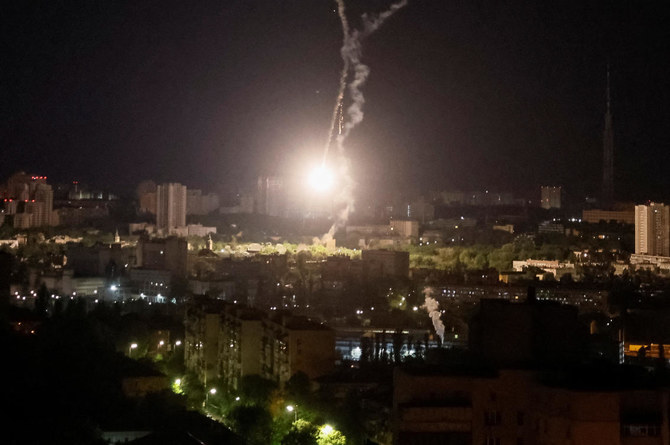
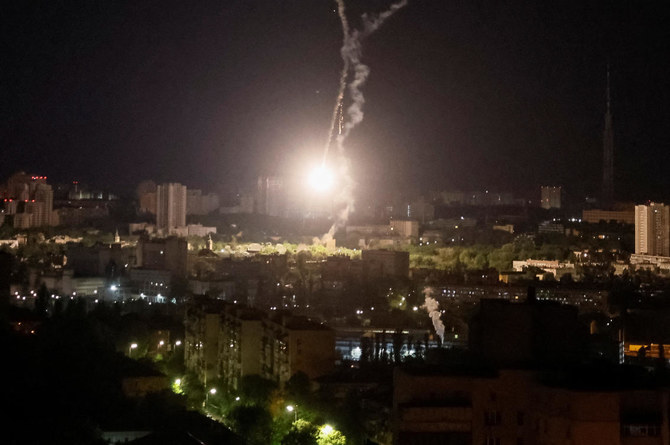
KYIV: Russian drones and ballistic missiles attacked Ukraine’s capital early Tuesday in what the defense forces called an exceptionally complex strike, a day after President Volodymyr Zelensky said he would return from a European tour with a restocked weapons arsenal.
The Kyiv City Military Administration said Tuesday’s attack — the eighth on the capital this month — involved drones, cruise missiles and probably ballistic missiles launched “from different directions simultaneously.”
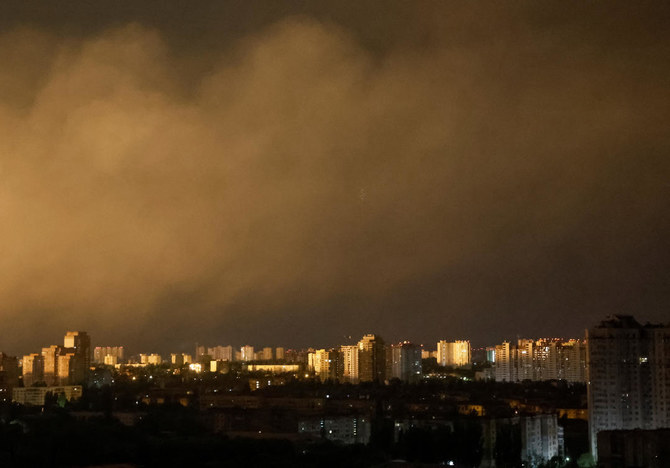
The busy Solomyansky district of Kyiv, home to the international airport, was the most heavily damaged, with a fire breaking out in a non-residential building.
According to Telegram posts by Mayor Vitali Klitschko, three people were injured in Solomyansky, while missile debris fell on Obolonsky district, a leafy outer suburb.
The latest attack on Kyiv follows Zelensky’s collection of a slew of fresh arms delivery pledges from Berlin, Paris and London, deepening a military arrangement between the West and Ukraine that has helped put Russia on the back foot.
After his whirlwind tour of major European capitals, Zelensky tweeted Monday night that he was “returning home with new defense packages.”
Ukrainian forces are widely believed to be gearing up for a long-awaited counter-offensive against Russian troops, with gains already claimed around the flashpoint of Bakhmut.
But Zelensky has yet to succeed in his coveted goal of enlisting Western fighter jets to seize command of the skies, although UK Prime Minister Rishi Sunak announced on Monday preparations to open a flight school to train Ukrainian pilots.
France, too, has offered to train Ukrainian fighter pilots, though President Emmanuel Macron ruled out sending warplanes to Kyiv.
And while Russia’s ally China vies to act as a peace broker, sending an envoy to Kyiv this week, Moscow’s reported attempt to acquire more drones with military collaborator Iran has caused ire in Washington.
“This is a full-scale defense partnership that is harmful to Ukraine, to the region in the Middle East, and to the international community,” US National Security Council spokesman John Kirby said Monday, adding that further sanctions would soon be announced.
Zelensky’s tour to shore up military assistance to help make his troops more battle-ready began in Italy, with weekend visits to France and Germany, followed by Monday’s stop in the UK.
France offered dozens more light tanks and armored vehicles, while Germany said it was preparing a new military package worth 2.7 billion euros ($3 billion) — its biggest yet for Ukraine.
At the UK prime minister’s country estate of Chequers outside London on Monday, Zelensky won the promise of hundreds more air-defense missiles and long-range attack drones.
Dressed in his trademark fatigues, he gave a bear hug to Sunak after disembarking from a Royal Air Force Chinook helicopter.
He said the crisis was a matter of “security not only for Ukraine, it is important for all of Europe.”
Sunak noted that the Chequers meeting was taking place in the buildup to a Council of Europe leaders’ meeting in Iceland and a G7 summit in Japan, as he hit out at Russian President Vladimir Putin.
“The front lines of Putin’s war of aggression may be in Ukraine, but the fault lines stretch all over the world,” Sunak said.
Russia said the new UK weapons would only cause “further destruction” and claimed to have downed a Storm Shadow cruise missile that Britain last week said it was providing, in the West’s first deployment of long-range missiles for Ukraine.
The timing and focus of Ukraine’s high-stakes counter-offensive remain unclear, but Zelensky’s tour of European capitals underscored the importance of securing Western heavy weapons and ammunition.
On the ground, the fighting appears poised to increase after months of stalemate.
Kyiv said the southern region of Kherson came under “massive enemy attack,” damaging several residential buildings.
Meanwhile, seven people, including a Moscow-installed senior official and a teenager, were injured in a blast in Russian-controlled Lugansk, local officials said.
Ukrainian forces said they have captured more than 10 Russian positions on the outskirts of Bakhmut, where a fierce battle for control began nearly a year ago.
Russia said two of its military commanders had been killed in combat near the town.
The head of Russia’s private Wagner mercenary group, Yevgeny Prigozhin, again accused the Russian army of inaction around Bakhmut.
But he dismissed as “laughable” a Washington Post report that he had offered information on Russian troop positions to Ukraine in January in return for respite for Wagner forces.
In another sign of tensions with the West, Russia said Monday it had scrambled a Su-27 fighter jet over the Baltic Sea to intercept two aircraft, one German and one French, which Moscow said had attempted to “violate” its airspace.
“After turning the foreign military planes away from the Russian Federation state border, the Russian fighter (jet) returned safely to its air base,” the Russian defense ministry said in a statement
As the search for an endgame to the war continues, high-ranking Chinese diplomat Li Hui will start a two-day visit to Kyiv on Tuesday, a Ukrainian government official told AFP.
Chinese President Xi Jinping visited Moscow in March and has been criticized for refusing to condemn Putin’s war.


![]()
![]()
Kyiv targeted in fresh attack as Europe renews weapons pledges
Short Url
https://arab.news/zaq5e
Kyiv targeted in fresh attack as Europe renews weapons pledges
- Solomyansky district of Kyiv, home to the international airport, was the most heavily damaged
- The latest attack on Kyiv follows Zelensky’s collection of a slew of fresh arms delivery pledges from Berlin, Paris and London


Latest updates


© 2026 SAUDI RESEARCH & PUBLISHING COMPANY, All Rights Reserved And subject to Terms of Use Agreement.