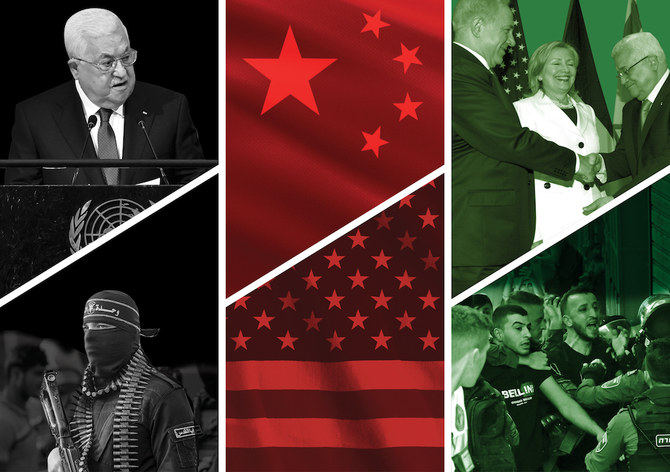
Arab News/YouGov poll surveys where Palestinians stand on Nakba’s 75th anniversary

Arab News/YouGov have released a survey to mark the 75th anniversary of the Nakba. (AN Photo)
Short Url
Updated 20 May 2023
Follow

Arab News/YouGov poll surveys where Palestinians stand on Nakba’s 75th anniversary

  • 63% of Palestinians feel that neither Fatah nor Hamas represents them
  • 75% of respondents have no confidence in their own leadership, with 86% of them feeling Israel is not serious about signing a peace deal

LONDON: More than half of Palestinians surveyed still support a two-state solution as the answer to the Israeli-Palestinian conflict, while a majority no longer feel that they are represented by neither Fatah nor Hamas, and three-quarters believe the current Palestinian leadership is incapable of reaching a peace deal with Israel. 

These are the key findings of a new Arab News/YouGov survey to mark the 75th anniversary of the Nakba. 

The online survey, carried out among 953 Palestinians between April 28 and May 11, found that half still believe in the two-state solution, which was agreed between Palestinian and Israeli leaders in Oslo in 1993 but failed to materialize in the face of opposition and violence from extremists on both sides. 

Backed by 51 percent overall, the two-state solution is more popular among older Palestinians — it is supported by 63 percent over the age of 45, compared with only 42 percent aged 18 to 29. 

It is also seen as the best of a range of options, although one in five favor the creation of a joint Israeli-Palestinian federal state.  

Another alternative — Palestinians becoming citizens of a single, Israeli state, is supported by 13 percent, rising to 15 percent among those aged 25 to 34. 

Meanwhile 11 percent of respondents opted for living under full Israeli occupation without obtaining citizenship.  

The survey reveals the extent of the loss of faith in the Palestinian leadership, with 63 percent of Palestinians saying that they feel unrepresented by either Hamas or Fatah. 

At the same time, only one in four still believes in the ability of the Palestinian leadership to successfully negotiate a peace settlement with Israel. 

“Palestinians lost trust in their leadership years ago,” US-Palestinian journalist, author and media consultant Ramzy Baroud told Arab News

“This lack of trust is intrinsically linked to the endemic corruption of the Palestinian Authority, but also to the total failure of the current Palestinian leadership to achieve a single meaningful political victory that could potentially renew the Palestinian people’s faith in the so-called peace process.” 

There is similar skepticism about the willingness of the current right-wing Israeli government to resolve the conflict peacefully — 86 percent of Palestinians believe Benjamin Netanyahu’s administration is not serious about securing a peace deal. 

Following China’s recent successful mediation in talks between Iran and Saudi Arabia, the country is seen as a potential go-between in the Israeli-Palestinian conflict by 80 percent of respondents. 

Furthermore, continued Israeli intimidation and illegal settlements are seen as the main causes for the failure of previous peace talks, followed by the US bias toward Israel and the continuing dispute over the Al-Aqsa Mosque and the status of Jerusalem. 

Palestinians appear polarized over their attitudes toward the Abraham Accords, with 52 percent of the opinion that the US-driven initiative had made Israel more aggressive toward Palestinians, but 43 percent believing the opposite is true. 

One thing the majority of Palestinians do agree on is what the priority of any future independent Palestinian state should be — the economy. More than 40 percent put economic development at the top of their to-do list. 

Writing in a column to comment on the study findings, Arab News Editor-in-Chief Faisal J. Abbas said “It is important to obtain credible data and insight relating to the views and sentiment of average Palestinians, since we rarely hear from them despite that its their cause that is often being debated worldwide.”  

“We hope this Arab News/YouGov study sheds important light on what is in the hearts and minds of Palestinian people and aids decision makers in finding a solution for their plight.” 



UN Security Council urged to put pressure on UAE to stop arming Sudanese paramilitary

Updated 8 sec ago
Follow

UN Security Council urged to put pressure on UAE to stop arming Sudanese paramilitary

  • Activist accuses Rapid Support Forces and its allies of widespread conflict-related sexual violence during war, calls for action against faction’s powerful international backers
  • Plea comes amid growing warnings of genocide in Sudan, ‘unchecked external interference’ that is allowing atrocities to continue, and the risk of further regional destabilization

NEW YORK CITY: The UN Security Council faced calls on Thursday to put pressure on the UAE to stop arming the Rapid Support Forces, one of the warring military factions in Sudan, amid warnings that atrocities bearing “the hallmarks of genocide” were spreading and the situation in the country risks causing further regional destabilization.

Sudanese activist Hala Alkarib said that “unchecked external interference” was allowing atrocities to continue. She cited the documentation by a UN panel of experts and international nongovernmental organizations of weapons and military equipment being shipped into Darfur, “including by the United Arab Emirates, in violation of this Council’s arms embargo.”

She told council members: “You can stop the violence by pressuring the RSF’s powerful backers with economic, political and criminal consequences.”

The council also heard warnings from Alkarib and senior UN officials that after more than 1,000 days of war, civilians face renewed risks of mass atrocities in Darfur and Kordofan.

Earlier on Thursday, the International Independent Fact-Finding Mission for Sudan issued a report that described atrocities committed by the RSF in and around El-Fasher in late October last year as “indicators of a genocidal path.”

Alkarib, regional director of the Strategic Initiative for Women in the Horn of Africa, told the Security Council that she had lost family members and her home in the conflict between the RSF and the Sudanese Armed Forces, which began in April 2023.

“To be here a third time, only to report that the situation is even worse, is an indictment not just of the warring parties but of this council’s inability to stop the bloodshed,” she said.

“Over 1,000 days since the start of the war, despite repeated warnings, this council has failed to act. Every red line — siege, forced displacement, man-made famine, genocide, mass rape — has been crossed.”

She warned that the kinds of atrocities seen in El-Geneina and El-Fasher now risk being repeated in Greater Kordofan and Blue Nile, where drone attacks by all sides are killing civilians and destroying hospitals, schools and markets.

“Unless you act now, you will have more blood on your hands,” Alkarib said.

Her organization has documented more than 1,294 cases of conflict-related sexual violence against women and girls since the war began, she said, “perpetrated primarily by the RSF and their allies.”

She accused RSF forces in Darfur of deliberately targeting women and girls from the Fur, Masalit, Berti, Zaghawa and Tunjur communities on the basis of ethnicity.

“As the UN Fact-Finding Mission confirmed in a report today, this is part of a strategy of genocide aimed at eradicating native African communities,” Alkarib said.

Sexual violence, arbitrary detention and enforced disappearances in RSF-controlled areas remain severely underdocumented due to access restrictions, communications blackouts and retaliation, she added.

Thousands of women and children have been detained in villages including Garny, Tura and Tabit in North Darfur, she said, and hospitals and schools have been turned into detention centers. Forced marriages, including child marriages, to RSF soldiers are frequently linked to abductions and enforced disappearances.

Alkarib called for an immediate end to hostilities, the release of civilians held by the warring parties, “particularly women held by the RSF in conditions amounting to sexual slavery,” and the deployment of a mission with a clear mandate to protect civilians across Sudan in collaboration with the African Union.

She also urged the Security Council to expand the arms embargo to the whole of Sudan; impose targeted sanctions on violators; demand safe and sustained humanitarian access; condemn attacks on aid convoys, including a recent strike on a World Food Programme convoy in North Kordofan; support Sudanese women-led organizations; and back efforts to ensure accountability, including the work of the International Criminal Court.

“None of this will stop without immediate action from you, the international community,” Alkarib added.

The UN’s political affairs chief, Rosemary DiCarlo, said: “Sudan reached a horrific milestone: 1,000 days of a brutal war that has nearly destroyed the third-largest country in Africa. 1,000 days of total impunity for the perpetrators of a long list of atrocities and war crimes.”

She warned that “the risk of regionalization of the conflict is a matter of urgent concern,” citing in particular the movement of armed groups across the border between Sudan and South Sudan “in both directions,” and reports that weapons continue to transit through neighboring states.

“The horrific events in El-Fasher in October 2025 were preventable,” DiCarlo said. During the time the city was under siege, more than a year, the UN’s Human Rights Office “repeatedly sounded the alarm about the risk of mass atrocities. But the warnings were not heeded.”

The UN high commissioner for human rights, Volker Turk, had also alerted the international community to the possibility of similar crimes in Kordofan, where civilians are once again at risk of “summary executions, sexual violence, arbitrary detention and family separation,” she added.

“During the final offensive of the RSF on El-Fasher, reports indicate that sexual violence against women and girls was widespread,” DiCarlo said. “The time to act to prevent a repeat of atrocities elsewhere in the country is now.”

She welcomed progress in an initiative to secure a humanitarian truce, led by Egypt, Saudi Arabia, the UAE and the US.

“These efforts offer a critical opportunity for immediate and much-needed deescalation and could pave the way for a sustainable cessation of hostilities,” she said. “We call on both parties to the conflict to engage with this initiative in good faith and without preconditions.”

But she stressed that unity among Sudan’s partners was essential.

“This entails ensuring that the flow of weapons to the warring parties is cut off,” DiCarlo said. “The war has gone on this long and been this deadly in large part because of the support the parties have received from abroad.”

Speaking on behalf of UN humanitarian chief Tom Fletcher, Edem Wosornu, the director of the crisis response division at the Office for the Coordination of Humanitarian Affairs, said violence continues to spread “relentlessly.”

“Nearly three years have passed since this war began — humanitarian needs have deepened and countless civilian lives have been shattered,” she added.

Since the start of this year, she said, conditions in much of Kordofan and Darfur have deteriorated and drone attacks across the three states in Kordofan have escalated, resulting in civilian casualties and displacement. More than 1 million people are now displaced in the region.

In North Kordofan, fighting around the state capital, El-Obeid, was restricting the delivery of humanitarian and commercial supplies, Wosornu said. In South Kordofan, there has been intensified fighting and aerial attacks in and around Kadugli and Dilling, where an assessment by the Integrated Food Security Phase Classification indicates famine conditions may be prevalent.

Despite recent announcements that sieges had been broken and convoys could move between El-Obeid to Kadugli and Dilling, “humanitarian access along these key supply lines remains unpredictable,” Wosornu added.

In December, rates of acute malnutrition in Um Baru and Kernoi in North Darfur exceeded the threshold for famine, she said, and more than 1,000 newly displaced people recently arrived in Tawila, joining 600,000 who were already living there “in dire conditions.”

She continued: “For over 12 million women and girls, this is a crisis within a crisis. Violence against women and girls in Sudan has reached catastrophic levels. Sexual violence against women and girls has reached horrific levels. Documented cases have nearly tripled – yet this is but a fraction of the real scale.”

Wosornu also warned that 4.2 million children and pregnant and breastfeeding women face acute malnutrition.

She urged the council to work together “in pursuit of an immediate stop to the fighting, to stem the flow of weapons into Sudan, and to press for the lasting, inclusive peace that is so desperately needed.”

The UK is chairing the Security Council this month, with British Foreign Minister Yvette Cooper serving as president of the council for February.