- Survey conducted for Arab News by YouGov finds EU and China behind Russia as potential effective mediators
- Almost 60 percent of respondents said they did not trust the US to mediate Palestinian-Israeli negotiations
LONDON: Majority of Palestinians view China and Russia as potentially effective mediators for their peace talks with the state of Israel, a recent survey revealed.
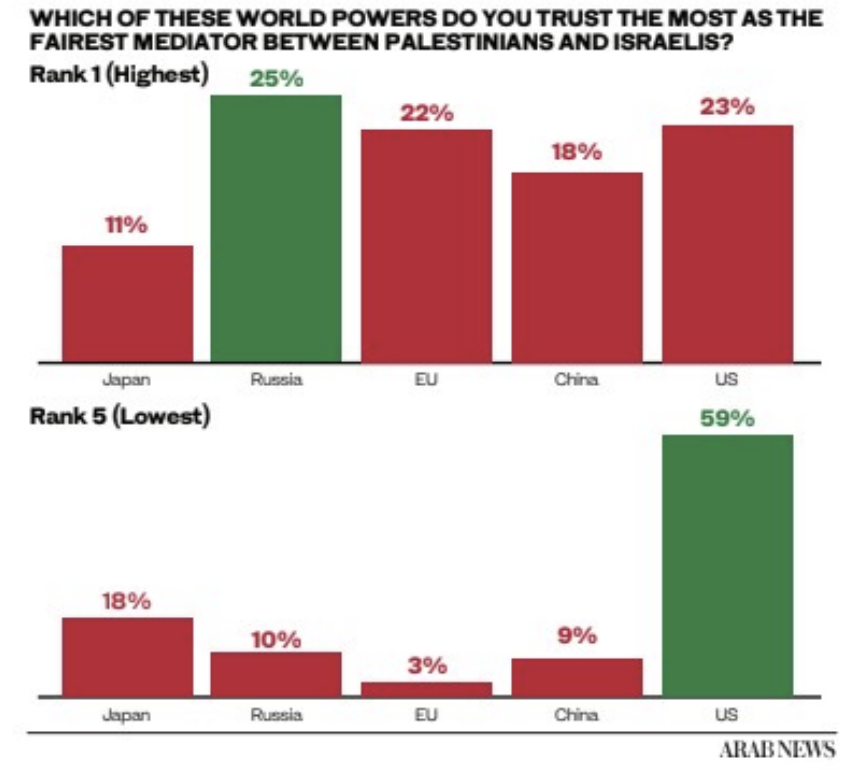
The survey, conducted by YouGov in May at the request of Arab News, showed that Palestinians’ most preferred potential peace broker was Russia, followed closely by the European Union and China, while the US proved far from popular among the residents of the West Bank and Gaza.
Commenting on the results of the survey on the preferences of Palestinians, Russian Foreign Ministry spokeswoman Maria Zakharova concluded: “Because Russia has not betrayed those who pinned their hopes on it.”
The Information and Press Department (IPD) of the Russian Foreign Ministry said: “Moscow, as it stated in IPD’s comment to Arab News, continues to believe that the existing international legal framework, the Arab peace initiative in Al-Taif and the groundwork that has been achieved between Israelis and Palestinians throughout the negotiation process on the basis of (a) two-state solution can serve as a foundation for resuming direct negotiations between the parties to the conflict.”
“Our position is clear, unchangeable and not subject to political conjuncture,” the IPD added. “We are constantly talking about this to our Palestinian friends and the Israeli side as well.”
In October last year, the Palestinian Authority told Russian President Vladimir Putin people in Palestine may consider US mediation only if it is part of the Quartet, a foursome of nations that includes Russia.
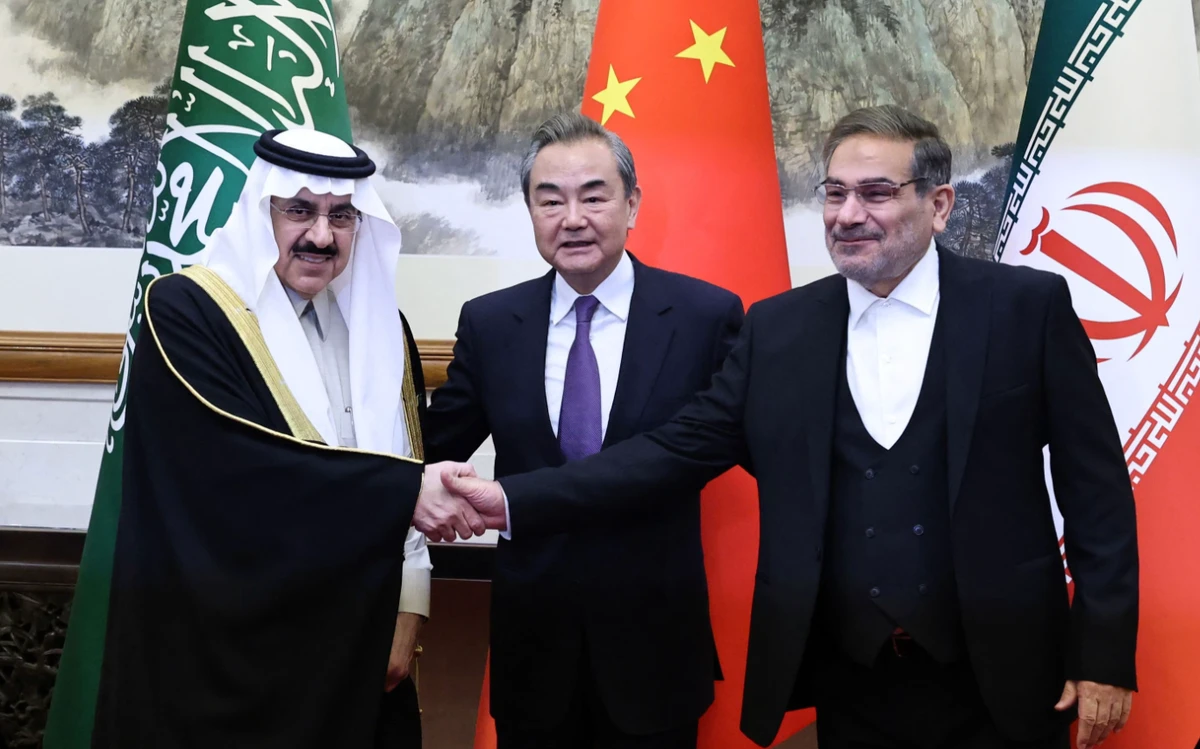
Following Beijing’s success in brokering the Saudi-Iranian diplomatic agreement in March, a sweeping 80 percent of the survey respondents, who expressed a clear opinion on the topic, supported a Chinese role in Israeli-Palestinian peace talks.
In December, President Xi Jinping expressed during an official visit to Riyadh his country’s keenness to help resolve the conflict between Saudi Arabia and Iran. This led to five days of intense talks in March in Beijing, delivering an agreement that entails a respect of sovereignty of regional countries, the restoration of diplomatic ties, and the revival of previously agreed bilateral treaties between Iran and Saudi Arabia.
In the wake of this success, China offered in April, amid rising tension in Jerusalem, to facilitate peace talks between Israel and Palestine, urging their resumption as soon as possible.
Contrary to the stance on China, almost 60 percent of participants did not trust the US to mediate Palestinian-Israeli negotiations despite that – or perhaps because – 86 percent believed the US had significant influence over Israel.
“Palestinians have never seen the US as a neutral or fair broker,” said director of the London-based Council for Arab-British Understanding (CAABU), Chris Doyle, adding that “the (Palestinian) leadership has tolerated the US because, quite simply, as the world’s sole superpower for many years, (they) have had no choice.”
He told Arab News that “there are many, many reasons why Palestinians – including the leadership – have never viewed the US as that responsible broker.”
“The US overtly states that it is pro-Israel, that it has a strategic alliance with the State of Israel, it routinely passes pro-Israel resolutions in Congress, and, of course, vetoes attempts to pass Security Council resolutions critical of the State of Israel and its conduct,” Doyle explained.
He pointed out that the “the US position in the region is clearly declining,” explaining that “in part, this is because of the decisions of successive presidents going back to the Obama administration to pivot to Asia, to have less to do with the Middle East, and to try to avoid getting sucked into protracted conflicts.
“We are seeing, therefore, less and less US mediation efforts in the region and involvement. It is still there – it is not a non-actor, but it is not there in the way that it once used to be. Not in the way, for example, under the Clinton administration, or when John Kerry was doing his very energetic diplomacy a decade ago.”
And while the EU was the respondents’ second preferred mediator among the five suggested major powers – the US, EU, Japan, and China alongside Russia, Doyle said “the problem with the EU is that it is increasingly divided, with a lot of Central and Eastern European countries increasingly moving away from the international consensus that had existed since 1980.”
“You have a core group of largely Western European states who do adopt sensible positions based in international national law,” he continued, “So the idea of the EU as a mediator right now seems rather far-fetched because it simply does not have the sort of unity which would allow it to play out that role.”
Doyle highlighted that the EU “has to have the political courage to act in this fashion and to ignore any pressures that the US and Israel would apply to the European Union – and as yet, there has been not enough political will involved.”
A better mediation model, according to Doyle, would be to “do it through the United Nations, with the involvement of major powers, including the US, who would be the guarantors of any agreement that came out of that sort of process.”
Some survey respondents also blamed US bias towards Israel for the recurring failure of peace talks. Doyle underscored that “the idea that the US can be the sole loan broker for a peace deal between Israel and the Palestinians” was “simply not credible anymore. Not to those on the outside, but above all to Palestinians.”