

Sri Lanka eyes more people-to-people ties with Saudi Arabia

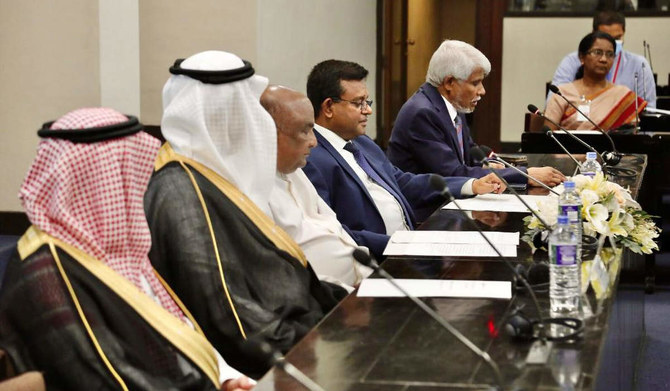
Sri Lankan Environment Minister Naseer Ahamed speaks during his inauguration as the president of the Saudi-Sri Lanka Parliamentary Friendship Association in Colombo on May 13, 2023. (Sri Lanka Ministry of Environment)
Short Url
Updated 13 May 2023
Follow

Sri Lanka eyes more people-to-people ties with Saudi Arabia

  • Environment minister elected president of Saudi-Sri Lanka Parliamentary Friendship Association
  • Association established in 2002 to strengthen cooperation between Sri Lankan MPs and Saudi Shoura councilors

COLOMBO: The new leadership of the Saudi-Sri Lanka Parliamentary Friendship Association vowed on Saturday to take bilateral ties to the next level by focusing on people-to-people connections that have been boosted by the Kingdom’s focus on tourism.

Established in Riyadh in 2002, the parliamentary association aims to strengthen relations between Sri Lanka’s MPs and Saudi Shoura councilors in all fields of cooperation.

Environment Minister Naseer Ahamed, who was elected as the association’s new president on May 10, told Arab News he will focus on economic, political, social and cultural issues during his tenure.

FASTFACT

Environment minister elected president of Saudi- Sri Lanka Parliamentary Friendship Association.

“I look at the need for stronger relations in the larger context of the Middle East and South Asia region and geopolitical priorities,” he said. “I hope to take that to the next level.”

Ahamed, a graduate of King Fahd University of Petroleum and Minerals, has ties with the Kingdom going back decades. He entered Sri Lankan politics in the 1990s and has served as a member of the Sri Lanka Muslim Congress, a presidential adviser, and chief minister of Eastern Province.

In April last year, he was appointed to lead the Ministry of Environment and oversee Middle Eastern affairs.

Ahamed said that he prioritizes the importance of people-to-people relations in establishing stronger ties between countries.

“Our mission is to develop people-to-people contact. This can be done more easily now since Saudi Arabia has opened up for tourists,” he said, referring to the Kingdom’s huge investment in tourism infrastructure under Vision 2030.

The last time a Saudi Shoura delegation visited Sri Lanka was in 2019, before the coronavirus pandemic.

Ahamed said that he was planning to increase interaction between the parliamentary association’s members for the sake of new collaborations between their countries.

“There are several areas where the two countries could develop new areas of cooperation,” he said. “The association will provide the necessary platform to extend areas of cooperation to new fields of interests.”


Army chief says Switzerland can’t defend itself from full-scale attack

Updated 2 sec ago
Follow

Army chief says Switzerland can’t defend itself from full-scale attack

ZURICH: Switzerland cannot defend itself against a full-scale attack and must boost military spending given rising risks from Russia, the head of ​its armed forces said.
The country is prepared for attacks by “non-state actors” on critical infrastructure and for cyberattacks, but its military still faces major equipment gaps, Thomas Suessli told the NZZ newspaper.
“What we cannot do is defend against threats from a distance or even a full-scale ‌attack on ‌our country,” said Suessli, who is ‌stepping ⁠down ​at ‌the end of the year.
“It’s burdensome to know that in a real emergency, only a third of all soldiers would be fully equipped,” he said in an interview published on Saturday.
Switzerland is increasing defense spending, modernizing artillery and ground systems ⁠and replacing aging fighter jets with Lockheed Martin F-35As.
But the ‌plan faces cost overruns, while ‍critics question spending on artillery ‍and munitions amid tight federal finances.
Suessli said ‍attitudes toward the military had not shifted despite the war in Ukraine and Russian efforts to destabilize Europe.
He blamed Switzerland’s distance from the conflict, its lack of ​recent war experience and the false belief that neutrality offered protection.
“But that’s historically ⁠inaccurate. There are several neutral countries that were unarmed and were drawn into war. Neutrality only has value if it can be defended with weapons,” he said.
Switzerland has pledged to gradually raise defense spending to about 1 percent of GDP by around 2032, up from roughly 0.7 percent now – far below the 5 percent level agreed by NATO countries.
At that pace, the Swiss military would only be ‌fully ready by around 2050.
“That is too long given the threat,” Suessli said.