

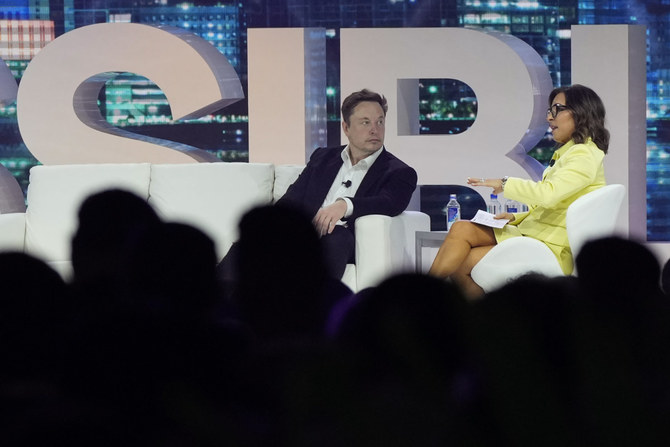

SAN FRANCISCO: Elon Musk confirmed on Friday that the new CEO for Twitter will be NBCUniversal’s Linda Yaccarino, an executive with deep ties to the advertising industry.
“I am excited to welcome Linda Yaccarino as the new CEO of Twitter!” Musk wrote in a Friday tweet. He added that Yaccarino “will focus primarily on business operations” while Musk will stay closely connected to product design and new technology.
Before that announcement, NBCUniversal said Friday that Yaccarino would step down immediately as chairwoman for global advertising and partnerships.
Musk, who bought Twitter last fall and has been running it since, has long insisted that he would step down as top executive at the company, which is now called X Corp.
Few expect Musk to remove himself from the decision making process at Twitter, however.
“While he’s stepping back from the CEO title, Musk is far from likely to step back from calling the product shots,” said Mike Proulx, research director at Forrester Research.
Yaccarino, with deep roots in the advertising industry, could be a linchpin in Twitter’s future.
Luring advertisers is critical for Musk and Twitter after many fled in the early months after his takeover of the social media platform, fearing harm to their brands in the ensuing chaos. Musk said in late April that advertisers had returned, but provided no details.
Mark DiMassimo, founder and creative chief of ad agency DiGo, said Yaccarino successfully integrated and digitized ad sales at Comcast and NBC — and that her track record of cross-selling ads across different platforms could appeal to Musk as he tries to transform Twitter from a social media company to a bigger media platform.
Yaccarino worked at NBCUniversal for nearly 12 years — with her team generating more than $100 billion in ad sales since 2011, her company bio notes.
According to LinkedIn, Yaccarino previously served as NBC’s chair for advertising and client partnerships and as president of cable entertainment and digital advertising sales. Prior to her time with NBC, Yaccarino worked at global entertainment company Turner for almost two decades.
Last month, Yaccarino interviewed Musk on a Miami stage last month in front of hundreds of advertisers.
“If anyone can translate the Musk vision into advantages for marketers she’ll be able to do it,” DiMassimo said Friday, prior to Musk’s confirmation. “Even though there’s skepticism and all marketers live in the ‘show me’ state right now with regard to Twitter, if in fact she does go to Twitter this is a powerfully reassuring move.”
Proulx added that advertising is not the only challenge that Twitter’s new CEO will face – after all, Musk has “fundamentally altered” Twitter both as a product and a community, arguably “for the worse.”
Musk’s tenure at Twitter’s helm has been chaotic. He began his first day firing the company’s top executives, followed by roughly 80 percent of its staff, which has meant that Twitter has far fewer engineers to ensure that the site is running smoothly and far fewer content moderators to help rid it of hate speech, animal cruelty and graphic violence.
He’s upended the platform’s verification system and has scaled back safeguards against the spread of misinformation. It’s been some of these changes — along with Musk’s own penchant for spreading misinformation and engaging with prominent conspiracy theorists and far-right figures — that analysts say soured many advertisers on the platform.
Regaining advertisers’ trust will require stabilizing Twitter and ensuring that key product decisions are made thoughtfully and deliberately and not, as Musk has often been known to do, on the spur of the moment, inspired by a fan’s tweet or a passing thought. Industry insiders describe Yaccarino as a marketer’s leader with key advertising expertise, but if she’s to succeed on the business side, she’ll need Musk’s buy-in on the product side.
Musk’s policy changes have led to divisions among users, some who have left the platform. There was more of that on Friday, but from some of Musk’s most boisterous supporters.
Some focused on Yaccarino’s affliation with The World Economic Forum, an organization that Musk has previously criticized — suggesting that this could signal movement away from Musk’s “2.0 values” for Twitter. On Thursday, however, Musk said that the platform’s “commitment to open source transparency and accepting a wide range of viewpoints remains unchanged.”
Others have also questioned Yaccarino’s political leanings. In 2018, Donald Trump appointed Yaccarino to serve on his Council on Sports Fitness and Nutrition for two years. As Ad Council chair in 2021 and 2022, she also worked with the Biden White House to help create a coronavirus vaccination campaign that reached over 200 million Americans.
Last November, Musk was questioned in court about how he splits his time among Tesla and his other companies, including SpaceX and Twitter. Musk had to testify in the trial in Delaware’s Court of Chancery over a shareholder’s challenge to his potentially $55 billion compensation plan as CEO of the electric car company.
Musk said he never intended to be CEO of Tesla, and that he didn’t want to be chief executive of any other companies either, preferring to see himself as an engineer. Musk also said at the time that he expected an organizational restructuring of Twitter to be completed in the next week or so. It’s been nearly six months since he said that.
Bantering with Twitter followers late last year, Musk expressed pessimism about the prospects for a new CEO, saying that person “must like pain a lot” to run a company that “has been in the fast lane to bankruptcy.”
“No one wants the job who can actually keep Twitter alive. There is no successor,” Musk tweeted at the time.
********
When Elon sparred with Christine: 3 takeaways from their on-stage interview
Elon Musk sat down in April for an on-stage interview with Christine Yaccarino, the advertising executive he named as Twitter’s new chief executive on Friday. Here are some highlights of their conversation:
Musk and Yaccarino spar over content moderation
The Miami discussion was cordial, although both participants drew some distinct lines in the sand. On a few occasions, Yaccarino steered the conversation toward issues of content moderation and the apparent proliferation of hate speech and extremism since Musk took over the platform. She couched her questions in the context of whether Musk could help advertisers feel more welcome on the platform.
At one point, she asked if Musk was willing to let advertisers “influence” his vision for Twitter, explaining that it would help them get more excited about investing more money — “product development, ad safety, content moderation — that’s what the influence is.”
Musk shut her down. “It’s totally cool to say that you want to have your advertising appear in certain places in Twitter and not in other places, but it is not cool to to try to say what Twitter will do,” he said. “And if that means losing advertising dollars, we lose it. But freedom of speech is paramount.”
Musk repeats: no special influence for advertisers
Yaccarino returned to the issue a few moments later when she asked Musk if he planned to reinstate the company’s “influence council,” a once-regular meeting with marketing executives from several of Twitter’s major advertisers. Musk again demurred.
“I would be worried about creating a backlash among the public,” he said. “Because if the public thinks that their views are being determined by, you know, a small number of (marketing executives) in America, they will be, I think, upset about that.”
Musk went on to acknowledge that feedback is important, and suggested Twitter should aim for a “sensible middle ground” that ensures the public “has a voice” while advertisers focus on the ordinary work of improving sales and the perception of their brands.
Pressing Elon on his own tweets
Musk didn’t pass up the opportunity to sell the assembled marketers a new plan to solve Twitter’s problems with objectionable tweets, which the company had announced the day before. Musk called the policy “freedom of speech but not freedom of reach,” describing it as a way to limit the visibility of hate speech and similar problems without actually removing rule-breaking tweets.
Yaccarino took a swing. “Does it apply to your tweets?” Musk has a history of posting misinformation and occasionally offensive tweets, often in the early morning hours.
Musk acknowledged that it does, adding that his tweets can also be tagged with “community notes” that provide additional context to tweets. He added that his tweets receive no special boosts from Twitter.
“Will you agree to be more specific and not tweet after 3 a.m.?” Yaccarino asked.
“I will aspire to tweet less after 3 a.m.,” Musk replied.


