Gold retreats as dollar gains upper hand

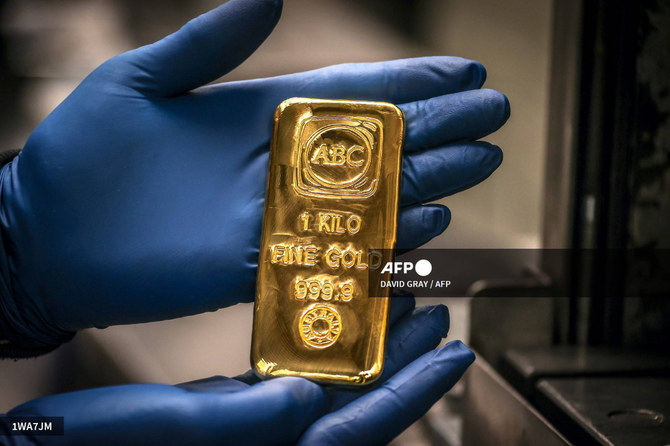
Gold is traditionally considered a hedge against inflation, but elevated interest rates dim appeal for zero-yield bullion. (AFP file photo)
Short Url
Updated 12 May 2023
Follow

Gold retreats as dollar gains upper hand

  • Dollar gains 0.6 percent to one-week high
  • Silver down nearly 5 percent, palladium down 3 percent

BENGALURU, India: Gold retreated on Thursday as rival safe-haven dollar advanced and outweighed support for bullion from lingering economic risks, while traders digested the impact of weak data on the interest rate outlook.

Spot gold was down 0.8 percent to $2,013.84 per ounce by 1:40 p.m. EDT (1740 GMT), while US gold futures settled down 0.8 percent to $2,020.50.

Gold popped up after data showed a jump in weekly jobless claims and the smallest annual increase in producer prices last month in over two years.
However, the metal soon gave up those gains as the dollar rose, making bullion more expensive for overseas buyers.
The banking situation with PacWest has prompted some safe haven demand into the US dollar, said Jim Wyckoff, senior analyst at Kitco Metals.
Investors also took stock of comments from Minneapolis Fed chief Neel Kashkari that an extended period of high rates would be necessary if inflation stayed stubbornly high.
While this weighs on sentiment for gold “to a certain extent, the precious metal remains in its uptrend channel established in November,” said Alexander Zumpfe, a precious metals dealer at Heraeus.
Gold is traditionally considered a hedge against inflation, but elevated interest rates dim appeal for zero-yield bullion.
On Wednesday, data showed the annual increase in US consumer prices slowed to below 5 percent in April for the first time in two years, but remained well above the Fed’s 2 percent target.
With inflation still sticky amid a slow deterioration in the US economy, the Fed is less likely to feel the need to hike rates further, keeping gold in a sideways to higher trend, said David Meger, director of metals trading at High Ridge Futures.
Silver plunged 4.9 percent to $24.18 per ounce, platinum shed 2 percent to $1,091.86 and palladium lost 3.4 percent to $1,551.96.


Saudi Arabia raises $605m in January sukuk issuance: NDMC

Updated 21 January 2026
Follow

Saudi Arabia raises $605m in January sukuk issuance: NDMC

RIYADH: Saudi Arabia’s National Debt Management Center has raised SR2.26 billion ($605 million) through its latest sukuk issuance.

Sukuk are Shariah-compliant financial instruments akin to bonds, granting investors a share in the issuer’s assets. Unlike conventional bonds, they comply with Islamic finance principles, which forbid interest-based transactions.

According to the NDMC, the January issuance was divided into five tranches. The first tranche was valued at SR410 million and is set to mature in 2031. The second amounted to SR338 million, maturing in 2033, while the third tranche, worth SR101 million, will expire in 2036. 

The fourth portion, valued at SR523,000, is due in 2039, while the last tranche, due in 2041, was valued at SR1.42 billion.

The January figure represents a decrease of 67.64 percent compared to December, when the Kingdom raised SR7.01 billion from sukuk issuances.

In recent years, the Kingdom’s debt market has experienced swift growth, with investors increasingly turning to fixed-income instruments as rising global interest rates reshape the financial landscape.

This comes as the Gulf Cooperation Council sukuk outstanding climbed 12.7 percent to $1.1 trillion by the end of the third quarter of 2025, according to a recent Fitch Ratings report.

The US-based credit rating agency said debt capital market activity in the GCC is expected to remain strong into 2026, supported by a healthy pipeline of anticipated issuances.

The report noted that sukuk issuances increased 22 percent year on year in the first nine months of this year, accounting for 40 percent of total GCC DCM outstanding.

Sukuk also outpaced bond growth, which expanded 7.2 percent year on year. 

Also known as Islamic bonds, these debt products allow investors to gain partial ownership of an issuer’s assets until maturity.