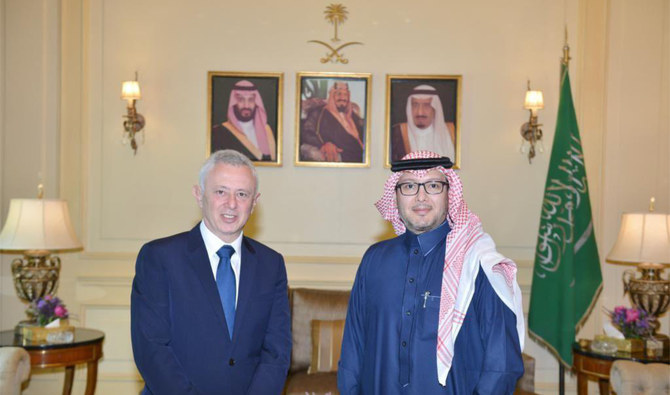

BEIRUT: Marada Movement leader and Hezbollah-backed presidential candidate Suleiman Frangieh said that he held a “friendly and quite excellent” meeting with Saudi Ambassador Walid Bukhari in Beirut.
The meeting on Thursday was the first since the Maronite leader emerged as a presidential candidate with Hezbollah’s support.
The two last met in November 2022 during the Saudi Embassy’s commemoration of the 33rd anniversary of the Taif Agreement in Beirut.
Bukhari visited Lebanese officials and met parliamentary blocs last week.
“Saudi Arabia does not place a veto on any presidential candidate, and it welcomes the agreement among the Lebanese to elect a new president” he said. “The most important thing is the president’s program and his work mechanism.”
After meeting with Bukhari on Thursday, Islamic Group MP Imad Al-Hout said that the Saudi ambassador was acting as a mediator to bring together points of view and was not suggesting any names.
Riyadh was not setting any conditions on Lebanon but was trying to help it carry out reforms, he added.
According to Al-Hout, the Saudi ambassador said that “no one will help Lebanon and the Lebanese if they do not help themselves and try to gain each other’s trust,” adding: Through reform measures, they can then gain the trust of the Arab and international community. This is all the Kingdom wants, nothing else.”
Bukhari also held a meeting on Thursday with the National Moderation parliamentary bloc, which includes former members of the Future Movement bloc.
The bloc presents itself as being apart from “political alignments.”
Parliament Speaker Nabih Berri had stopped calling parliament to convene to elect a president amid a sharp division among MPs over candidates.
Although the Saudi ambassador and other foreign envoys hold the Lebanese alone responsible for staging presidential elections, the internal division remains the same.
The EU representative to Lebanon Ralph Tarraf stressed the need for “Lebanon to quickly restore its ability to take political and administrative decisions and implement them — namely electing a new president, forming a new government, reaching agreements regarding the appointment of other senior officials and finding a solution to the economic crisis.”
He added: “Monetary and fiscal reforms would restore much-needed liquidity to the economy, stop the slide into an informal economy, and rebuild the ailing banking system.”
Tarraf said: “Implementing the measures agreed upon with the International Monetary Fund more than a year ago would open the way for an economic recovery program with the help of the IMF and the international community, including Europe.”
He said that the EU “is ready to enter into a constructive dialogue on all these issues, taking into account the limits imposed by our respect for Lebanon’s sovereignty, and it is up to the Lebanese to decide their fate; we cannot to impose solutions.”
Several opposition MPs held meetings in parliament on Thursday to search for a presidential hopeful after MP Michel Moawad was rejected by Hezbollah and its allies as a provocative candidate.
However, opposition MPs and those of major Christian blocs in parliament believe that Frangieh’s candidacy is also provocative.
Despite holding 11 election sessions, the most recent in January, the Lebanese Parliament has failed to elect a successor to former President Michel Aoun, whose term ended on Oct. 31, 2022.
According to the Lebanese constitution, the presidential candidate must obtain the votes of 86 out of 128 MPs in the first round, and whoever gets a majority of only 65 votes wins in the second round during the same session. But Parliament failed to secure a quorum for the second session, which is 86 MPs.
Since the last voting session on Jan. 11, Berri has refrained from setting a new date for an election session due to the vertical division within parliament, which, according to Berri, requires a “dialogue for consensus.”
This was rejected by parliamentary blocs opposing Hezbollah and its allies for fear of imposing the party’s candidate.
Berri insisted on Wednesday that the presidential elections must be completed by June 15.
“No one can predict where the country is heading amid the presidential vacuum,” he said.
Berri’s media office quoted him as saying: “It is not permissible for the Arab region to achieve understanding and harmony while we bicker internally and lose our unity and our rights.”
He stressed that the Taif Agreement — if implemented — paves the way for Lebanon’s gradual transition to a civil state.
Berri said: “We cannot appoint a governor for the Banque du Liban or the central bank without the president having a say in this matter. The same applies to the position of the army command.”
Central Bank Gov. Riad Salameh’s term ends in July.
Caretaker Prime Minister Najib Mikati said on Monday that he would not agree to extend Salameh’s term, and rejected the idea that the Cabinet could appoint a successor amid the presidential vacuum.