

Arab News joins KSrelief aid flight to Sudan

1 / 6
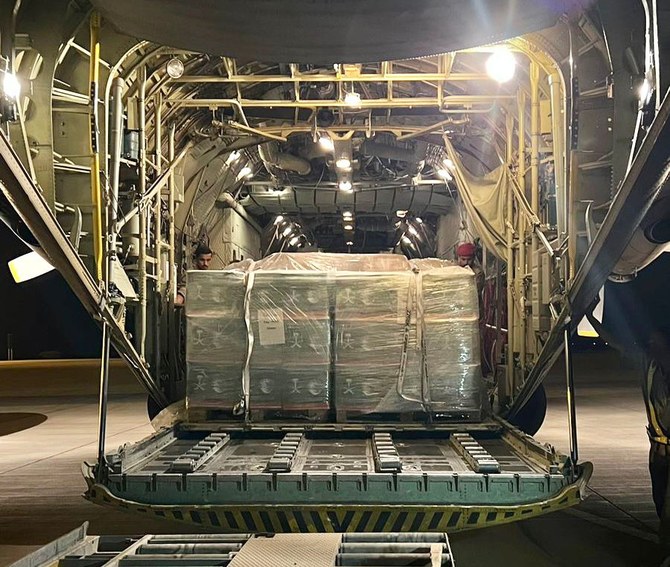
The cargo had been stacked onto pallets and loaded onto the plane. (AN Photo)
2 / 6
The cargo had been stacked onto pallets and loaded onto the plane. (AN Photo)
3 / 6
The cargo had been stacked onto pallets and loaded onto the plane. (AN Photo)
4 / 6
The cargo had been stacked onto pallets and loaded onto the plane. (AN Photo)
5 / 6
The cargo had been stacked onto pallets and loaded onto the plane. (AN Photo)
6 / 6
The cargo had been stacked onto pallets and loaded onto the plane. (AN Photo)
Short Url
Updated 11 May 2023
Follow

Arab News joins KSrelief aid flight to Sudan

  • Aid flights will continue with an expansion to sea bridges
  • More than $1 million already raised for aid to Sudan

RIYADH: The King Salman Humanitarian Aid and Relief Center (KSrelief) has created an air bridge between Saudi Arabia and Sudan, flying emergency supplies into the troubled country to help those forced to flee their homes as skirmishes continue between rival military groups.

It is a mission the Saudis take seriously, with everyone understanding the urgent need for the aid they are supplying.

“We are here in Port Sudan Airport to receive the third plane from the King Salman Humanitarian Aid and Relief Center,” Nasser Alsubaie, assistant director of emergency aid at KSrelief, told Arab News.

“This aircraft is carrying food baskets, non-food items, shelter and medical supplies and medical aid. With this aid we will target the IDP (internally displaced persons),” he said.

Alsubaie said there is more aid to come.

“Tomorrow we are also expecting two aircraft carrying the same items as before.”

Work will continue to ensure that more aid is supplied by air and sea to those who most need it, he added.

As of Sunday, the Kingdom has raised over $1.2 million in humanitarian aid for Sudan in a directive led by King Salman and Crown Prince Mohammed bin Salman. KSrelief is set to provide over $100 million in humanitarian aid to help civilians in the country.

Fighting broke out in Sudan in mid-April when rival paramilitary Rapid Support Forces stormed the capital Khartoum.

Since then thousands of foreign nationals have fled the country, while thousands of Sudanese have been left displaced.


Talks are underway between the two sides in Jeddah, guided by Saudi and US officials, while an uneasy ceasefire remains in place.

While the Saudi leadership continues its efforts to end the bloody battle between the feuding sides, aid provided by KSrelief guarantees that basic human needs — shelter, warmth, food and health — are met.

Two flights arrived in Port Sudan International Airport from Riyadh’s King Khalid International Airport on Tuesday, carrying 20 tons of emergency aid for the Sudanese people.

Arab News joined the third KSrelief flight on Wednesday night and saw tons of food and medical aid, as well as blankets and cooking equipment, loaded on the aircraft by Saudi military.

With the cargo loaded, military personnel and media representatives boarded the aircraft, sitting shoulder to shoulder on the floor or on canvass seats with cargo nets as back support, and settled in for the three-hour journey to Sudan.

Landing in a dark Port Sudan at midnight, the flight was met by teams of KSrelief volunteers, as well as Saudi military and Sudanese airport staff, who raced to unload the emergency aid — an operation that took three hours using forklifts, pulleys and ropes.

All those involved work around the clock to ensure that emergency supplies reach those affected by the conflict.

Once the supplies were unloaded, those returning to the Kingdom to collect the next cargo of aid reboarded the aircraft.

The plane touched back down in Jeddah’s King Abdullah Air Base in the early hours of Thursday — the city asleep and largely unaware of the mission we had witnessed — but there was one final show of appreciation for those on board.

As we stepped off the aircraft, tired and ready for some decent sleep, two lines of soldiers waited, standing to attention, to salute their military colleagues in recognition of their essential work alongside volunteers.


UN, aid groups warn Gaza operations at risk from Israel impediments

Updated 18 December 2025
Follow

UN, aid groups warn Gaza operations at risk from Israel impediments

  • Dozens of international aid groups face de-registration by December 31, which then means they have to close operations within 60 days

UNITED NATIONS: The United Nations and aid groups warned on Wednesday that humanitarian operations in the Palestinian territories, particularly Gaza, were at risk of collapse if Israel does not lift impediments that include a “vague, arbitrary, and highly politicized” registration process.
Dozens of international aid groups face de-registration by December 31, which then means they have to close operations within 60 days, said the UN and more than 200 local and international aid groups in a joint statement.
“The deregistration of INGOs (international aid groups) in Gaza will have a catastrophic impact on access to essential and basic services,” the statement read.
“INGOs run or support the majority of field hospitals, primary health care centers, emergency shelter responses, water and sanitation services, nutrition stabilization centers for children with acute malnutrition, and critical mine action activities,” it said.

SUPPLIES LEFT OUT OF REACH: GROUPS
While some international aid groups have been registered under the system that was introduced in March, “the ongoing re-registration process and other arbitrary hindrances to humanitarian operations have left millions of dollars’ worth of essential supplies — including food, medical items, hygiene materials, and shelter assistance — stuck outside of Gaza and unable to reach people in need,” the statement read.
Israel’s mission to the United Nations in New York did not immediately respond to a request for comment on the statement. Under the first phase of US President Donald Trump’s Gaza plan, a fragile ceasefire in the two-year-old war between Israel and Palestinian militants Hamas began on October 10. Hamas released hostages, Israel freed detained Palestinians and more aid began flowing into the enclave where a global hunger monitor said in August famine had taken hold.
However, Hamas says fewer aid trucks are entering Gaza than was agreed. Aid agencies say there is far less aid than required, and that Israel is blocking many necessary items from coming in. Israel denies that and says it is abiding by its obligations under the truce.
“The UN will not be able to compensate for the collapse of INGOs’ operations if they are de-registered, and the humanitarian response cannot be replaced by alternative actors operating outside established humanitarian principles,” the statement by the UN and aid groups said.
The statement stressed “humanitarian access is not optional, conditional or political,” adding: “Lifesaving assistance must be allowed to reach Palestinians without further delay.”