JAKARTA: Indonesian President Joko Widodo said on Thursday that the credibility of the Association of Southeast Asian Nations is at stake, as the bloc comes under increasing pressure over the lack of progress in ending ongoing deadly violence in Myanmar.
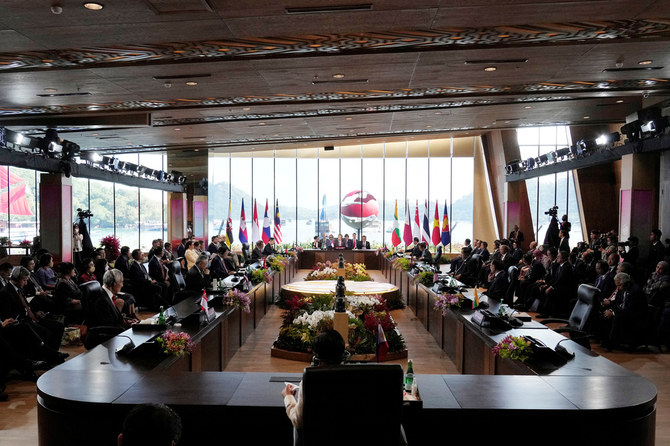
ASEAN leaders met this week for the first of their biannual summits in Labuan Bajo, East Nusa Tenggara, with the exception of Myanmar’s junta leaders who have been barred from attending over their lack of progress in implementing a peace plan endorsed by the regional grouping in 2021.
More than two years since the military junta seized power and unleashed a bloody crackdown on opponents, violence in Myanmar has been on the rise. One of the most recent incidents included an attack on an aid convoy comprised of Indonesian and Singaporean diplomats.
“ASEAN’s credibility is at stake, and Indonesia is ready to talk with anyone, including with the junta, and all the stakeholders in Myanmar for the sake of humanity,” Widodo told a press briefing at the summit’s conclusion.
He added that “engagement doesn’t mean recognition.”
As ASEAN chair this year, Indonesia said it has engaged many stakeholders in Myanmar to discuss possible solutions, as it continues to push for dialogue and the implementation of its peace plan, which has not been enforced since the bloc forged it with Myanmar’s top general in April 2021.
The Five-Point Consensus plan, also referred to as 5PC, called for an immediate end to the violence in Myanmar and dialogue among contending parties to seek a peaceful solution, to be brokered by an ASEAN special envoy.
“I have to be honest, there has been no significant progress in the implementation of the Five-Point Consensus, so we need ASEAN unity to formulate our next steps,” Widodo told Southeast Asian leaders.
More than 3,450 people have been killed by security forces since the junta took power, and thousands more remain imprisoned, according to the Assistance Association for Political Prisoners, a non-governmental organization that tracks killings and arrests.
In April, an airstrike killed at least 100 people, who were mostly civilians and included many children. Human Rights Watch on Tuesday described the attack as a war crime.
“There is disunity within ASEAN regarding on how it should actually deal with Myanmar crisis to some extent,” Lina Alexandra, senior researcher at the Center for Strategic and International Studies, told Arab News.
“This is a very crucial time for Indonesia and the fact that there is no progress that means Indonesia needs to work harder,” she said. “Indonesia (needs) to be much more bold … and also to be more brave, particularly to discuss this further with the other ASEAN leaders … to push for a breakthrough.”
In a review meeting held last November, ASEAN leaders highlighted the “need for an implementation plan that outlines concrete, practical and measurable indicators with a specific timeline to support the Five-Point Consensus” and delegated their foreign ministers to develop one.
“If Indonesia chairmanship this year, you know, can really say ‘this is the implementation plan that ASEAN has decided on how we can implement the 5PC’ — that will be a major achievement,” Alexandra said.
Even though Indonesia has acknowledged the lack of progress, a solution to the problem remains to be found.
“Restating the problem is not really solving the problem, right?” Alexandra said. “Here’s the problem, so what’s your solution, proposed solution to that?”


![]()

Indonesia says ASEAN credibility at stake as Myanmar crisis worsens
Short Url
https://arab.news/n8y2m
Indonesia says ASEAN credibility at stake as Myanmar crisis worsens
- Indonesia acknowledges lack of progress in Myanmar peace plan
- Jakarta says ready to engage anyone, including junta, other groups


Latest updates


© 2026 SAUDI RESEARCH & PUBLISHING COMPANY, All Rights Reserved And subject to Terms of Use Agreement.