

More Iranian fuel being smuggled to Pakistan, petroleum dealers say 

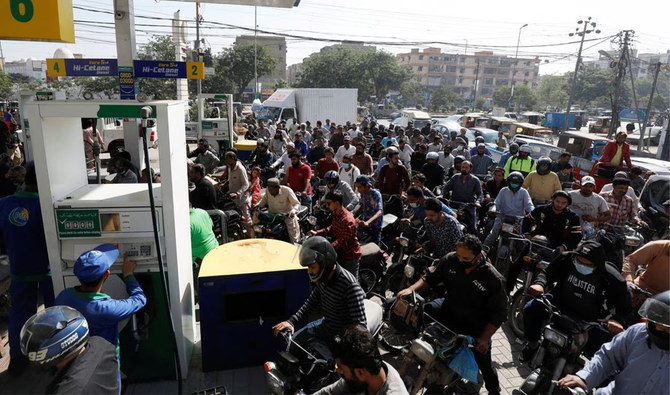
People on motorcycles wait for their turn to get petrol at a petrol station, after Pakistan Petroleum Dealers Association (PPDA) announced a countrywide strike, in Karachi, Pakistan, on November 25, 2021. (REUTERS/File)
Short Url
Updated 09 May 2023
Follow

More Iranian fuel being smuggled to Pakistan, petroleum dealers say 

  • Up to 35 percent of diesel sold Pakistan has arrived illegally from Iran, Pakistan Petroleum Dealers Association says 
  • Association said smuggling of fuel limited to province of Balochistan previously, now has spread to the rest of the country

KARACHI: Petroleum dealers have flagged a surge in the smuggling of Iranian fuel to Pakistan, saying that up to 35 percent of diesel sold in the South Asian country has arrived illegally from Iran, the Pakistan Petroleum Dealers Association (PPDA) told Reuters on Tuesday.

The association said that in the past, the smuggling of fuel was limited to the Pakistani province of Balochistan, but that it has now spread to the rest of the country.

In April, Pakistan’s energy ministry asked security forces to clamp down on fuel smuggling from Iran, according to an official memo seen by Reuters. The memo said diesel sales have slumped “more than 40 percent” due to smuggled products.

Pakistan mostly meets its demand for fuel from the Middle East, but it is also smuggled in through its western border with Iran.

The minister of state for petroleum was not immediately available for comment.

The country is facing an acute balance of payment crisis with barely enough foreign exchange reserves to cover a month’s imports. Pakistan is undertaking several measures, including raising fuel prices, to unlock a $1.1 billion tranche of aid from the International Monetary Fund.

Fuel prices have jumped 143 rupees ($0.5046), or nearly 100 percent, in the last 12 months. Inflation stands at a record high of 36.4 percent for April, significantly diminishing purchasing power for individuals and companies.

The country’s oil product sales have dropped 46 percent to 8.8 million barrels in April compared to last year, according to the Oil Companies Advisory Council in Pakistan. A breakdown shows diesel sales have slumped 50 percent year on year. This excludes smuggled fuel.

According to an S&P Global Commodity Insights report, Iranian fuel is around 53 rupees cheaper than the official retail price per liter.

“Private dealers have been able to make decent profits by selling Iranian diesel rupees 35 ($0.1235)/liter cheaper than local dealers,” it added.

The energy ministry said that according to the Oil & Gas Regulatory Authority (OGRA), around 4,000 tons per day of fuel smuggled into Pakistan was causing a total revenue loss of around 10.2 billion rupees a month.

The PPDA said that Iranian fuel smuggled into Pakistan was further hurting the industry, already reeling from low sales.

“I think they’re allowing Iranian oil to be smuggled into the country because there’s an FX shortage,” Abdul Sami Khan, chairman PPDA told Reuters.

“In the past smuggled fuel was restricted to just Balochistan, but it has now spread all over,” Khan said.

Due to Iranian fuel being significantly cheaper than domestic fuel, refineries are having trouble with stock uptake.

The energy ministry said there was a threat of supply insecurity for products other than diesel as refineries are operating at between 50-70 percent of capacity.

Earlier this month, Attock Refinery Limited told the Pakistan Stock Exchange that it would operate at around 25 percent capacity due to low sales owing to “multiple reasons, including the possible inflow of smuggled product in our supply envelope.”


China backs Pakistan in fight against militancy after deadly Balochistan attacks

Updated 03 February 2026
Follow

China backs Pakistan in fight against militancy after deadly Balochistan attacks

  • China is a major ally and investor in Pakistan and has pledged over $65 billion in major infrastructure projects, including in Balochistan
  • Chinese Foreign Ministry spokesperson Lin Jian says ‘we mourn for lives lost, and our hearts go out to injured and those who lost loved ones’

ISLAMABAD: China condemns the recent attacks that killed more than 200 people in Pakistan’s southwestern Balochistan province, a Chinese foreign ministry spokesperson said on Tuesday, reaffirming Beijing’s support for Pakistan in its fight against militancy.

The Baloch Liberation Army (BLA) group launched coordinated attacks in several cities across Balochistan on Saturday, killing 33 civilians and 17 security personnel. Officials said 117 militants were killed in skirmishes and follow-up operations.

Balochistan, which borders Iran and Afghanistan, is the site of a decades-long insurgency waged by Baloch separatist groups who often attack security forces, foreigners and non-local Pakistanis and kidnap government officials.

China is a major ally and investor in Pakistan and has pledged over $65 billion in investment in road, infrastructure and development projects under the China-Pakistan Economic Corridor (CPEC).

“China strongly condemns the [Balochistan] attacks... We mourn for the lives lost, and our hearts go out to the injured and those who lost their loved ones,” Chinese Foreign Ministry spokesperson Lin Jian said at a press briefing on Tuesday.

“China firmly opposes any form of terrorism and will as always firmly support Pakistan in combating terrorism, maintaining solidarity and social stability, and protecting the safety of the people.”

Chinese nationals working in Pakistan have often been targeted by militants, particularly in the southwestern Balochistan province, where China is developing a deep seaport that is touted as the crown jewel of CPEC.

Interior Minister Mohsin Naqvi said last week the attacks, claimed by the separatist Baloch Liberation Army (BLA), were planned from India. New Delhi rejected the allegation as “baseless,” saying Islamabad was attempting to deflect attention from its internal challenges.

Balochistan is home to vast reserves of minerals and hydrocarbons. Separatist militant groups such as the BLA blame Islamabad for exploiting Balochistan’s natural resources and denying locals a share in them. The military and civilian government reject these allegations and say they are investing in the province’s development.