

Over 600 killed in Haiti violence in April, says UN

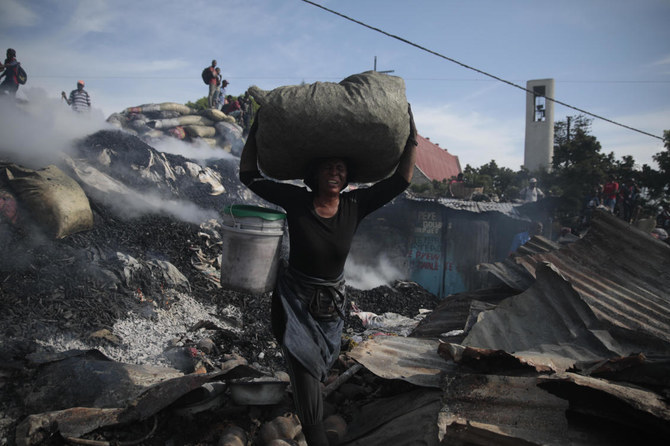
A vendor salvages items from the burned ruins of the Chada Market in the Petion-ville area of Port-au-Prince, Haiti, Thursday, May 4, 2023. (AP)
Short Url
Updated 09 May 2023
Follow

Over 600 killed in Haiti violence in April, says UN

  • The Caribbean nation, the poorest in the Americas, has been gripped by a political and economic crisis since the assassination in July 2021 of president Jovenel Moise

GEVENVA: More than 600 people died in gang violence last month in Haiti, where the authorities did not have the capacity to protect civilians, the United Nations said on Tuesday.
"Every report I get from Haiti underlines the scale of the suffering and rams home the message that Haitians need urgent support and they need it now," said the UN High Commissioner for Human Rights, Volker Turk.
He repeated his call for the international community to send a specialised armed force to help Haiti's police and authorities restore order.
The Caribbean nation, the poorest in the Americas, has been gripped by a political and economic crisis since the assassination in July 2021 of president Jovenel Moise.
Rival gangs now control most of the capital, Port-au-Prince.
In its quarterly update for January to March published on Tuesday, -- the UN said violence was "becoming more extreme and more frequent (and) spreading relentlessly as gangs seek to extend their control".
"In the month of April alone, more than 600 people were killed in a new wave of extreme violence that hit several districts across the capital," Turk's office said, adding that areas previously considered safe were now affected.

"This follows the killing of at least 846 people in the first three months of 2023, in addition to 393 injured and 395 kidnapped during that period -- a 28-percent increase in violence on the previous quarter."
The report said gangs were using snipers to shoot "indiscriminately" at people on the street and "firing into homes", and people were "being burned alive on public transport".
Turk said the Haitian state did "not have the capacity to respond", so civilians were forming vigilante groups to fight the gangs.
This had led to a rise in "mob killings and lynchings of alleged gang members". At least 164 such murders were documented in April alone.
"This will only fuel the spiral of violence," said Turk, who last week warned that Haiti was "dangling over an abyss".
"We must not forget that extreme poverty and the lack of basic services lie at the root of the current violence and of the gangs' power over communities.
"The government, with support from the international community, must do its utmost to comply with its obligation to provide people with regular and unimpeded access to clean water, food, health and shelter," Türk said.



Costa Rica’s Grynspan pledges reform in bid for UN chief job

Updated 3 sec ago
Follow

Costa Rica’s Grynspan pledges reform in bid for UN chief job

GENEVA: Rebeca Grynspan is upbeat about her chances of becoming the next head of the United Nations, which she insists must become more agile in tackling the world’s crises.
The Costa Rican former vice president said she wanted to rebuild global trust in the United Nations if she becomes its next secretary-general.
“We are very optimistic. I think that I am more than a viable candidate,” Grynspan said on Friday, her last working day before stepping aside as head of the UN trade and development agency UNCTAD to focus on her campaign.
The second term of current UN chief Antonio Guterres expires at the end of the year.
“My profile is right for this moment. I know the UN enough to reform it and enough to defend it,” she told the UN correspondents’ association ACANU.
“I have a lot of experience in my political life, taking decisions under a lot of stress and in complex situations. I have been in the highest positions in the UN.”
It is Latin America’s turn next for the top UN job and two other candidates are running: former Chilean president Michelle Bachelet, and Rafael Grossi, the Argentinian head of the International Atomic Energy Agency.
Founded in 1945, the UN has never had a woman secretary-general.
Grynspan, an economist, is not looking to be chosen on that basis.
“I don’t need any favors to be elected for the secretary-general; I just need people not to discriminate me for being a woman,” the 70-year-old said.
“If the competition will be fair, with no biases, I will make it. I have the CV; I have the merits.”

- Rebuilding trust -

Last month, Guterres warned that the UN was facing financial collapse and could run out of cash by July, with member states neither paying in full nor or time.
“The UN has to change,” said Grynspan.
There are far greater capacities in civil society and the private sector than in 1945, “and we need to be able to harness that: we don’t have to do everything in the UN.”
As for peace and security, “prevention and mediation are essential. But they need agility and flexibility from the structures of the UN. And I don’t think we have that right now.”
US President Donald Trump has slashed funding to some UN agencies and has repeatedly questioned the UN’s relevance and attacked its priorities, setting up his own “Board of Peace.”
“The UN is unique because it’s the only legitimate, universal organization,” said Grynspan.
“We need to rebuild trust with the member states. We need to regain the belief that the UN is useful to solve problems,” she said, vowing to bring her personal qualities to the task.
“I am able to reach to people not only with logic, but also with inspiration, optimism and hope,” she said.
“We need more of that too, because we need to connect again much more with people. We will need to conquer the hearts and minds again.”

- Leadership style -

The UNCTAD chief said her leadership style revolved around being “direct, honest, and evidence-based... There have to be reasons, not only emotions.”
Grynspan recounted that her parents, who were from Poland, “barely survived” World War II. Her maternal grandparents were killed in the Holocaust.
Her parents went “with nothing” to Costa Rica, a country that “allowed them to have a good life.”
“Costa Rica has taught me a lot. It’s a country that I not only love dearly, but I admire,” she said.
“I am not an impetuous person. I think things through. I have the serenity not to lose it under tension and under pressure. I consult. I hear. And I am brave. I take risks.”
rjm/ceg