

10 civilians die in targeted Israeli strikes against 3 militants in Gaza

1 / 3
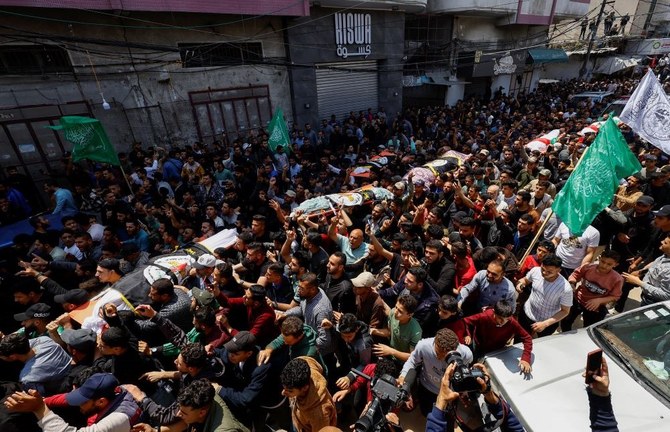
Mourners attend the funeral of Islamic Jihad commanders Tareq Izzeldeen and Khalil Al-Bahtini, and other Palestinians who were killed in Israeli strikes, Gaza City, May 9, 2023. (Reuters)
2 / 3
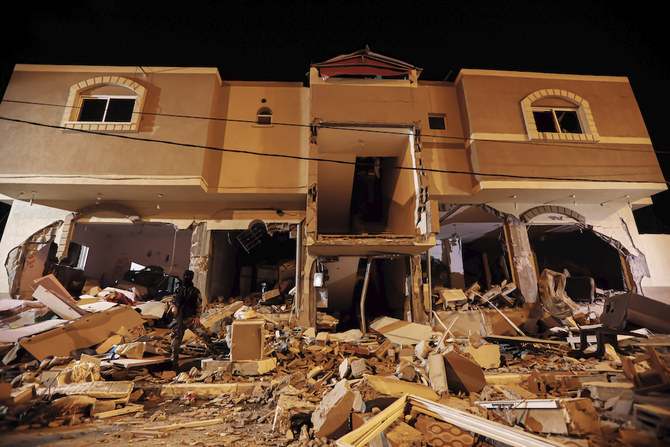
Islamic Jihad said Israel had ‘scorned all the initiatives of mediators’ and vowed it would ‘avenge the leaders’ killed in the latest air strikes. Above, a masked militant secures the damaged building hit by Israeli airstrikes in Gaza. (AP Photo)
3 / 3
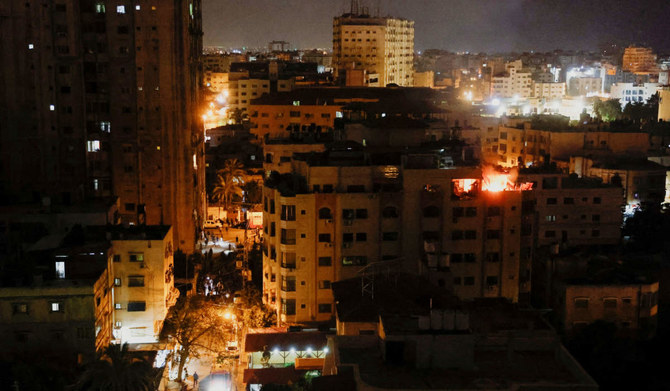
A fire burns in a building after the Israeli military struck Islamic Jihad targets, it said in a statement, in Gaza, May 9, 2023. (Reuters)
Short Url
Updated 09 May 2023
Follow

10 civilians die in targeted Israeli strikes against 3 militants in Gaza

  • 4 women, 4 children, renowned dentist among 13 killed
  • Forty warplanes took part in simultaneous strikes targeting Islamic Jihad commanders

GAZA CITY: Four women, four children, and two other civilians were among 13 people killed in Israeli strikes on the Gaza Strip early on Tuesday, according to the Palestinian Ministry of Health.

Among the dead were three senior commanders of the militant Islamic Jihad group, Israel’s military said.

Palestinian health officials said the victims included the commanders, their wives, several of their children, and others nearby.

Forty warplanes took part in simultaneous strikes that hit the apartments of the Islamic Jihad commanders and the movement’s training sites and watch towers on the Israel-Gaza border.

Islamic Jihad identified the killed military leaders as Jihad Al-Ghanam, secretary of the military council, Khalil Al-Bahtimi, commander of Gaza’s northern region, and Tariq Ezz El-Din, a member of the military council in the West Bank.

Among the 10 civilian victims of the Israeli airstrikes was a dentist known for offering free treatment to poor families, who lived in the same residential block as Ezz El-Din, according to Reuters.

Jamal Khuswan was killed along with his wife, Mervat, and 21-year-old son Youssef, a medical student, who were all asleep in their apartment in the center of Gaza city.

The former chief executive of Al-Wafa Rehabilitation Hospital and a leader in the local union of dentists, Khuswan was hailed by the health department as a national figure, “who spared no effort to carry out his humanitarian duty.”

Twenty people were also injured in the attacks including three children and seven women.

In a statement, the Israeli army said: “Our forces attacked sites for the production of weapons for Islamic Jihad, including workshops for the production of missiles in Khan Yunis, in addition to a site used to produce cement materials for the construction of terrorist tunnels.

“Six military compounds belonging to the Islamic Jihad were also targeted, most of which were used as weapons depots and logistical structures. A military site in the southern Gaza Strip was also targeted.”

Gaza’s Ministry of Education announced the closure of schools and educational institutions in the wake of the Israeli strikes but kept some government institutions open to provide services.

In a press statement, Islamic Jihad said: “The Palestinian response to this heinous aggressive massacre will not be delayed, and the Al-Quds Brigades and the resistance will never tolerate this bloodshed.

“The enemy will not achieve its goals and desires behind this heinous crime, for the resistance has unified ranks and its positions are firm.”

Israel carried out a similar raid in August, which led to the outbreak of a military confrontation that lasted for three days.

Ismail Haniyeh, head of the Hamas political bureau, said:

“Assassinating the leaders in a treacherous operation will not bring security to the occupier, but rather more resistance.

“Only the resistance will determine the way to hurt the treacherous enemy. The aggression targets all of our people. The resistance is united in confronting it.”

Palestinian militant groups in Gaza have previously retaliated for such targeted killings. In anticipation of Palestinian rocket attacks in response to the airstrikes, the Israeli military advised residents of communities within 40 kilometers of Gaza to stay close to designated bomb shelters.

Israeli authorities ordered the closure of schools, beaches, and highways in cities and towns in southern Israel, and limited public gatherings.


First responders enter devastated Aleppo neighborhood after days of deadly fighting

Updated 12 January 2026
Follow

First responders enter devastated Aleppo neighborhood after days of deadly fighting

  • The US-backed SDF, which have played a key role in combating the Daesh group in large swaths of eastern Syria, are the largest force yet to be absorbed into Syria’s national army

ALEPPO, Syria: First responders on Sunday entered a contested neighborhood in Syria’ s northern city of Aleppo after days of deadly clashes between government forces and Kurdish-led forces. Syrian state media said the military was deployed in large numbers.
The clashes broke out Tuesday in the predominantly Kurdish neighborhoods of Sheikh Maqsoud, Achrafieh and Bani Zaid after the government and the Syrian Democratic Forces, the main Kurdish-led force in the country, failed to make progress on how to merge the SDF into the national army. Security forces captured Achrafieh and Bani Zaid.
The fighting between the two sides was the most intense since the fall of then-President Bashar Assad to insurgents in December 2024. At least 23 people were killed in five days of clashes and more than 140,000 were displaced amid shelling and drone strikes.
The US-backed SDF, which have played a key role in combating the Daesh group in large swaths of eastern Syria, are the largest force yet to be absorbed into Syria’s national army. Some of the factions that make up the army, however, were previously Turkish-backed insurgent groups that have a long history of clashing with Kurdish forces.
The Kurdish fighters have now evacuated from the Sheikh Maqsoud neighborhood to northeastern Syria, which is under the control of the SDF. However, they said in a statement they will continue to fight now that the wounded and civilians have been evacuated, in what they called a “partial ceasefire.”
The neighborhood appeared calm Sunday. The United Nations said it was trying to dispatch more convoys to the neighborhoods with food, fuel, blankets and other urgent supplies.
Government security forces brought journalists to tour the devastated area, showing them the damaged Khalid Al-Fajer Hospital and a military position belonging to the SDF’s security forces that government forces had targeted.
The SDF statement accused the government of targeting the hospital “dozens of times” before patients were evacuated. Damascus accused the Kurdish-led group of using the hospital and other civilian facilities as military positions.
On one street, Syrian Red Crescent first responders spoke to a resident surrounded by charred cars and badly damaged residential buildings.
Some residents told The Associated Press that SDF forces did not allow their cars through checkpoints to leave.
“We lived a night of horror. I still cannot believe that I am right here standing on my own two feet,” said Ahmad Shaikho. “So far the situation has been calm. There hasn’t been any gunfire.”
Syrian Civil Defense first responders have been disarming improvised mines that they say were left by the Kurdish forces as booby traps.
Residents who fled are not being allowed back into the neighborhood until all the mines are cleared. Some were reminded of the displacement during Syria’s long civil war.
“I want to go back to my home, I beg you,” said Hoda Alnasiri.