


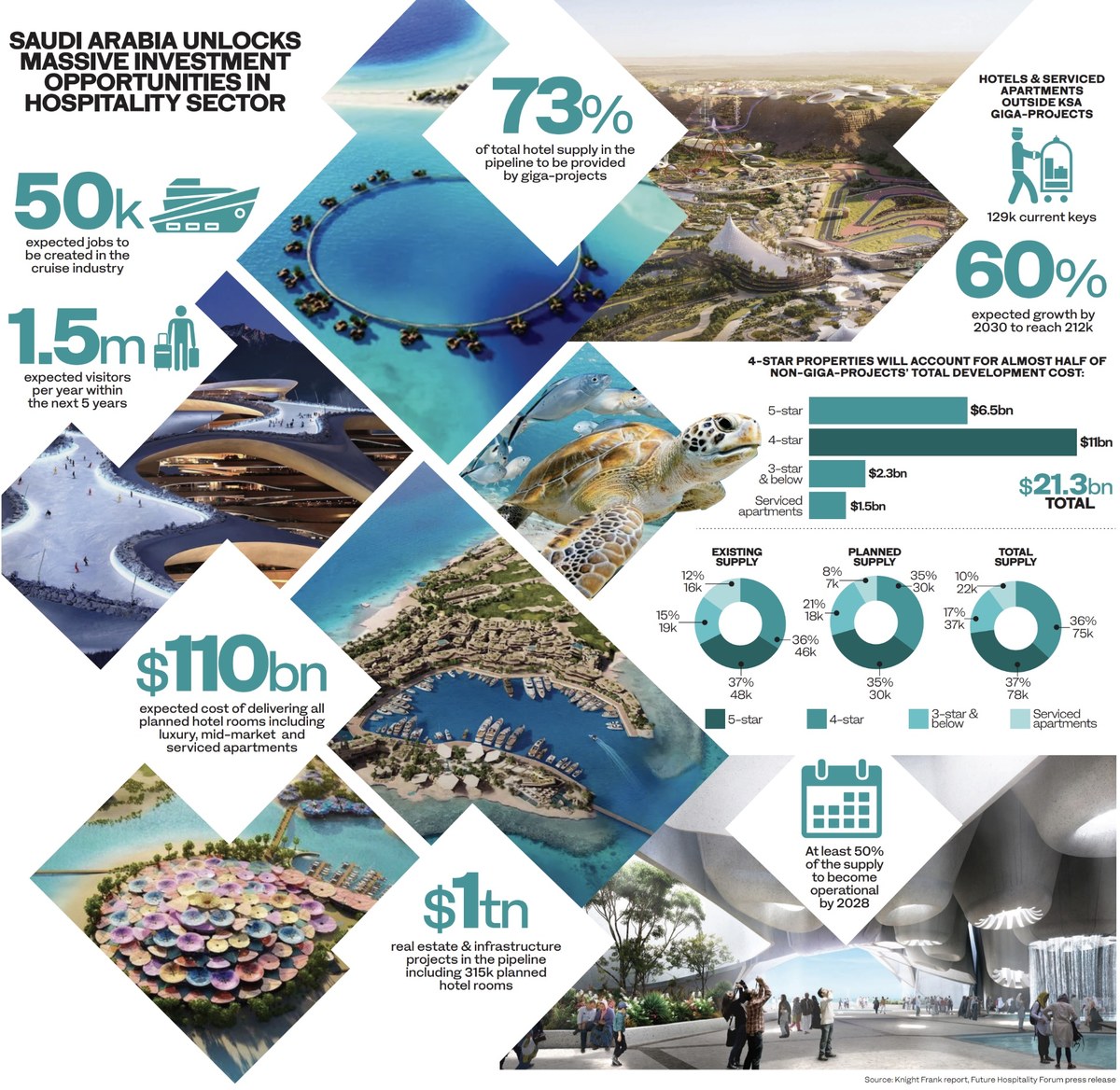
RIYADH: There has been no looking back for the hospitality industry in Saudi Arabia since September 2019 when the Kingdom opened its doors to international tourism with the introduction of e-visas and visas on arrival to visitors from 49 countries.
Despite challenging global conditions, Saudi Arabia has emerged as one of the most competitive markets for the hospitality industry.
The Kingdom’s hotel segment is projected to generate $2.51 billion in revenue this year and is expected to reach $3.02 billion by 2027 according to Statista, an online platform specialized in market and consumer data.
“Saudi Arabia was named the most-visited Arab country in 2022 and is set to continue a growth trajectory for years to come,” Dimitris Manikis, president of Europe, the Middle East, Eurasia, and Africa at Wyndham Hotels & Resorts, told Arab News.
“Events such as the Future Hospitality Summit underpin the Kingdom’s efforts, opening the floodgates to regional and international travelers and investors, and will play a key role in firmly cementing Saudi Arabia’s place on the global map as a destination for business and leisure,” he added.
Key trends
“Modern, multilayered hospitality experiences are very much in-demand and essential to the future of hospitality in Saudi Arabia,” Agnès Roquefort, global chief development officer, luxury and lifestyle, Accor, told Arab News.
She said: “Hospitality has evolved beyond simply just room stays — today it is a multilayered experience. The key is to develop hotels that are as attractive to locals as they are to travelers.”
The country is now ushering in a new era as the Kingdom aims to reach net zero by 2060.
Agnès Roquefort, Global chief development officer, luxury and lifestyle, Accor
Manikis added: “One of the most notable trends in the hospitality sector right now is the blending of business and leisure travel. With more people working remotely and the lines between work and personal life becoming increasingly blurred, many travelers are combining business trips with leisure activities, resulting in a growing demand for hotels and resorts that offer both business and leisure amenities across a diversified offering of accommodation styles.”
He said as the hospitality industry continues its resilient recovery from the challenges of a global pandemic, hoteliers are more and more interested in soft brands.
Haitham Mattar, managing director of India, the Middle East & Africa, IHG Hotels & Resorts, told Arab News: “Data-driven personalization is another trend influencing the Kingdom’s hospitality sector evolution. There is a focus on a traveler-centric approach that depends on careful technology planning and digital infrastructure that creates a seamless experience for visitors. This approach extends to the hotel experience, whether that is in how travelers find a room, or the experience gained once they step through the doors.”
Focus on sustainability
“Guests are paying more attention than ever before to how a hotel impacts the world around it, with an increasing number deciding whether to book a stay based on a property’s carbon footprint, sustainable practices and how it supports the communities in which it operates,” Mattar explained.
He added: “New destinations such as Red Sea Global are incorporating key sustainability practices to minimize the impact they have on the environment. Building on our commitment, in 2021, we launched a 10-year action plan called ‘Journey to Tomorrow’ that will make a positive difference to our people, communities, and the planet. This is being reflected in our operations as well as growth in Saudi Arabia.”

One of the defining shifts in the industry is the focus around sustainability.
Ahmad Darwish, Chief administrative officer at Red Sea Global
Sandeep Walia, chief operating officer, the Middle East, Marriott International, told Arab News: “According to Marriott Bonvoy’s 2023 Travel Trends research, we are seeing that sustainability is increasingly becoming a priority for travelers, with most taking it into consideration and many shaping their holidays around this.”
Roquefort went on to say that “sustainability is at the heart of everything we do at Accor and has also been at the heart of Saudi Arabia’s Vision 2030 plan since its inception. The country is now ushering in a new era as the Kingdom aims to reach net-zero by 2060 and our group’s growth ambitions are aligned with this.”
Guy Hutchinson, president, and CEO, of Rotana, told Arab News: “As environmental awareness becomes increasingly important for travelers, we are actively working to reduce our carbon footprint, further cementing our commitment to creating practical and ambitious solutions in line with the net-zero vision.”
Ahmad Darwish, chief administrative officer at Red Sea Global, told Arab News: “One of the defining shifts in the industry is the focus around sustainability. What’s unique about the Red Sea (Global) is that it aims to be the world’s most ambitious regenerative tourism destination, delivering a 30 percent net conservation benefit by 2040.”


