

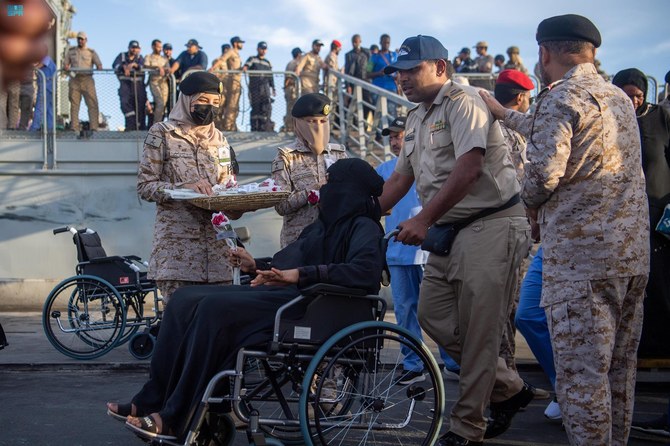
450 Yemeni evacuees depart Port Sudan for Jeddah, hundreds remain stranded

Yemeni evacuees who landed early aboard Saudi ships in Jeddah were taken by road to Aden and Marib. (File/SPA)
Short Url
Updated 07 May 2023
Follow

450 Yemeni evacuees depart Port Sudan for Jeddah, hundreds remain stranded

  • ‘We express our heartfelt gratitude to our brothers in Saudi Arabia’: Yemeni Embassy

AL-MUKALLA: Two Saudi navy vessels transported 450 Yemenis from the Red Sea city of Port Sudan to the Kingdom on Sunday, the highest number of Yemeni evacuees since the Saudi evacuation operation began.
The Yemeni Embassy in Sudan said two Saudi ships named Abha and Riyadh left Port Sudan carrying 450 Yemenis to Jeddah Islamic Port on Sunday evening.
“We express our heartfelt gratitude and admiration to our brothers in Saudi Arabia, the Yemeni government, the Yemeni Emergency Committee, and all those who worked tirelessly to finish the evacuation process,” the embassy in Sudan said in a statement on social media.

Thousands of Yemenis have been stranded since April 15, when violence broke out between the Sudanese Armed Forces and the paramilitary Rapid Military Forces.
Hundreds of Yemenis who escaped safely from the capital Khartoum have been crowded into a handful of shelters in Port Sudan for two weeks, awaiting rescue by their government.
Speaking to Arab News, people stranded in Port Sudan complained about a worsening humanitarian crises, a lack of health services, food and money, as well as being packed into two banquet halls.

After the departure of 450 Yemenis, more than 2,000 are awaiting their turn to be evacuated as the Yemeni Emergency Committee, which coordinates evacuations, has received new calls from those in conflict-stricken cities who have decided to flee.
“We’ve received numerous phone calls from Yemeni families residing in and around Khartoum. They initially decided to reside there because there were no battles in their area, but they’ve now decided to depart due to the continuance of the conflict, the high cost of living and the scarcity of services,” student activist Afif Al-Barashi told Arab News, adding that Yemenia Airways will begin airlifting evacuees from Jeddah to Yemen’s port city of Aden.
A Yemeni mother and her daughter died in a car accident while escaping Khartoum to Port Sudan, Al-Barashi said.

Yemeni evacuees who landed early aboard Saudi ships in Jeddah were taken by road to Aden and Marib.
On Saturday, the chairman of Yemen’s Presidential Leadership Council instructed the airline to organize rescue flights from Port Sudan to Yemen, and asked the government to transport additional trapped citizens by sea to Yemen, according to the country’s official media.


Israel bars Al-Aqsa imam from entering mosque in Ramadan

Updated 17 February 2026
Follow

Israel bars Al-Aqsa imam from entering mosque in Ramadan

  • ‘This ban is a grave matter for us as our soul is tied to Al-Aqsa, Al-Aqsa is our life’

JERUSALEM: A senior imam of the Al-Aqsa Mosque in East Jerusalem said on Tuesday that Israeli authorities had barred him from entering the compound, just days before the start of the holy month of Ramadan.

“I have been barred from the mosque for a week, and the order can be renewed,” Sheikh Muhammad Al-Abbasi said.
He said he was not informed of the reason for the ban, which came into effect from Monday.

FASTFACT

A Waqf source said 33 of its employees had been barred from entering the compound in the week leading up to Ramadan.

“I had only returned to Al-Aqsa a month ago after spending a year in the hospital following a serious car accident,” Abbasi said. “This ban is a grave matter for us, as our soul is tied to Al-Aqsa. Al-Aqsa is our life.”
On Monday, Israeli police said they had recommended issuing 10,000 permits for Palestinians from the occupied West Bank, who require special permission to enter Jerusalem.
Arad Braverman, a senior Israeli police officer in occupied Jerusalem, said forces would be deployed “day and night” across the compound.
He said thousands of police would also be on duty for Friday prayers, which draw the largest crowds of Muslim worshippers.
The Palestinian Jerusalem Governorate said it had been informed that permits would again be restricted to men over 55 and women over 50, mirroring last year’s criteria.
It added that Israeli authorities had prevented the Islamic Waqf — the Jordanian-run body that administers the site — from carrying out routine preparations, including installing shade structures and setting up temporary medical clinics.
A Waqf source said 33 of its employees had been barred from entering the compound in the week leading up to Ramadan.
Under long-standing arrangements, Jews may visit the Al-Aqsa compound —  but they are not permitted to pray there.
Palestinians fear the status quo it is being eroded.
In a separate development, Israeli NGOs have raised the alarm over a settlement plan signed by the government which they say would mark the first expansion of Jerusalem’s borders into the occupied West Bank since 1967. Palestinians view East Jerusalem as the capital of their future state.
The proposal, published in early February but reported by Israeli media only on Monday, comes as international outrage mounts over creeping measures aimed at strengthening Israeli control over the West Bank.
Critics say these actions by the Israeli authorities are aimed at the de facto annexation of the Palestinian territory.
The planned development, announced by Israel’s Ministry of Construction and Housing, is formally a westward expansion of the Geva Binyamin, or Adam, settlement situated northeast of Jerusalem in the West Bank.
In a statement, the ministry said the development agreement included the construction of around 2,780 housing units for the settlement, with an investment of roughly $38.7 million.
But the area to be developed lies on the Jerusalem side of the separation barrier built by Israel in the early 2000s, while Geva Binyamin sits on the West Bank side of the barrier, and the two are separated by a road.
Israeli settlement watchdog Peace Now said there would be no “territorial or functional connection” between the area to be developed and the settlement.
“The new neighborhood will be integral to the city of Jerusalem,” Lior Amihai, Peace Now’s executive director, said.
“What is unique about that one is that it will be connected directly to Jerusalem, but it will be beyond the annexed municipal border. So it will be in complete West Bank territory, but just adjacent to Jerusalem,” he said.