Fourth Green Riyadh project now in Al-Uraija neighborhood

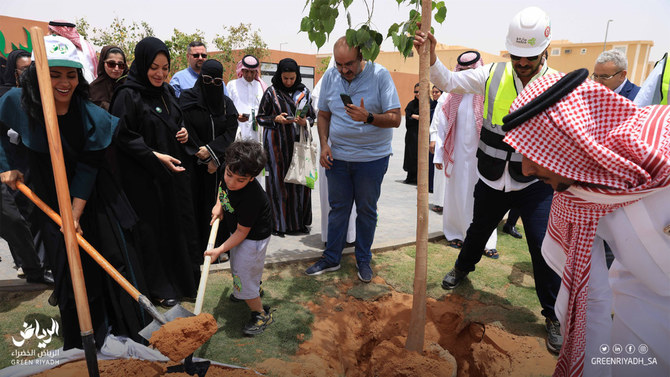
Volunteers take part in tree planting activities in Riyadh's al-Uraja neighborhood. (SPA))
Short Url
Updated 05 May 2023
Follow

Fourth Green Riyadh project now in Al-Uraija neighborhood

  • Part of Vision 2030’s upgrading of capital into a world-class city
  • Qurtuba, Al-Ghadeer, Al-Nakhil areas also earmarked for future

RIYADH: Urban greening works began in the Al-Uraija neighborhood of the Saudi capital on Thursday, a continuation of the tree-planting schemes in residential neighborhoods of the city within the framework of the Green Riyadh project.

The program aims to plant more than 110,000 trees and shrubs, as well as construct 30 gardens in Al-Uraija neighborhood. Trees will also be planted in the surroundings of 46 mosques, 70 parking lots and 19 schools, and along 37 kilometers of roads and streets in the district.

After Al-Uraija, afforestation work will continue in the neighborhoods of Qurtuba, Al-Ghadeer and Al-Nakhil. Contracts have already been signed for the implementation of the program in these districts.

The details of the afforestation of Al-Uraija was announced during an event held in the neighborhood. The event was designed as an interactive journey for visitors to acquaint themselves with the various stages of the project.

A visitor’s journey begins with an introduction to the Green Riyadh program and the Neighborhood Afforestation project, through advanced presentation techniques, which help people visualize the future neighborhood and what it looks like after the completion of the project.

The “Green Riyadh” program, one of the major Riyadh development projects launched by the Saudi leadership in 2019, aims to support the goals of Saudi Vision 2030 in terms of upgrading Riyadh into a world-class city.


Sustainability in focus as Madinah marks World Soil Day

Updated 50 min 11 sec ago
Follow

Sustainability in focus as Madinah marks World Soil Day

MADINAH: Madinah joined the world in celebrating World Soil Day on Dec. 5, highlighting the importance of soil conservation for food security and ecosystems, according to the Saudi Press Agency.

The day holds added significance in Madinah due to its rich agricultural history, diverse soil types — from clay to sand and volcanic Harrat — and its longstanding connection to date production.

The region’s soil faces challenges, notably salinization from imbalanced irrigation and climate change, the SPA added.

Authorities are addressing this through soil protection programs, improved irrigation techniques and sustainable agricultural practices.

Soil plays a vital role in water purification, acting as a natural filter. As winter begins, it is an opportune time to prepare soil for spring, expanding crop cultivation and harvest, the SPA reported.

The Ministry of Environment, Water and Agriculture in Madinah is implementing initiatives to enhance resource efficiency, raise farmer awarenes and combat desertification. Farmers contribute by using organic fertilization and recycling agricultural waste.

World Soil Day highlights the need for collaboration between government agencies, farmers and stakeholders to ensure soil sustainability, preserve agricultural heritage and support Vision 2030’s sustainable development goals.

Approved by the Food and Agriculture Organization in 2013, World Soil Day aims to raise awareness of soil’s critical role in healthy ecosystems and human well-being.