

Pakistan calls for ‘aggressive marketing’ to expand exports to Saudi Arabia

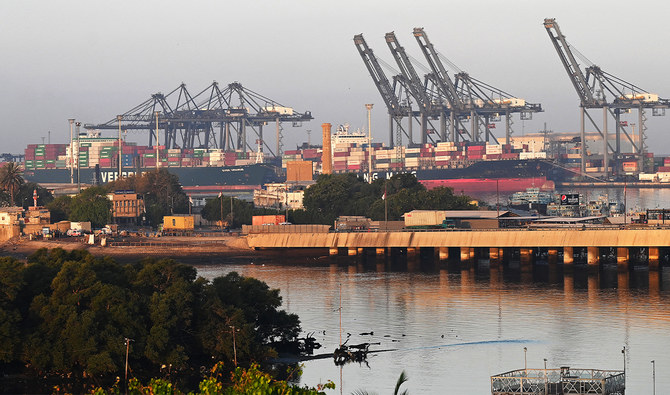
Shipping containers are seen stacked on a ship at a sea port in Karachi on April 6, 2023. (AFP/File)
Short Url
Updated 04 May 2023
Follow

Pakistan calls for ‘aggressive marketing’ to expand exports to Saudi Arabia

  • Commerce minister Syed Naveed Qamar discusses trade ties with Pakistan’s ambassador-designate to Saudi Arabia
  • Exports to Saudi Arabia have seen consistent increase from $336.9 million in 2017 to $446.18 million in 2020

ISLAMABAD: Pakistani commerce minister Syed Naveed Qamar said on Thursday “aggressive marketing” in the fields of agriculture and technology was needed to expand Pakistani exports to Saudi Arabia, a statement from the ministry of commerce said.

Pakistani exports to the kingdom mainly comprise food products, textiles, and engineering goods. According to the United Nations COMTRADE database on international trade, Pakistan’s exports to Saudi Arabia stood at $402.81 million in 2021.

Exports to Saudi Arabia have seen a consistent increase from $336.9 million in 2017 to $342.08 million in 2019 and $446.18 million in 2020.

Qamar’s statement came after a meeting with Pakistan’s ambassador-designate to Saudi Arabia, Ahmed Farooq, in which the two discussed trade ties between the two brotherly countries.

“The federal minister stressed the need for aggressive marketing in the field of agriculture and technology to expand Pakistani exports to Saudi Arabia,” the statement from the commerce ministry said.

“He emphasized that Pakistan had immense potential to export agricultural products and technology to Saudi Arabia, and both countries needed to work together to identify new areas of cooperation.”

The minister also assured the ambassador-designate of his full support and cooperation.

“The ambassador-designate appreciated the efforts of Syed Naveed Qamar to improve the trade ties between the two countries and expressed his desire to work closely with the Ministry of Commerce to explore avenues for mutual investment,” the statement added. 

Prior to meeting the commerce minister, Farooq also met Pakistan’s state minister for foreign affairs, Hina Rabbani Khar, to talk about how to enhance bilateral relations with Saudi Arabia.

Saudi Arabia is home to over two million Pakistanis and the largest contributor of remittance inflows to the South Asian nation.

Saudi authorities have also helped Pakistan deal with an ongoing economic crisis by offering a deferred oil payment facility and depositing about $3 billion in the central bank to help shore up forex reserves.


Pakistani student launches ‘Urdu ChatGPT’ AI model

Updated 5 sec ago
Follow

Pakistani student launches ‘Urdu ChatGPT’ AI model

  • Developer says “Qalb” is largest large language model built exclusively for Urdu
  • Project highlights push to localize artificial intelligence for non-English users

ISLAMABAD: A Pakistani student studying in the United States has launched an artificial intelligence model designed exclusively for the Urdu language, a development its creator says could help bridge longstanding gaps in access to advanced digital tools for millions of speakers worldwide.

The project, called Qalb, is positioned as an Urdu-first large language model at a time when most generative AI systems are primarily trained on English and other widely used global languages. Supporters of language-specific models argue they can improve accuracy, cultural relevance and accessibility for users in education, business and public services.

Urdu is spoken by more than 230 million people globally, including in Pakistan, India and diaspora communities, but remains under-represented in advanced AI systems. Efforts to localize artificial intelligence have increasingly been seen as critical for widening participation in digital economies, particularly in developing countries.

“Qalb is now recognized as the world’s largest Large Language Model created exclusively for the Urdu language,” Taimoor Hassan, the project’s developer, was quoted this month in a report in state-run news agency APP. 

“Trained on a massive dataset of 1.97 billion tokens and benchmarked across seven-plus international evaluation frameworks, Qalb outperforms existing Urdu-focused AI models on key real-world performance indicators, setting a new standard for natural language processing in Pakistan,” Hassan said.

“This is a development model and in the next phase we would soon launch App for mobile and web so that people could use and benefit from Qalb ChatGPT.”

Hassan completed his undergraduate degree in computer science at FAAST University’s Peshawar campus and is currently studying for a master’s degree in computer science and software engineering at Auburn University in the United States. According to APP, he is a serial entrepreneur who has previously launched and exited multiple startups and has represented Pakistan at international technology forums.

“I had the opportunity to contribute in a small way to a much bigger mission for the country,” Hassan said.

“Together with my undergraduate roommates and teammates, Jawad Ahmed and Muhammad Awais, we are committed to continuously fine-tuning localized models for niche industries, which we believe can become a major breakthrough for Pakistan.”

Both collaborators are also graduates of FAAST University Peshawar Campus and are currently studying in Germany, APP reported.

The team behind Qalb said the model is intended to support local businesses, startups, educational platforms and voice-based digital services, arguing that meaningful innovation is no longer limited to large technology firms.

“Technology is no longer locked behind big budgets or big teams. With the right mindset, even a small group can build products that educate, automate, and serve millions,” Hassan told APP.