

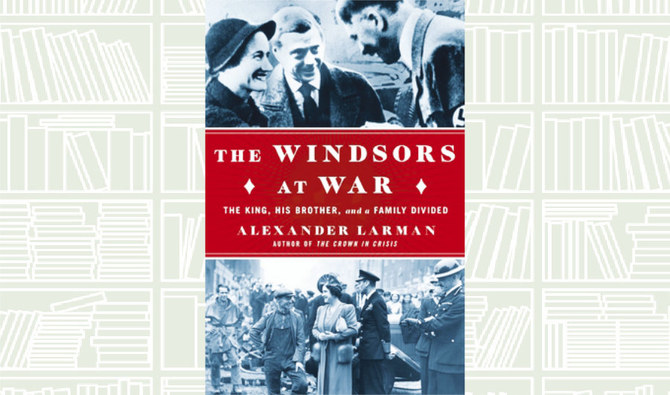
What We Are Reading Today: The Windsors at War by Alexander Larman

Short Url
Updated 03 May 2023
Follow

What We Are Reading Today: The Windsors at War by Alexander Larman

At the beginning of 1937, the British monarchy was in a state of turmoil. The previous king, Edward VIII, had abdicated the throne, leaving his unprepared and terrified brother Bertie to become George VI. 

Meanwhile, as the now-Duke of Windsor awaited the decree that would allow him to marry his mistress Wallis Simpson, he took an increased interest in the expansionist plans of Adolf Hitler.

As double agents and Nazi spies thronged the corridors of Buckingham Palace, the only man the king could trust was his prime minister, Winston Churchill. 

But they faced a formidable, even unbeatable, adversary: his own brother.


What We Are Reading Today: The Political Economy of Security by Stephen G. Brooks

Updated 04 March 2026
Follow

What We Are Reading Today: The Political Economy of Security by Stephen G. Brooks

In this book, Stephen Brooks provides a systematic empirical and theoretical examination of how economic factors influence security affairs. Empirically, he analyzes how economic variables of all kinds affect interstate war, terrorism, and civil war; in total, 16 pathways are examined.

Brooks shows that the relationship between economic factors and conflict is complex and multifaceted; discrete economic factors—such as international trade, economic development, and globalized manufacturing, to name a few—are sometimes helpful for promoting peace and stability, but at other times are detrimental.

Brooks also develops a stronger theoretical foundation for guiding future research on the economics-security interaction. 

Drawing on Adam Smith, he provides a more complete range of answers to the three key conceptual questions analysts must consider: how economic goals relate to security goals; what economic factors to focus on; and how economic actors influence security policies.

Combining an innovative theoretical understanding with empirical rigor, Brooks’s account will reshape our understanding of the political economy of security.