Iraq eyes deal on Kurdistan oil exports within weeks

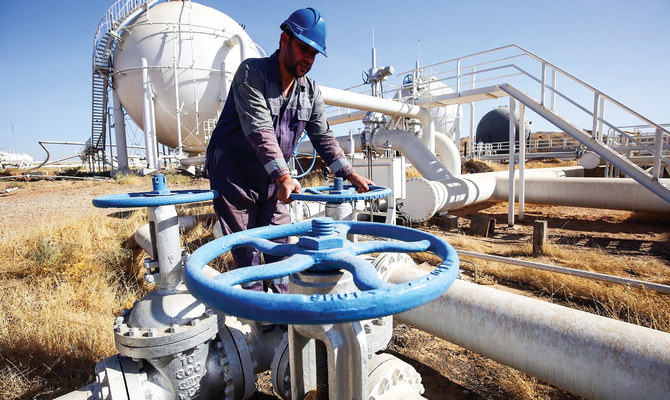
Under the terms of the deal announced in April, sales of Kurdish oil are to go through the Iraqi National Oil Co., and no longer exclusively through the authorities in Iraqi Kurdistan. (AFP)
Short Url
Updated 03 May 2023
Follow

Iraq eyes deal on Kurdistan oil exports within weeks

  • US crude stockpiles fall, gasoline builds as demand weakens: EIA

BAGHDAD, NEW YORK: Iraq’s oil minister expressed hope on Wednesday his government can reach an agreement soon on the resumption of crude exports from the autonomous Kurdistan region to Turkiye.

Ankara stopped importing oil from Iraqi Kurdistan in March after the International Chamber of Commerce ruled the federal government in Baghdad was the only entity authorized to manage exports.

Baghdad and the Kurdish authorities in Irbil signed last month a provisional agreement establishing an export mechanism that would be supervised by the federal government, but some issues remain unresolved.

“Regarding the agreement with Iraqi Kurdistan, within a week or two maximum we will reach a final agreement for the resumption of crude exports,” Iraqi Oil Minister Hayan Abdel Ghani said, adding the indications were “positive.”

Abdel Ghani said tests had been carried out on Turkish pipelines to avoid potential oil leaks, after a deadly and devastating earthquake hit Turkiye on Feb. 6.

Under the terms of the agreement announced in April, sales of Kurdish oil are to go through the Iraqi National Oil Co., and no longer exclusively through the authorities in Iraqi Kurdistan.

In addition, revenues from Kurdish exports are to be paid into an account managed by Irbil and supervised by Baghdad.

US inventories

US crude oil inventories fell for a third week in a row, while gasoline stockpiles unexpectedly rose last week as demand weakened, the Energy Information Administration said on Wednesday.

Crude inventories fell by 1.3 million barrels in the week ending April 28 to 459.6 million barrels, compared with analysts’ expectations in a Reuters poll for a 1.1-million-barrel drop.

Crude in the Strategic Petroleum Reserve declined 2 million to 364.9 million barrels, its lowest since October 1983. Levels dropped for the third week in a row as part of a congressionally mandated sale of 26 million barrels. “Overall, hydrocarbon inventories are declining at the same time that the US continues with its Strategic Petroleum Reserve release,” said Andrew Lipow, president of Lipow Oil Associates in Houston.

Gasoline stocks rose by 1.7 million barrels to 222.9 million barrels, the EIA said, compared with forecasts for a 1.2-million-barrel drop.

Demand for the motor fuel ahead of the peak summer driving season fell significantly, down 9.4 percent to 8.6 million bpd.

Crude prices extended their losses after the data showed weakness in the fuel sector.

US crude oil futures fell $2.93, or 4.1 percent, to $68.73 a barrel by 11 a.m. ET (1600 GMT). Brent crude fell $2.70, or 3.6 percent, to $72.64.

Distillate stockpiles, which include diesel and heating oil, also fell by 1.2 million barrels to 110.3 million barrels, versus expectations for a 1.1-million-barrel drop, the EIA data showed.


Arab food and beverage sector draws $22bn in foreign investment over 2 decades: Dhaman 

Updated 28 December 2025
Follow

Arab food and beverage sector draws $22bn in foreign investment over 2 decades: Dhaman 

JEDDAH: Foreign investors committed about $22 billion to the Arab region’s food and beverage sector over the past two decades, backing 516 projects that generated roughly 93,000 jobs, according to a new sectoral report. 

In its third food and beverage industry study for 2025, the Arab Investment and Export Credit Guarantee Corp., known as Dhaman, said the bulk of investment flowed to a handful of markets. Egypt, Saudi Arabia, the UAE, Morocco and Qatar attracted 421 projects — about 82 percent of the total — with capital expenditure exceeding $17 billion, or nearly four-fifths of overall investment. 

Projects in those five countries accounted for around 71,000 jobs, representing 76 percent of total employment created by foreign direct investment in the sector over the 2003–2024 period, the report said, according to figures carried by the Kuwait News Agency. 

“The US has been the region's top food and beverage investor over the past 22 years with 74 projects or 14 projects of the total, and Capex of approximately $4 billion or 18 percent of the total, creating more than 14,000 jobs,” KUNA reported. 

Investment was also concentrated among a small group of multinational players. The sector’s top 10 foreign investors accounted for roughly 15 percent of projects, 32 percent of capital expenditure and 29 percent of newly created jobs.  

Swiss food group Nestlé led in project count with 14 initiatives, while Ukrainian agribusiness firm NIBULON topped capital spending and job creation, investing $2 billion and generating around 6,000 jobs. 

At the inter-Arab investment level, the report noted that 12 Arab countries invested in 108 projects, accounting for about 21 percent of total FDI projects in the sector over the past 22 years. These initiatives, carried out by 65 companies, involved $6.5 billion in capital expenditure, representing 30 percent of total FDI, and generated nearly 28,000 jobs. 

The UAE led inter-Arab investments, accounting for 45 percent of total projects and 58 percent of total capital expenditure, the report added, according to KUNA. 

The report also noted that the UAE, Saudi Arabia, Egypt, and Qatar topped the Arab ranking as the most attractive countries for investment in the sector in 2024, followed by Oman, Bahrain, Algeria, Morocco, and Kuwait. 

Looking ahead, Dhaman expects consumer demand to continue rising. Food and non-alcoholic beverage sales across 16 Arab countries are projected to increase 8.6 percent to more than $430 billion by the end of 2025, equivalent to 4.2 percent of global sales, before exceeding $560 billion by 2029. 

Sales are expected to remain highly concentrated geographically, with Egypt, Saudi Arabia, Algeria, the UAE and Iraq accounting for about 77 percent of the regional total. By product category, meat and poultry are forecast to lead with sales of about $106 billion, followed by cereals, pasta and baked goods at roughly $63 billion. 

Average annual per capita spending on food and non-alcoholic beverages in the region is projected to rise 7.2 percent to more than $1,845 by the end of 2025, approaching the global average, and to reach about $2,255 by 2029. Household spending on these products is expected to represent 25.8 percent of total expenditure in 13 Arab countries, above the global average of 24.2 percent. 

Arab external trade in food and beverages grew more than 15 percent in 2024 to $195 billion, with exports rising 18 percent to $56 billion and imports increasing 14 percent to $139 billion. Brazil was the largest foreign supplier to the region, exporting $16.5 billion worth of products, while Saudi Arabia ranked as the top Arab exporter at $6.6 billion.