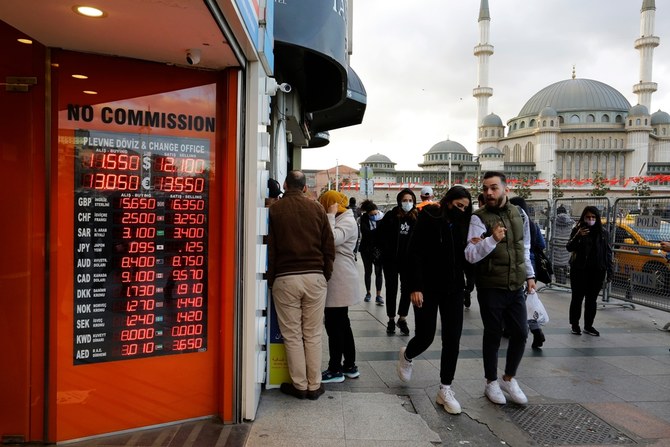
Turkish inflation slows to 44% ahead of landmark election 

The consumer price index rose 2.39 percent in April from a month earlier, the Turkish Statistical Institute said. (Shutterstock)
Short Url
Updated 03 May 2023
Follow

Turkish inflation slows to 44% ahead of landmark election 

ISTANBUL: Turkish annual inflation slowed to 43.68 percent in April, official data showed on Wednesday, easing ahead of elections that polls show President Tayyip Erdogan risks losing largely due to a cost-of-living crisis. 

Unorthodox rate cuts sought by Erdogan sparked a currency crisis in late 2021, sending inflation to a 24-year peak of 85.51 percent last year. It fell in December and touched 50.51 percent by March with a favorable base effect and a relatively stable lira. 

The consumer price index rose 2.39 percent in April from a month earlier, the Turkish Statistical Institute said. The official numbers were slightly less than predicted, with a median monthly estimate of 2.60 percent and an annual forecast of 44 percent in the latest Reuters poll. 

The cost-of-living crisis has eaten away at household savings and also at Erdogan’s popularity ahead of the presidential and parliamentary votes on May 14, seen as the president’s biggest test in his 20-year reign. 

Some polls show Erdogan trailing his main opponent Kemal Kilicdaroglu. 

The base effect that helped lower the annual reading so far this year is expected to wear off in the coming months and economists say April could be the lowest reading this year. The year-end median estimate was 46.5 percent in the Reuters poll. 

Annually, the biggest increase was seen in the health sector with 66.62 percent, followed by restaurants and hotels with 66.41 percent and food and non-alcoholic beverages with 53.92 percent. 

On a monthly basis, communication prices rose 5.93 percent, restaurant and hotel prices rose 4.24 percent and food and non-alcoholic beverage prices rose 3.95 percent. 

The poll had forecast that consumer prices were expected to end the year at 46.5 percent. 

The domestic producer price index was up 0.81 percent month-on-month in April for an annual rise of 52.11 percent, the data showed. 


Saudi Arabia set to attract $500bn in private investment, Al-Falih tells conference

Updated 09 December 2025
Follow

Saudi Arabia set to attract $500bn in private investment, Al-Falih tells conference

RIYADH: Sustainability, technology, and financial models were among the core topics discussed by financial leaders during the first day of the Momentum 2025 Development Finance Conference in Riyadh.

The three-day event features more than 100 speakers and over 20 exhibitors, with the central theme revolving around how development financial institutions can propel economic growth.

Speaking during a panel titled “The Sustainable Investment Opportunity,” Saudi Investment Minister Khalid Al-Falih elaborated on the significant investment progress made in the Kingdom.

“We estimate in the midterm of 2030 or maybe a couple of years more or so, about $1 trillion of infrastructure investment,” he said, adding: “We estimate, as a minimum, 40 percent of this infrastructure is going to be financed by the private sector, so we’re talking in the next few years $400 (billion) to $500 billion.”

The minister drew a correlation between the scale of investment needs and rising global energy demand, especially as artificial intelligence continues to evolve within data processing and digital infrastructure in global spheres.

“The world demand of energy is continuing to grow and is going to grow faster with the advent of the AI processing requirements (…) so our target of the electricity sector is 50 percent from renewables, and 50 percent from gas,” he added.

Al-Falih underscored the importance of AI as a key sector within Saudi Arabia’s development and investment strategy. He made note of the scale of capital expected to go into the sector in coming years, saying: “We have set a very aggressive, but we believe an achievable target, for AI, and we estimate in the short term about $30 billion immediately of investments.”

This emphasis on long-term investment and sustainability targets was echoed across panels at Momentum 2025, during which discussions on essential partnerships between public and private sectors were highlighted.

The shared ambition of translating the Kingdom’s goals into tangible outcomes was particularly essential within the banking sector, as it plays a central role in facilitating both projects and partnerships.

During the “Champions of Sectoral Transformation: Development Funds and Their Ecosystems” panel, Saudi National Bank CEO Tareq Al-Sadhan shed light on the importance of partnerships facilitated via financial institutions.

He explained how they help manage risk while supporting the Kingdom’s ambitions.

“We have different models that we are working on with development funds. We co-financed in certain projects where we see the risk is higher in terms of going alone as a bank to support a certain project,” the CEO said.

Al-Sadhan referred to the role of development funds as an enabler for banks to expand their participation and support for projects without assuming major risk.

“The role of the development fund definitely is to give more comfort to the banking sector to also extend the support … we don’t compete with each other; we always complement each other” he added.